Il progetto Parola ai giovaniThe Youth and Future project
Introduzione
Gli ultimi sono stati per me anni di solitudine, cammino e scoperta. Anni che hanno dato alla luce due istantanee indissolubili del mio percorso artistico: l’album Parola e il progetto collettivo Youth and Future – Parola ai giovani.
Da diverso tempo provo a seguire le preziose coordinate ricevute dal mio maestro, Franco Battiato. In un terso pomeriggio di primavera, seduti sul divano della sua biblioteca a Milo, dopo diversi minuti di silenzio, mi disse: «Avrai solo una strada per rimanere un uomo e un artista libero: ricordati sempre di scardinare la tua arte da ogni fine, fa sì che sia semplicemente lo specchio di ciò che sei. Non chiederti cosa dovresti fare o come dovresti essere per riuscire a scalare le classifiche, avere maggior successo o vendere più dischi; sarebbe una gabbia d’oro! Cerca invece di ascoltarti in profondità e capire cosa possa farti battere il cuore ed emozionarti in modo autentico. Lungo il cammino farai incontri ed esperienze da cui nasceranno spontanei i tuoi nuovi germogli artistici. Lascia che fioriscano e non preoccuparti del resto!».
La sensazione che provo prima di ogni nuova avventura è sempre un misto di paura, entusiasmo e ambizione, ma gettare l’amo più lontano di quanto i miei occhi possano scorgere è sempre stata una costante nella mia vita.
La crisi che stiamo vivendo è l’anticamera di un grande cambiamento possibile e la nostra incapacità di immaginarlo si trasformerebbe nella morte del futuro stesso.
Qualche anno fa, di fronte all’ennesimo foglio bianco, sono tornato a chiedermi in che modo la mia arte potesse trasformarsi in luce per me e per gli altri, quale nuovo e appassionante viaggio potesse farmi innamorare ancor di più della vita. Dopo settimane di ricerca ho trovato una risposta nel vibrante discorso di Andrea Camilleri: «Stiamo perdendo la misura, il peso, il valore della parola. Le parole sono pietre, le parole possono trasformarsi in pallottole. Bisogna pesare ogni parola che si dice, far cessare questo vento dell’odio; lo si sente palpabile attorno a noi. Ma perché? Ma perché l’altro è diverso da me? L’altro, non è altro che me stesso allo specchio».
Folgorato da queste verità, mi sono tuffato nell’ascolto di diverse sue testimonianze e interviste. In una di queste, affidava a noi giovani il compito di far sorgere un nuovo “Umanesimo della parola”. Ho pensato si trattasse di una missione utopistica ma, nel mio piccolo, non volevo tradire la sua fiducia, così è nata l’idea di scrivere un album in cui la parola fosse protagonista indiscussa, perno creativo e poetico; un album in cui ogni canzone fosse ispirata da un testo di letteratura.
Dopo la pubblicazione dell’album, ho preso coscienza di come le azioni di un singolo acquistino il loro pieno valore nel momento in cui riescono a essere l’inizio di una nuova armonia condivisa.
Attraverso una risposta corale di centinaia di giovani, l’auspicio di Camilleri poteva, forse, prendere vita.
Nel 2022 ho deciso quindi di lanciare in Italia il concorso di idee Parola ai giovani per la redazione del libro Manifesto del Cambiamento, pubblicato per la prima volta nel maggio 2023, rivolto a studenti o lavoratori che, come me, credono in un nuovo mondo possibile.
Per partecipare bisognava rispondere per iscritto alle domande: “Cosa cambieresti della società in cui vivi e come? Qual è la tua parola di cambiamento?”.
Ho incontrato migliaia di ragazzi in università, carceri e centri d’accoglienza, ascoltato i loro bisogni, le loro paure e la loro visione di futuro. Ragazzi disorientati chiedono con voce flebile e sibillina attenzioni e ascolto analogico, un contatto umano autentico, lontano dai social network.
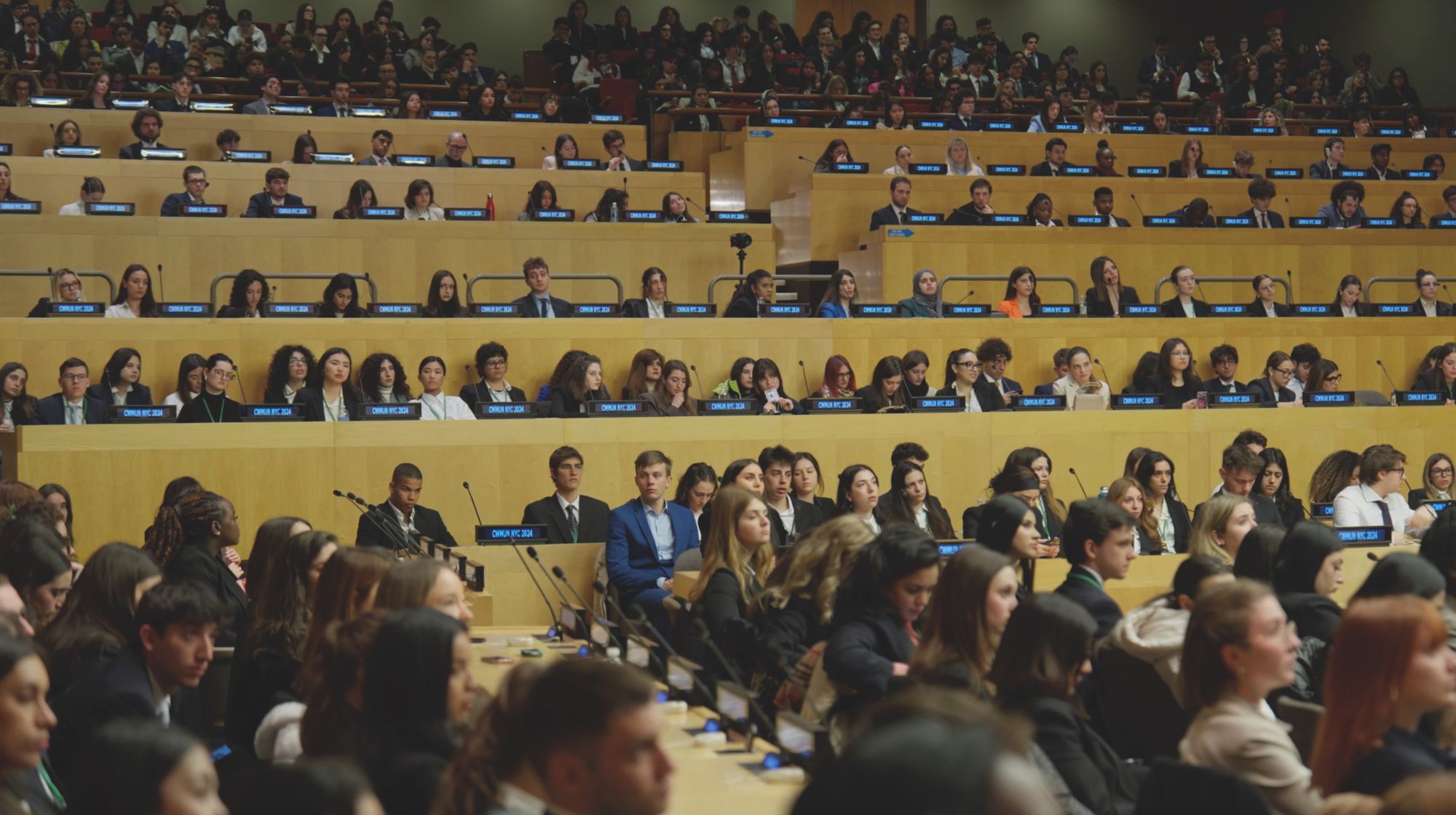
Il 5 aprile 2024, alle Nazioni Unite di New York, in occasione del “Change the world forum”, ho rivolto lo stesso appello ai giovani di tutto il mondo, alla presenza di 5.000 ragazzi provenienti da oltre centoquarantadue Paesi e diffuso l’iniziativa in alcune delle più prestigiose università e organizzazioni giovanili internazionali.
Parola ai giovani si trasforma così in Youth and Future.
Il 20 marzo 2025 viene pubblicato il Manifesto for Change, la nuova edizione internazionale del Manifesto del Cambiamento che raccoglie le visioni di futuro di giovani provenienti da ogni parte del mondo.
Ho scommesso che tra i tantissimi testi ricevuti avrei trovato delle testimonianze di valore in grado di riaccendere qualsiasi anima si trovasse ad attraversare un periodo di impasse e a ritrovare la bussola interiore.
Questo viaggio nasce dalla certezza che non esista futuro senza radici. Solo con il dialogo con gli anziani e i saggi potremo salpare a vele spiegate verso nuovi mari.
Per questo alcuni testi dei ragazzi sono stati incisi su fogli di carta cotone con caratteri tipografici in piombo, utilizzando l’antica tecnica di Gutenberg del Quindicesimo secolo e ciascuno di questi fogli è stato poi affidato a un grande artista contemporaneo che ne ha tratto ispirazione per un’opera d’arte.
Ciò che ha trasformato questo progetto da un viaggio di pochi mesi a una missione di vita, è stato l’aver constatato che troppi giovani oggi hanno spento il motore dei sogni. Per questo ho deciso di fondare l’Associazione Youth and Future - Parola ai Giovani APS, con l’obiettivo di creare dei “defibrillatori per le coscienze” che attraverso le arti e le voci delle nuove generazioni possano riaccendere il motore dei sogni dell’umanità.
I giovani di tutti i tempi hanno cambiato la storia!
Quella che stiamo vivendo è l’età più fertile, l’età dell’amore e della possibilità.
Bach scrisse la sua Toccata e fuga in re minore a vent’anni anni. Michelangelo scolpì la Pietà a ventitré anni e iniziò a dipingere la volta della Cappella Sistina a trentatré. Giovanna D’Arco guidò con successo l’esercito francese per liberare la città di Orléans a soli diciassette anni e James Watt, a venti, mise a punto la prima macchina a vapore. Michael Jackson pubblicò Thriller a ventiquattro anni – ad oggi l’album più venduto di tutti i tempi – mentre Steve Jobs a ventun anni fondò Apple. Malala Yousafzai, a soli diciassette anni disse: «Un bambino, un insegnante, un libro e una penna possono cambiare il mondo», diventando la più giovane Premio Nobel per la Pace grazie alle sue dure battaglie per il diritto all’istruzione. Marie Curie a trentaquattro anni isolò il peso di un atomo di radio rivoluzionando la storia della scienza. Lewis Carroll a trentatré anni scrisse Le avventure di Alice nel Paese delle Meraviglie, mentre Walt Disney a ventisette inventò Topolino.
E noi? È il nostro momento!
Mi sento inerme, straziato dal silenzio assordante delle immagini di guerra, dalla crisi climatica, dalla povertà, dalle carestie, dalle disuguaglianze, dalla nostra indifferenza e noncuranza. Poi però, rivolgendo lo sguardo alla natura e al creato, capisco che la mia missione è quella di essere portavoce di pace e armonia nella mia quotidianità, cercando di trovare sempre il coraggio di guardare quella piccola lanterna accesa all’angolo della stanza anche quando il buio pesto mi impaurisce.
Questo è il momento di mettere da parte la paura;
Questo è il momento di capire ciò che amiamo e inseguire i nostri sogni;
Questo è il momento di fare ciò che è giusto e non ciò che è facile;
Questo è il momento di imparare a prenderci cura del nostro pianeta;
Questo è il momento di riscoprire le nostre radici e tornare a dialogare con i Maestri;
Questo è il momento di cambiare ciò che non ci appartiene;
Questo è il momento di sentire che non siamo soli;
Questo è il momento di ascoltare l’altro e difendere i diritti di tutti;
Questo è il momento di considerare la diversità come un valore;
Questo è il momento di essere consapevoli che non esiste vittoria senza fallimento;
Questo è il momento di imparare a non avere timore della morte, ma occuparci di più della vita chiedendoci: «Mi sento pienamente vivo?»;
Cambiare per gli altri è mentire a sé stessi; questo è il momento di divenire ciò che siamo.
La mia parola di cambiamento è “gratitudine”. La tua qual è?
Giovanni Caccamo
Introduction
The past few years have been a time of solitude, exploration and discovery for me. Years that have led to two major milestones on my artistic journey: the album Parola and the collective project Youth and Future – Parola ai giovani.
For some time now, I have been striving to follow the precious guidance of my mentor, Italian singer-songwriter Franco Battiato. One clear spring afternoon, as we sat on the sofa in his library in the small town of Milo, Sicily, after several minutes of silence, he told me: “There is only one path to remaining a free man and a free artist: always remember to free your art from any purpose. Let it simply reflect who you are. Don’t ask yourself what you should do or how you should be in order to top the charts, become more successful or sell more records. That would be a golden cage! Instead, listen deeply to yourself and discover what truly moves you and makes your heart race. Along the way, you will meet people and have experiences, and your art will naturally grow from them. Let them flourish, and don’t worry about the rest”.
What I feel before each new venture is always a mixture of fear, excitement and ambition. Yet, throughout my life, I have always cast my line far beyond what my eyes can see.
The crisis we face is the precursor to profound transformation. If we fail to imagine this transformation, we risk extinguishing the future itself.
A few years ago, faced with yet another blank page, I found myself asking how my art could become a source of light for me and for others. What exciting new journey could make me fall even more deeply in love with life? After weeks of searching, I found my answer in a vibrant speech by Andrea Camilleri: “We are losing sight of the measure, the weight, the value of words. Words are stones; words can turn into bullets. We must weigh every word we speak, stop this whirlwind of hatred; we can feel it all around us. Why? Why is the Other different from me? The Other is nothing more than a reflection of myself”.
Struck by these truths, I immersed myself in listening to his testimonies and interviews. In one of them, he entrusted us young people with the task of ushering in a new ‘Humanism of the Word’. I thought his mission was utopian, but I did not want to betray his trust. This is how I came up with the idea for an album in which words would be the undisputed protagonists, the creative and poetic centrepiece – an album in which each song was inspired by a literary text.
After the album’s release, I realised how an individual’s actions acquire their full value when they become the starting point for a new, shared harmony. A choral response from hundreds of young people might just bring Camilleri’s hope to life.
In 2022, I decided to launch a competition in Italy called Parola ai giovani to create the book Manifesto for Change, published for the first time in May 2023. The competition was aimed at students and young people in the workforce who, like me, believe that a new world is possible. To participate, they had to answer the following questions in writing: What would you change about the society you live in, and how? What is your word for change?
I met thousands of young people in universities, prisons and refugee centres, and I listened to their needs, fears and visions for the future. They felt lost and disoriented, and were all seeking genuine human connection beyond social media.
On 5 April 2024, at the United Nations in New York, during the Change the World Forum, I extended this invitation to young people across the globe in front of 5,000 participants from more than one-hundred-forty-two countries, and presented the initiative to some of the world’s most prestigious universities and international youth organisations.
Parola ai giovani thus became Youth and Future.
On 20 March 2025, Manifesto for Change, a new international edition of Manifesto del Cambiamento, was published. The book brings together young people’s visions of the future from all over the world.
I was certain that, among the many testimonies I received, there would be stories capable of rekindling the light of hope within anyone navigating a period of uncertainty and helping them find their inner compass.
This journey was born from the conviction that there can be no future without roots. Only by engaging in dialogue with our elders and with wise minds can we set sail across uncharted seas. As a symbolic gesture of this dialogue, some of the responses were printed on sheets of cotton paper in lead type, using the fifteenth-century Gutenberg movable-type method. Each sheet was then given to a prominent contemporary artist as inspiration for the creation of a new work of art.
What transformed this project from an initiative lasting a few months into a lifelong mission was the realisation that too many young people today have switched off the engine of their dreams. This awareness led me to found the Associazione Youth and Future - Parola ai Giovani APS, with the goal of creating ‘defibrillators of consciousness’ that reach the limbs and voices of the new generation, jump-starting the engine of humanity’s dreams.
Throughout history, young people have been the architects of change and the harbingers of a better future.
We are living in the most fertile of ages, the age of love and possibility.
Bach wrote his Toccata and Fugue in D Minor at the age of twenty. Michelangelo sculpted the Pietà at twenty-three and began painting the ceiling of the Sistine Chapel at thirty-three. Joan of Arc led the French army to liberate Orléans at just seventeen, and James Watt developed the first steam engine at twenty. Michael Jackson released Thriller at twenty-four, still the best-selling album of all time, while Steve Jobs founded Apple at twenty-one.
At just seventeen, Malala Yousafzai said, “One child, one teacher, one pen and one book can change the world”, becoming the youngest Nobel Peace Prize laureate for her fierce fight for the right to education. At thirty-four, Marie Curie isolated the weight of a radium atom, revolutionising science. Lewis Carroll was thirty-three when he wrote Alice’s Adventures in Wonderland, and Walt Disney was only twenty-seven when he created Mickey Mouse.
What about us? Our time is now!
I feel powerless, torn by the haunting silence conveyed by images of war, the weight of the climate crisis, poverty, famine and inequality, and by the shadows of our indifference and neglect. Yet, when I turn my gaze to nature and creation, I understand that my mission is to be a spokesperson for peace and harmony in my daily life, striving to find the courage to look at that small lantern flickering in the corner of the room, even when the darkness terrifies me.
It’s time to put fear aside.
It’s time to figure out what we love and pursue our dreams.
It’s time to do what is right, not what is easy.
It’s time to learn how to care for our planet.
It’s time to rediscover our roots and reconnect with our Masters.
It’s time to change what does not belong to us.
It’s time to realise that we are not alone.
It’s time to listen to others and defend everyone’s rights.
It’s time to celebrate diversity as a source of strength.
It’s time to see how failure often lights the path to victory.
It’s time to cast away our fear of death, to surrender ourselves to life,
to dare to ask: “Am I truly alive?”
Changing for other people means lying to ourselves. Now is the time to become who we are meant to be.
My word for change is ‘gratitude’. What is yours?
Giovanni Caccamo
L’album Parola
17 settembre 2021
Con la partecipazione di Willem Dafoe, Patti Smith, Jesse Paris Smith, Liliana Segre, Aleida Guevara, Michele Placido, Beppe Fiorello e la registrazione del discorso di Andrea Camilleri che ha dato origine al progetto.
Parola è il quarto album di inediti di Giovanni Caccamo. Un progetto che mette al centro l’importanza della parola in un dialogo intergenerazionale tra testi e voci, suoni acustici ed elettronica. Il monito di Andrea Camilleri e il suo “appello ai giovani”, hanno dato il via al lungo processo creativo per l’ideazione e la creazione di questo disco, durate quasi tre anni.
Partendo da queste suggestioni, Giovanni si è tuffato nelle parole delle generazioni che lo hanno preceduto, leggendo testi di ogni genere e forma letteraria, per poi scegliere i più emozionanti, trasformandoli in ispirazione per le canzoni di Parola. Ognuno dei sette brani dell’album è preceduto da un’introduzione strumentale nella quale una voce d’eccezione legge il testo corrispondente. Giovanni ha scelto e coinvolto personalmente ciascuno di loro, instaurando un cammino creativo ed emotivo condiviso.
La canzone che ha accompagnato l’uscita dell’album, Il cambiamento, racconta il rapporto tra uomo e natura. La straordinaria introduzione di Patti Smith e Jesse Paris Smith, Our world, è un dialogo tra madre e figlia, metafora del dialogo tra madre natura e le sue creature. Questo è il primo anello del progetto Parola ai giovani.
The album Parola
September 17, 2021
With the participation of Willem Dafoe, Patti Smith, Jesse Paris Smith, Liliana Segre, Aleida Guevara, Michele Placido, and Beppe Fiorello and a recording of Andrea Camilleri’s speech inspiring the project.
Parola is Giovanni Caccamo’s fourth album of original songs. The project emphasizes the importance of words in intergenerational dialogue, with spoken and sung vocals as well as acoustic and electronic sounds. Andrea Camilleri’s warning and “appeal to the youth” inspired the extensive creative process involved in conceptualizing and creating this album over the course of almost three years.
To create the album, Giovanni immersed himself in the words of the generations that came before him, reading texts from every literary genre and form, later choosing the most moving ones and using them as inspiration for the songs on Parola. Each of the seven tracks on the album begins with an instrumental introduction and an extraordinary voice reading the corresponding text. Giovanni personally chose and involved each artist on this shared creative and emotional journey.
The lead single during the album’s release entitled Il cambiamento is about the relationship between man and nature. The riveting introduction by Patti Smith and Jesse Paris Smith in Our World is a dialog between a mother and daughter, a metaphor for the dialog between Mother Nature and her creatures. This album was the first stage in the Parola ai giovani project.
Il progetto collettivo Parola ai giovani
2022
Dopo la pubblicazione del suo quarto album, Parola, Giovanni, consapevole dell’urgenza di disegnare un nuovo orizzonte in un momento storico di crisi, conflitti e disgregazione, lancia un concorso di idee rivolto a tutti i giovani italiani sotto i trentacinque anni, organizzando quindici simposi in università, carceri e centri d’accoglienza e chiedendo a ciascuno di scegliere una parola di cambiamento e rispondere per iscritto alla domanda: “Cosa cambieresti della società in cui vivi e in che modo?”.
Parte da qui il progetto collettivo Parola ai giovani per dare vita al libro Manifesto del Cambiamento.
In collaborazione con: Casa di reclusione di Roma Rebibbia; Istituto San Carlo di Milano; IULM di Milano; LUISS Guido Carli di Roma; UNIBA Aldo Moro Dipartimento Jonico di Taranto; Università Cattolica del Sacro Cuore di Milano; Università degli Studi del Sannio – Benevento; Università degli Studi di Firenze; Università degli studi di Padova; Università degli studi di Palermo; Università degli studi di Perugia; Università Luigi Vanvitelli – Caserta; Università Roma Tre.
The collective project Parola ai giovani
2022
Following the release of the album Parola, Giovanni Caccamo, aware of the urgent need to create a new horizon in this historic moment of crisis, conflict and disintegration, launched an ideas competition open to all Italians under the age of thirty-five. Giovanni organised fifteen symposiums at universities, prisons and migrant reception centres, inviting participants to choose one word for change and respond in written form to a single question: “What would you change about the society you live in, and how?”.
This was the starting point for the collective project Parola ai giovani, which led to the creation of the book Manifesto for Change.
In collaboration with: Casa di reclusione di Roma Rebibbia; Istituto San Carlo di Milano; IULM di Milano; LUISS Guido Carli di Roma; UNIBA Aldo Moro Dipartimento Jonico di Taranto; Università Cattolica del Sacro Cuore di Milano; Università degli Studi del Sannio – Benevento; Università degli Studi di Firenze; Università degli studi di Padova; Università degli studi di Palermo; Università degli studi di Perugia; Università Luigi Vanvitelli – Caserta; Università Roma Tre.
Le opere del progetto italiano
2022/2023
Quanto la tecnologia ci sta allontanando dalla nostra natura umana di condivisione e lentezza? In un dialogo inedito tra analogico e digitale, giovani e saggi, dodici testi selezionati tra quanti ricevuti, sono stati incisi su fogli di carta cotone da Loredana Amenta, giovane stampatore e incisore, utilizzando una storica Albion Press del 1846, uno dei primi modelli di torchio tipografico verticale in ferro che ha permesso la diffusione del sapere.
Nella prima parte del progetto, in collaborazione con i Musei Vaticani e il MAXXI – Museo Nazionale delle Arti del XXI Secolo – ciascuno di questi fogli è stato affidato a un grande maestro contemporaneo italiano che ne ha tratto ispirazione per un’opera d’arte.
Queste opere sono state presentate nella mostra La forma delle parole, a cura di Micol Forti, esposta al Meeting di Rimini alla presenza del presidente Mattarella e al Museo del Novecento di Milano.
Nei mesi successivi è stata creata una cartella in trenta esemplari in numeri arabi e venti esemplari in numeri romani con le riproduzioni delle opere in serigrafia e calcografia in edizione limitata.
Il ricavato è stato devoluto alla Andrea Bocelli Foundation – Ente Filantropico, a supporto della mission Empowering people and communities, per sostenere progetti educativi rivolti alla formazione, l’orientamento e la valorizzazione dei giovani cittadini di domani.
The artworks from the Italian edition of the project
2022/2023
To what extent is technology distancing us from our human inclination towards sharing and slowness? In an original dialogue between the analogue and the digital, between youth and wisdom, twelve texts were printed onto sheets of cotton paper by Loredana Amenta, a young printer and engraver, using a traditional Albion Press dating from 1846 – one of the first vertical printing presses designed to facilitate the dissemination of knowledge.
During the initial stage of the project, in collaboration with the Vatican Museums and MAXXI – Museo Nazionale delle Arti del XXI Secolo, each sheet was given to a leading contemporary Italian artist, who used it as inspiration for a work of art.
These works were presented in the exhibition La forma delle parole, curated by Micol Forti, and exhibited at the Meeting for Friendship Among Peoples in Rimini, Italy, in the presence of the President of the Italian Republic, Sergio Mattarella, and subsequently at the Museo del Novecento in Milan.
In the following months, a portfolio was created comprising thirty copies in Arabic numerals and twenty copies in Roman numerals, featuring limited-edition screen prints and intaglio reproductions of the works.
The proceeds were donated to the Andrea Bocelli Foundation, a philanthropic organisation supporting its mission of empowering people and communities through educational projects aimed at training, guiding and nurturing the young citizens of tomorrow.
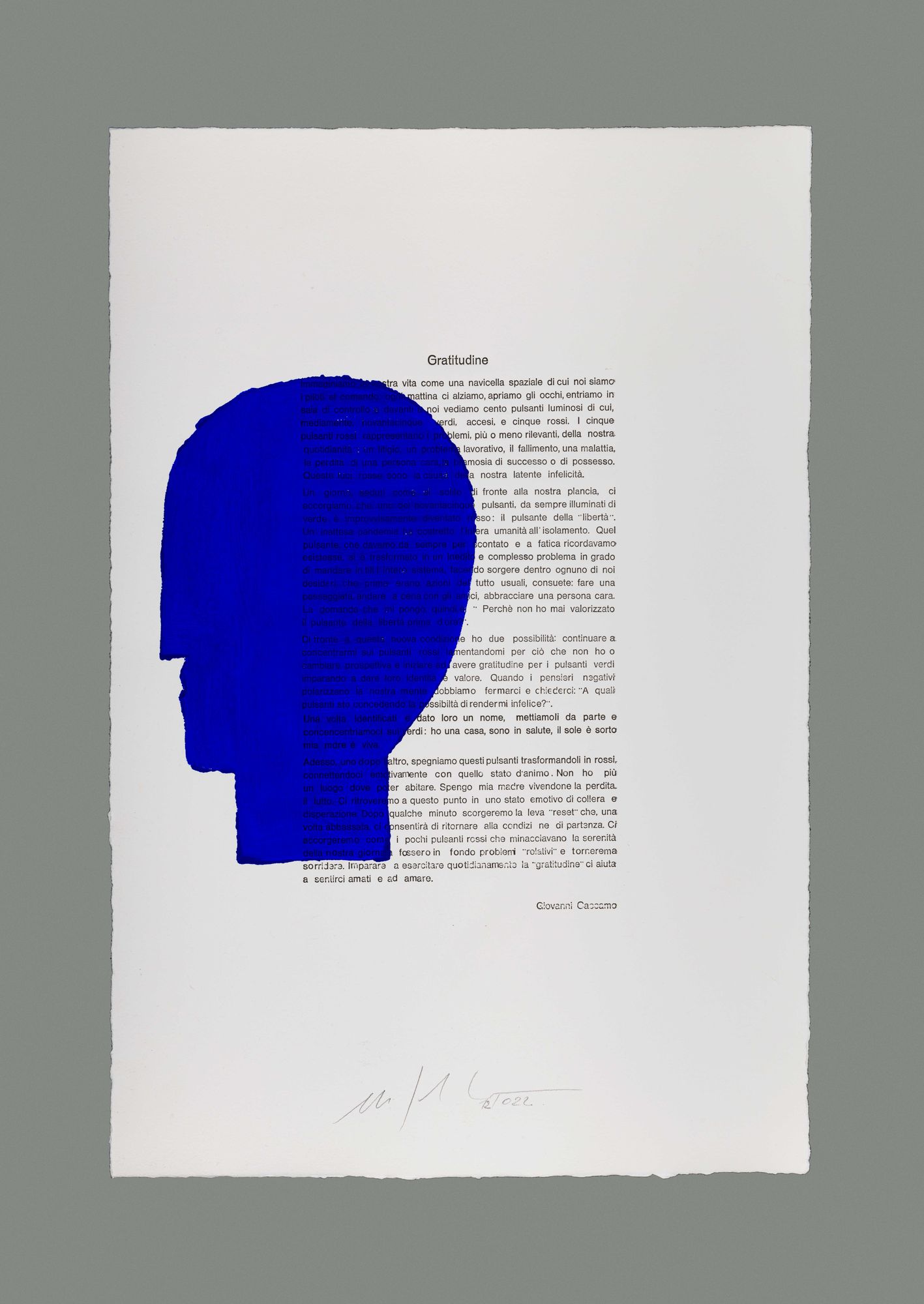
Mimmo PaladinoGratitudine, 2022tempera su carta cotone / tempera on cotton paper40 x 60 cmTesto di Giovanni Caccamo / Text by Giovanni Caccamo 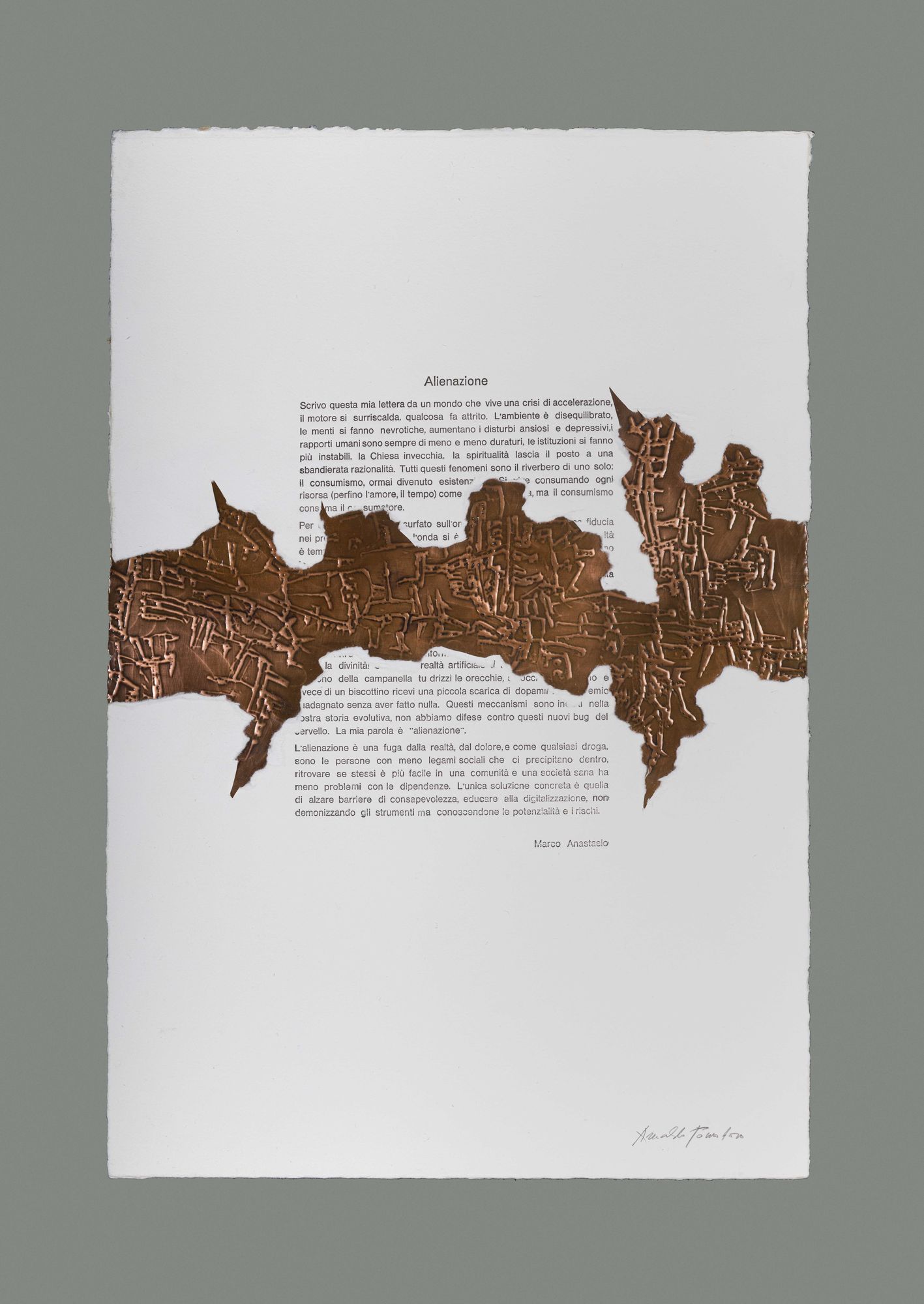
Arnaldo PomodoroAlienazione, 2023lamina di rame e carta cotone / copper foil and cotton paper40 x 60 cmTesto di Marco Anastasio / Text by Marco Anastasio 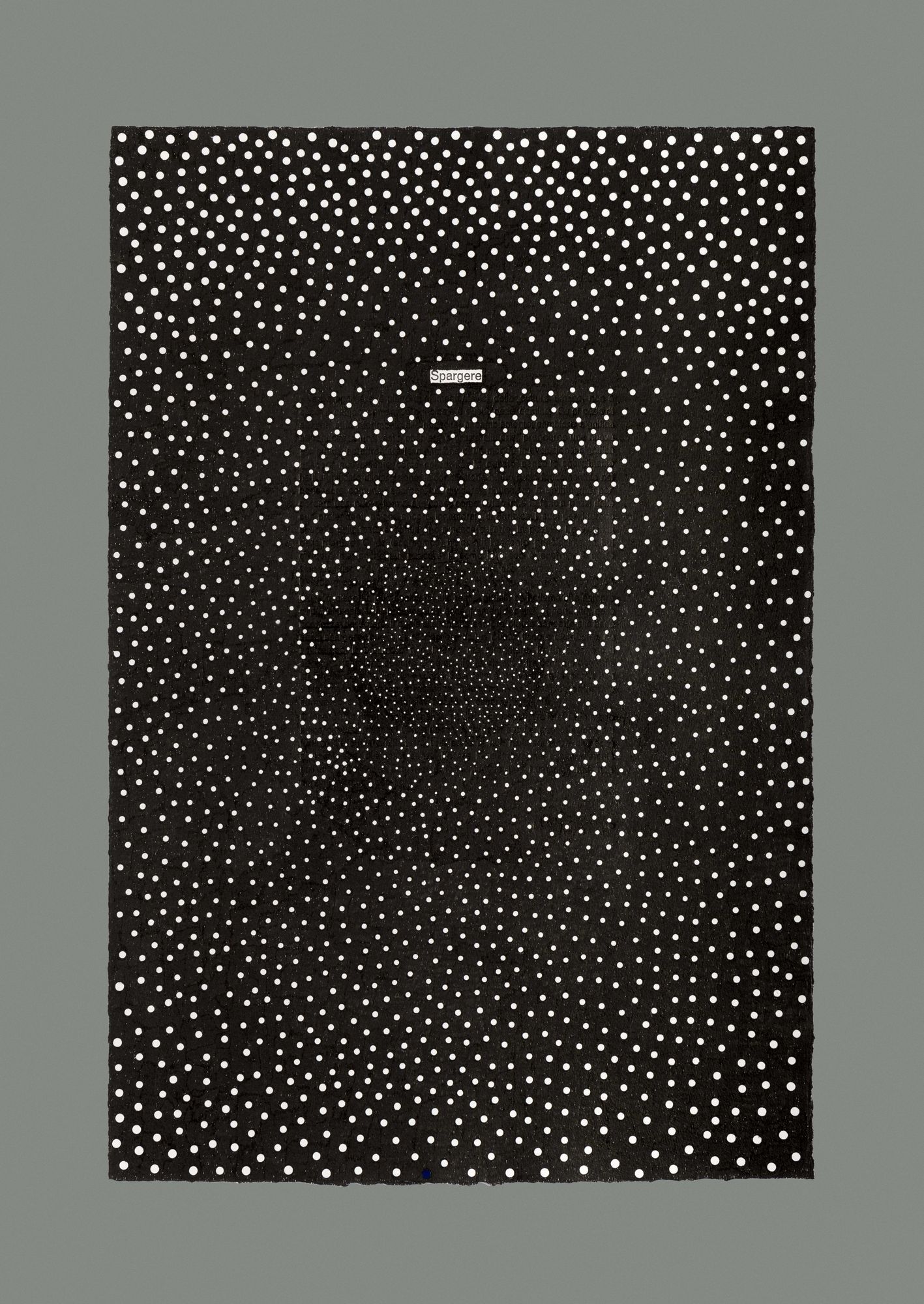
Giulia NapoleoneSpargere, 2023inchiostro di china su carta cotone / India ink on cotton paper40 x 60 cmTesto di Matteo Trapanese / Text by Matteo Trapanese 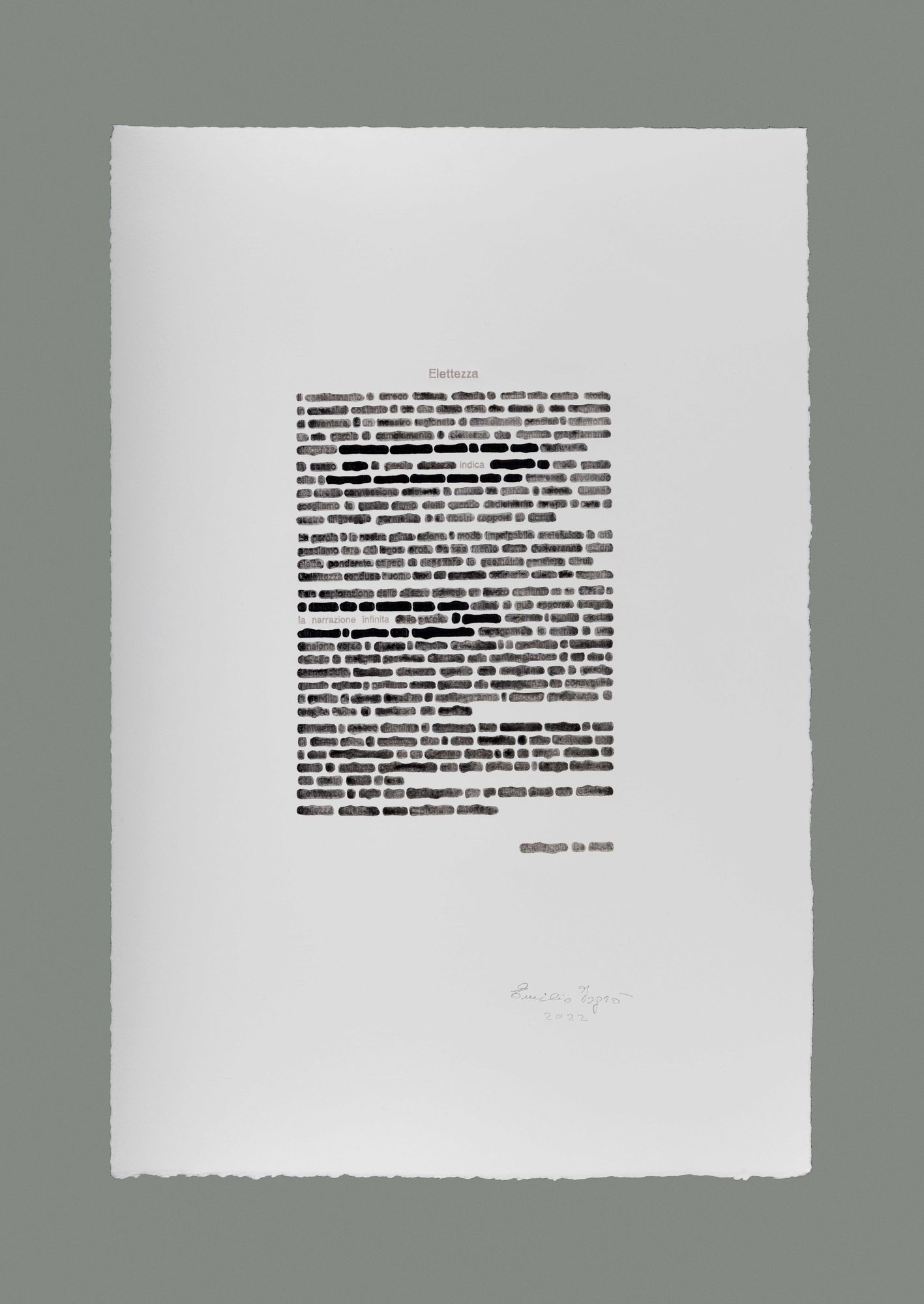
Emilio IsgròNarrazione Infinita, 2023acquerello su carta cotone / watercolour on cotton paper40 x 60 cmTesto di Mariangela De Luca / Text by Mariangela De Luca 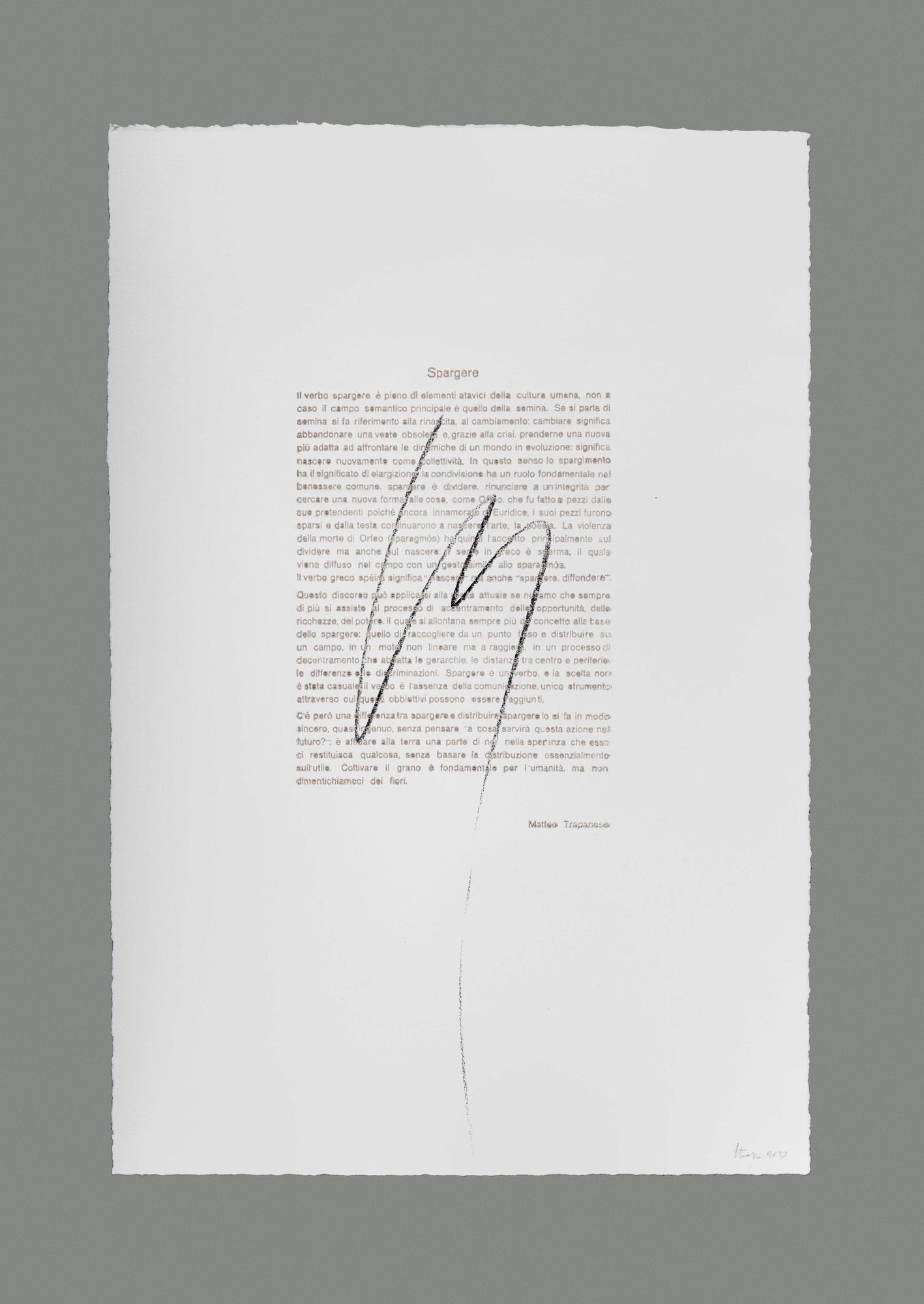
Guido StrazzaSpargere, 2023carboncino su carta cotone / charcoal on cotton paper40 x 60 cmTesto di Matteo Trapanese / Text by Matteo Trapanese 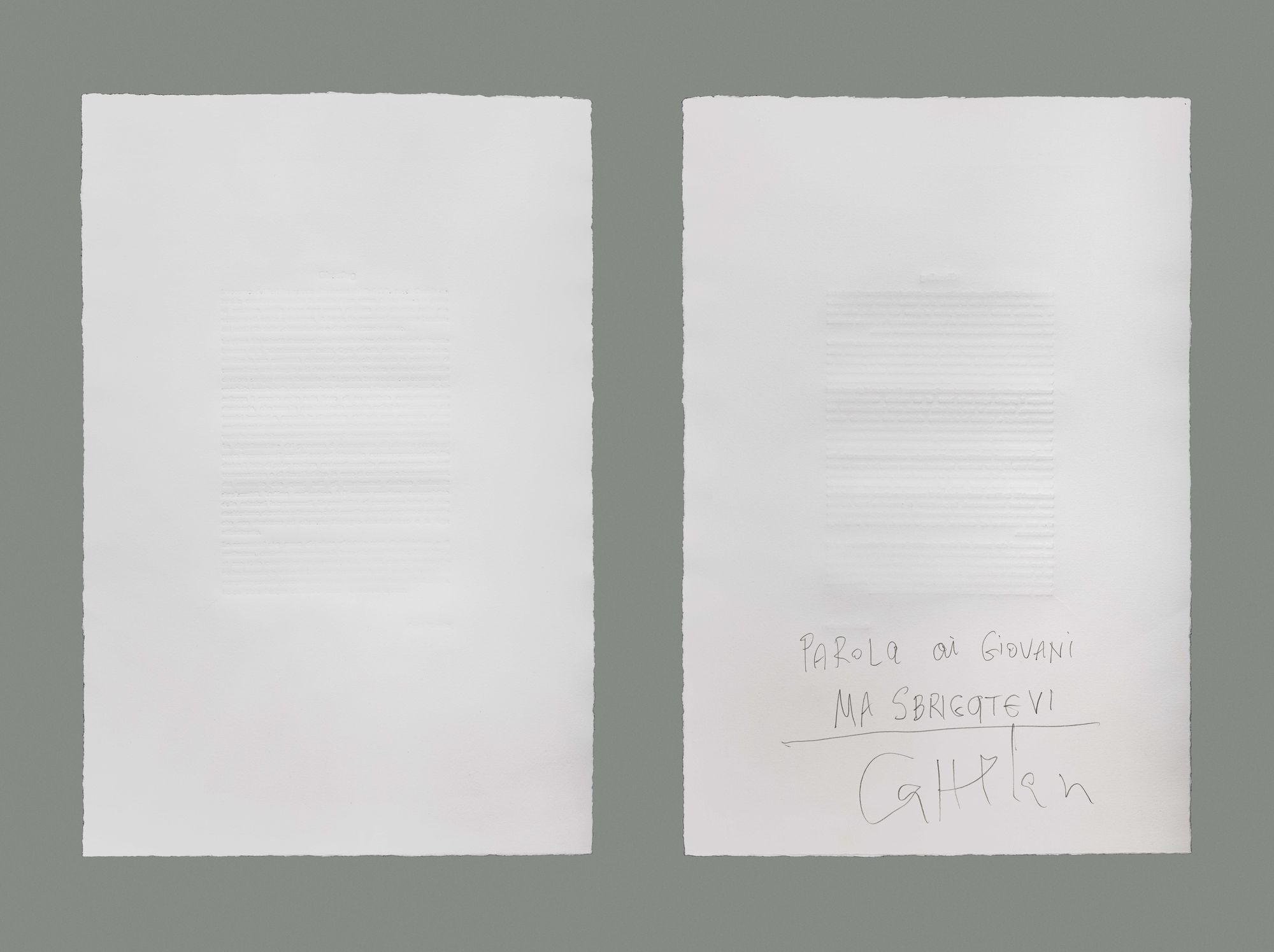
Maurizio CattelanUntitled, 2023incisione a secco su carta cotone / drypoint on cotton paper40 x 60 cmTesto di Carlo Corallo / Text by Carlo Corallo 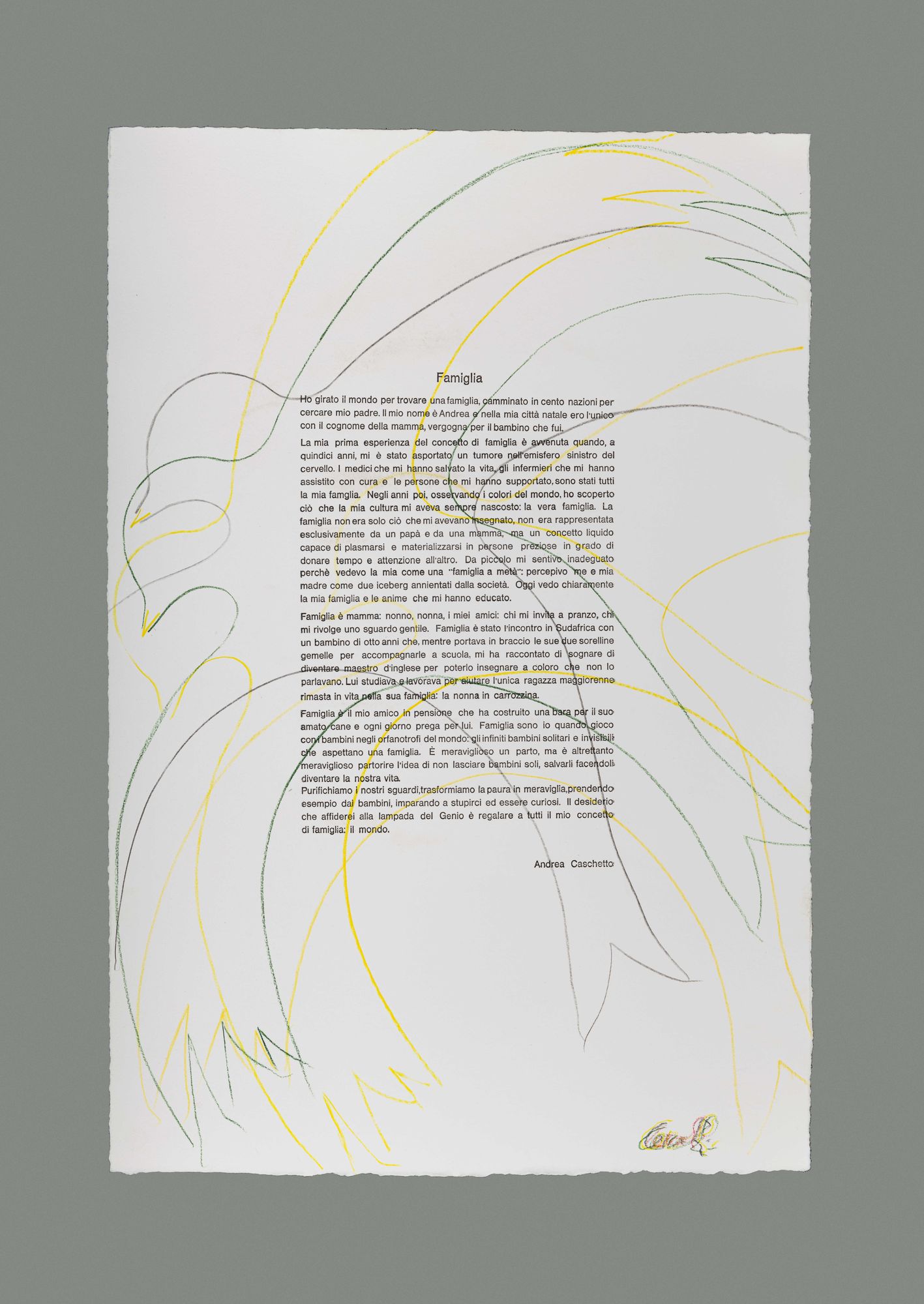
Mario CeroliFamiglia, 2023pastelli su carta cotone / pastels on cotton paper40 x 60 cmTesto di Andrea Caschetto / Text by Andrea Caschetto 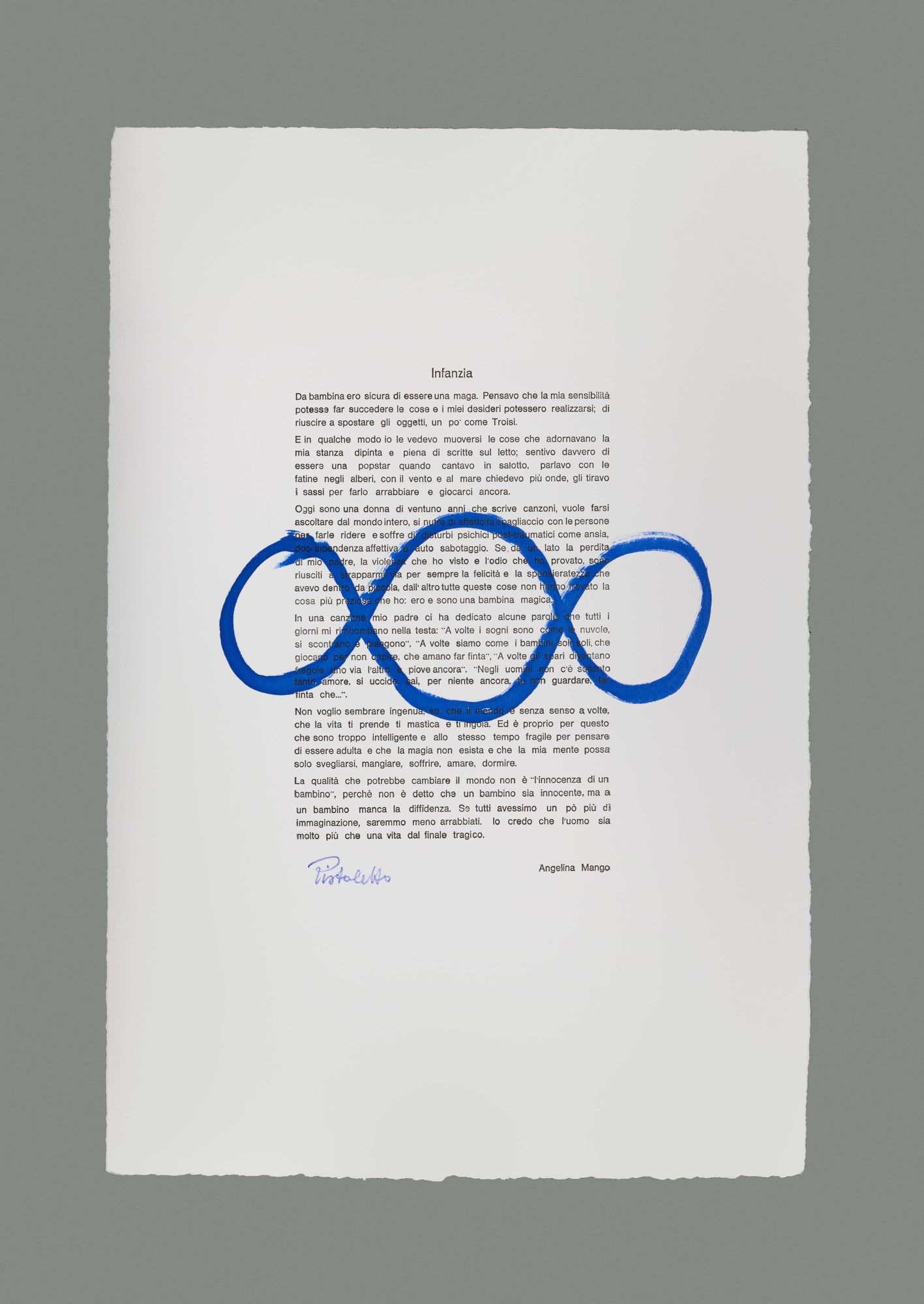
Michelangelo PistolettoInfanzia, 2023tempera su carta cotone / tempera on cotton paper40 x 60 cmTesto di Angelina Mango / Text by Angelina Mango 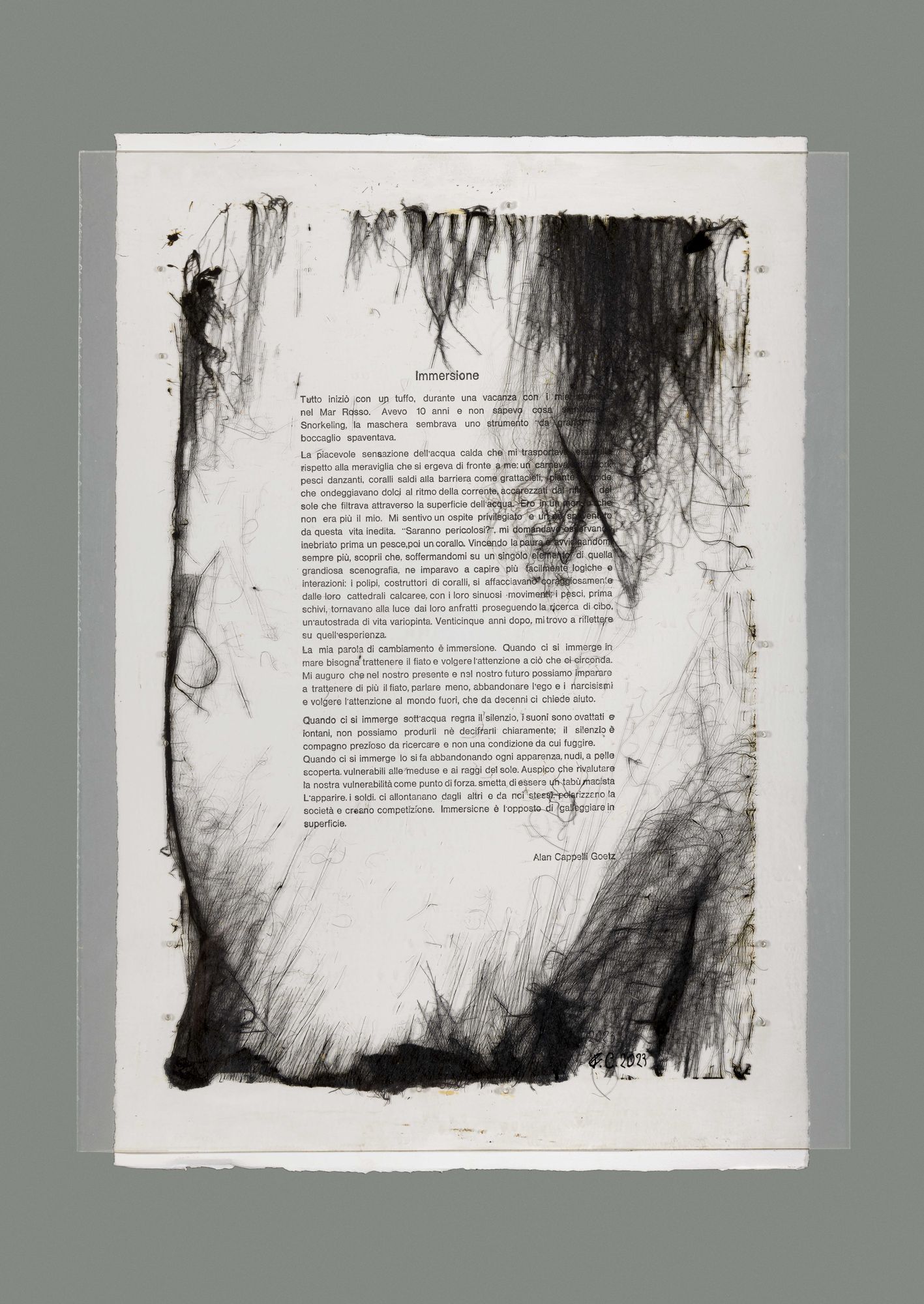
Francesca CataldiImmersione, 2022plexiglass, catrame fuso, carta cotone / plexiglass, molten tar, cotton paper45 x 60 cmTesto di Alan Cappelli Goetz / Text by Alan Cappelli Goetz 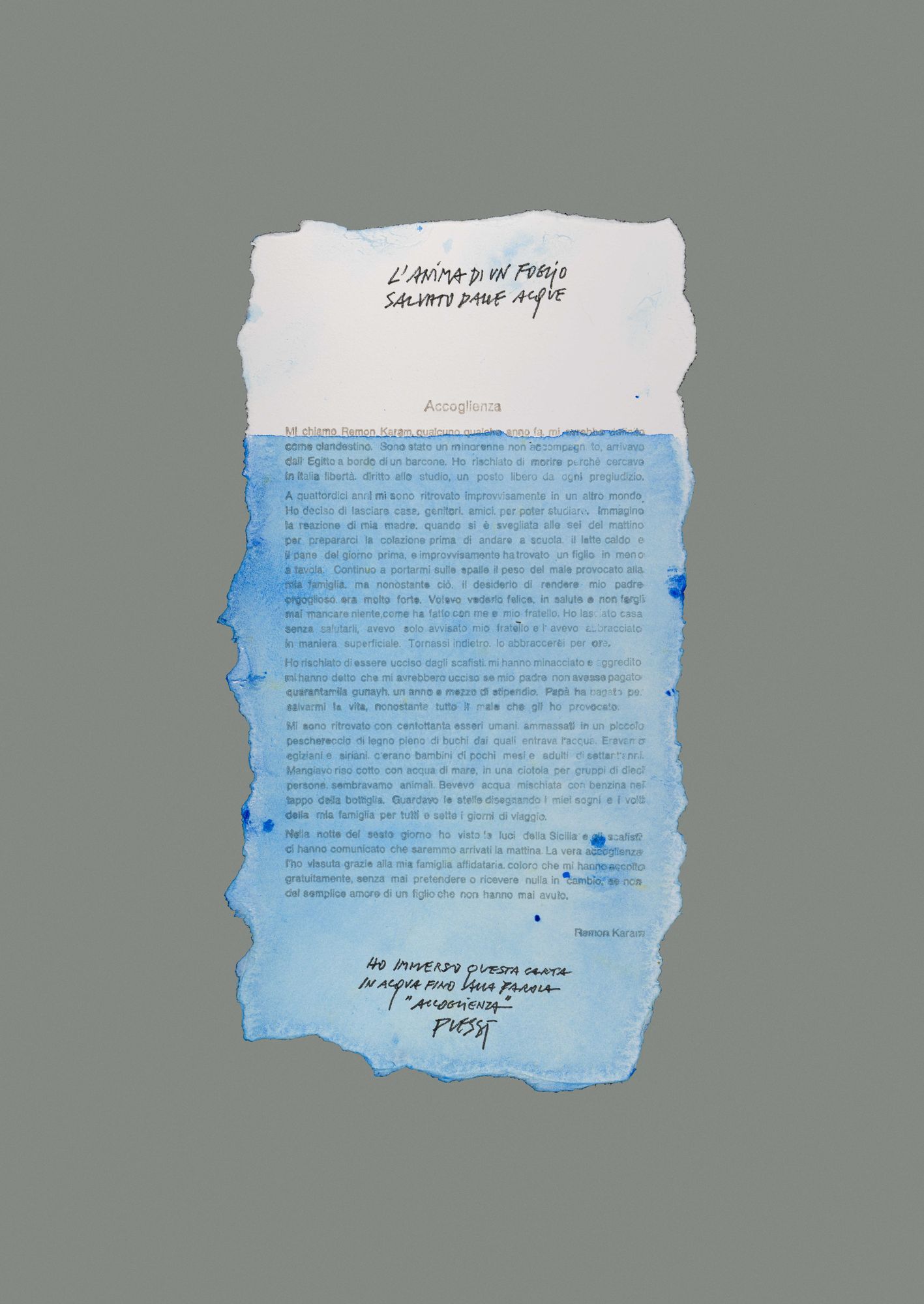
Fabrizio PlessiAccoglienza, 2023carta cotone immersa in acquerello / cotton paper dipped in watercolour23 x 44 cmTesto di Remon Karam / Text by Remon Karam 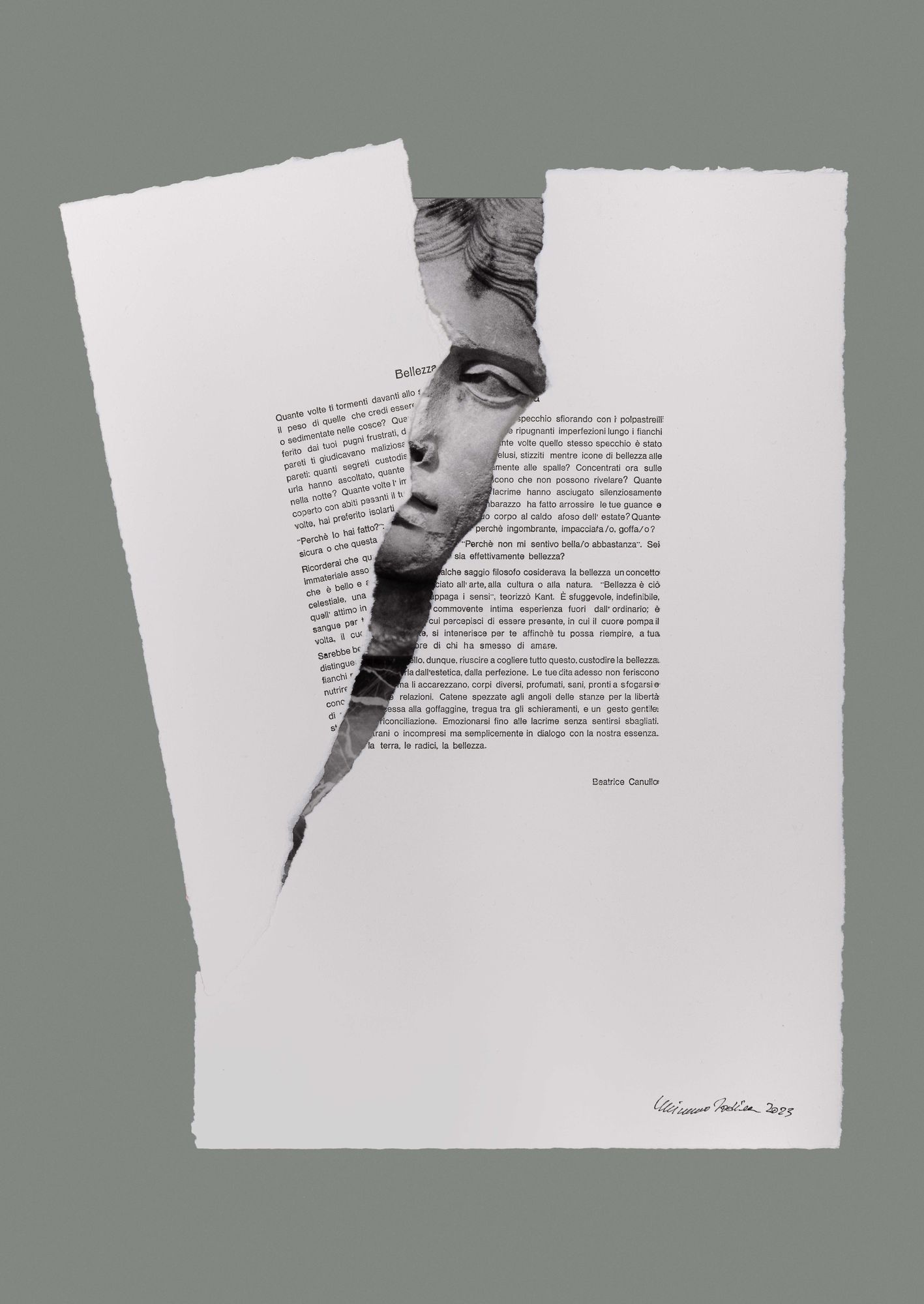
Mimmo JodiceBellezza, 2023carta cotone, stampa fotografica su cartoncino / cotton paper, photographic print on card60 x 72 cmTesto di Beatrice Canullo / Text by Beatrice Canullo 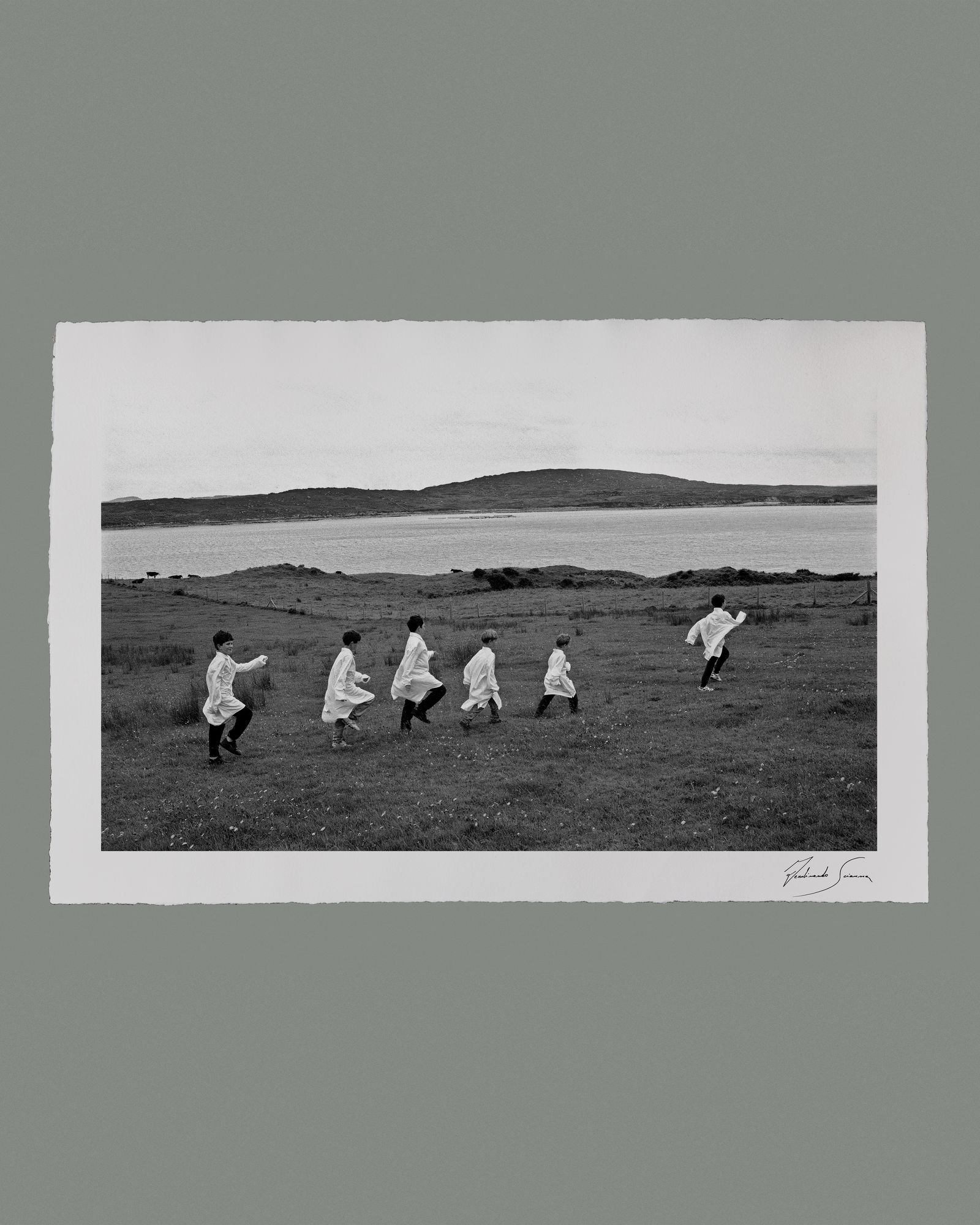
Ferdinando SciannaCoraggio, 1993stampa fotografica del 2023 / photographic print, 202360 x 40 cmTesto di Anna Caputo / Text by Anna Caputo 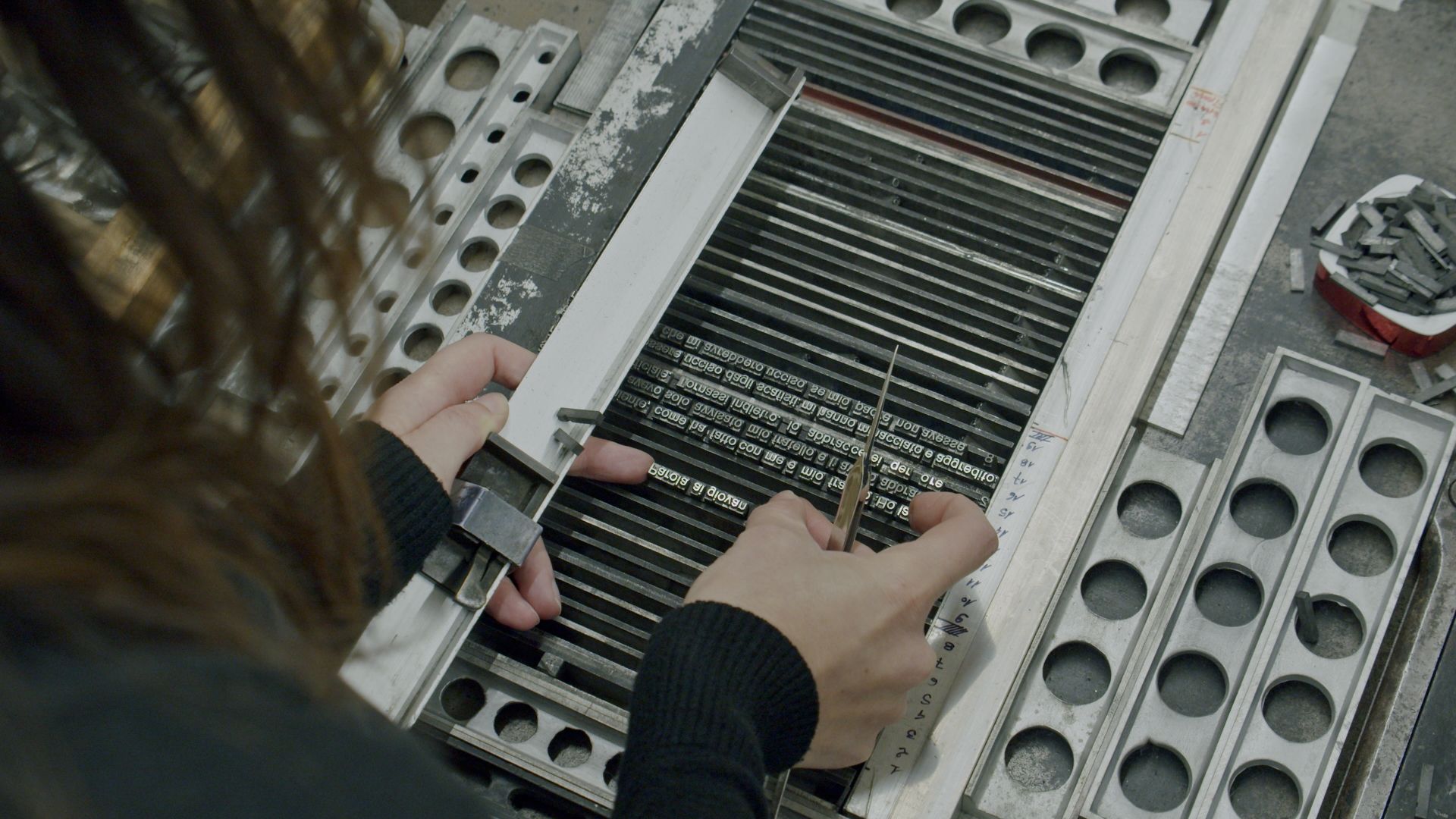
La performance Agorà del cambiamento
21 dicembre 2022
Giovani coinvolti: Agnese Di Lorenzo, Alessandro De Rosa, Andrea Caschetto, Anna Caputo, Aurora Ruffino, Daniele Pasquini, Giorgio Brizio, Giovanni Caccamo, Laura Rossi, Marco Anastasio, Mariangela De Luca, Mario Falanga, Rajae Bezzaz, Remon Karam, Silvia Parrino.
Alla fine del viaggio nelle università, carceri e centri d’accoglienza in Italia, Giovanni ha riflettuto sulla necessità di mettere in relazione le idee di ciascuno con quelle degli altri, chiedendosi per diversi mesi cosa dovesse scaturire concretamente da questo manifesto con il desiderio di stimolare la collettività all’evoluzione e al dialogo.
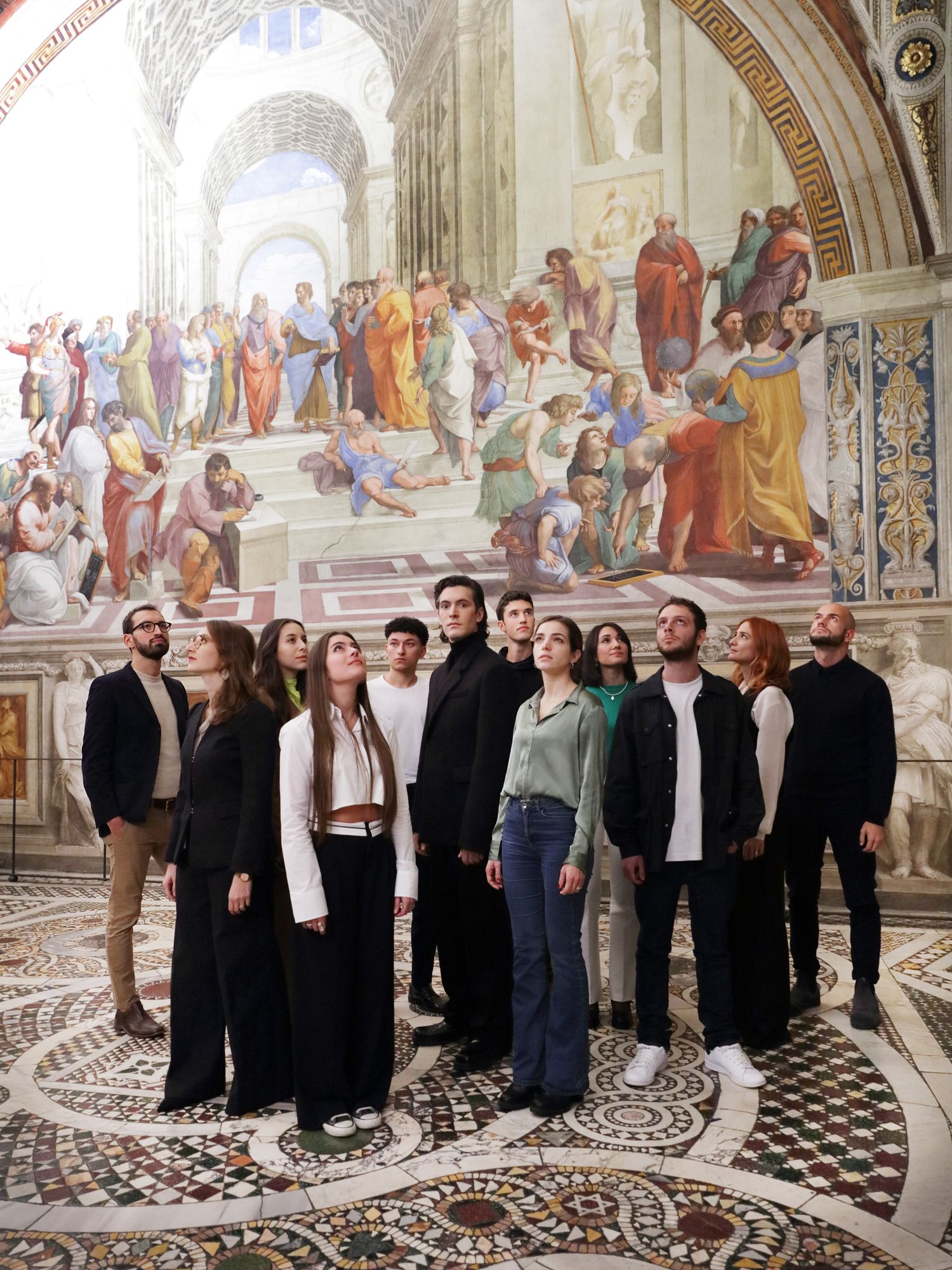
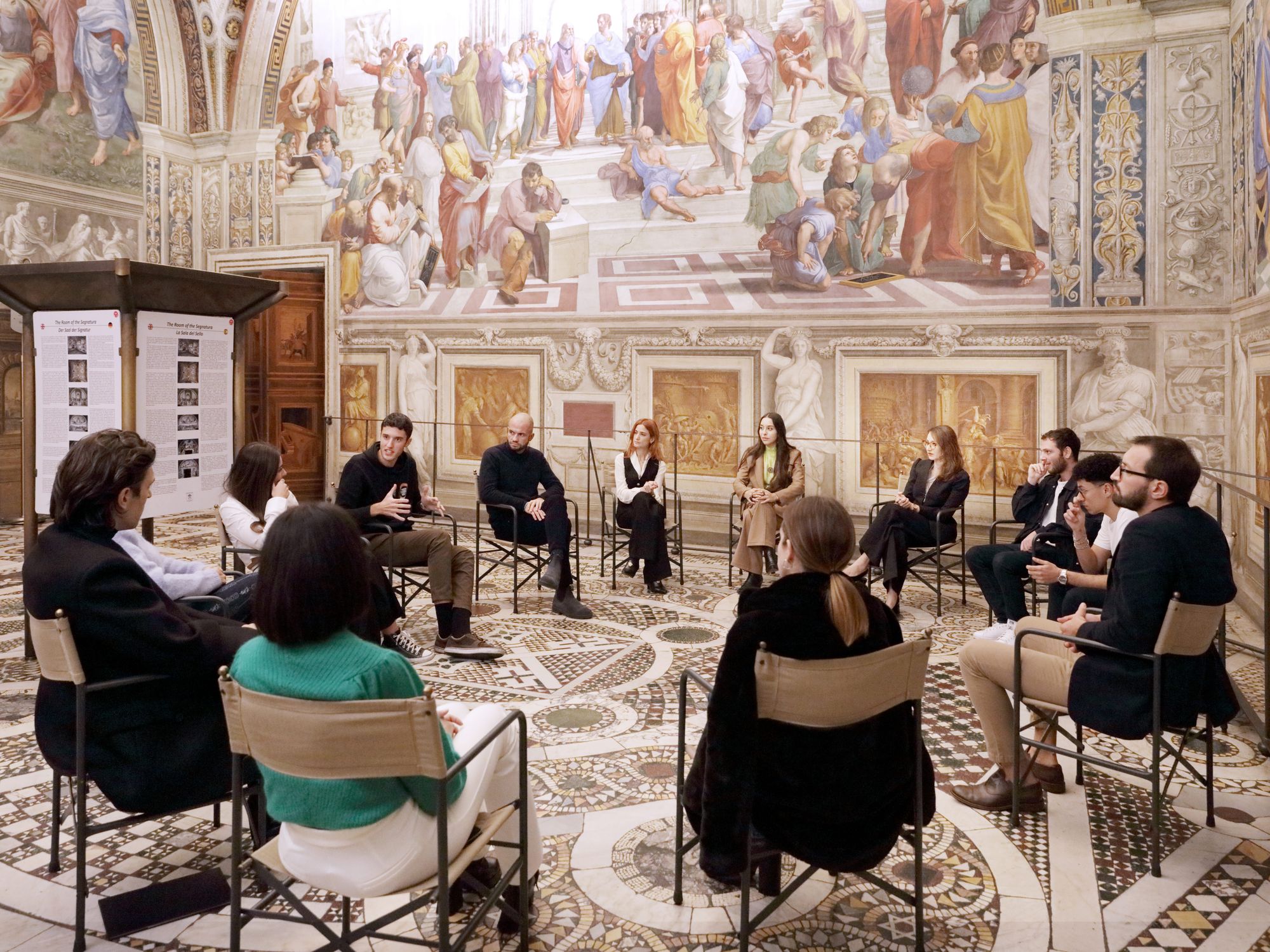
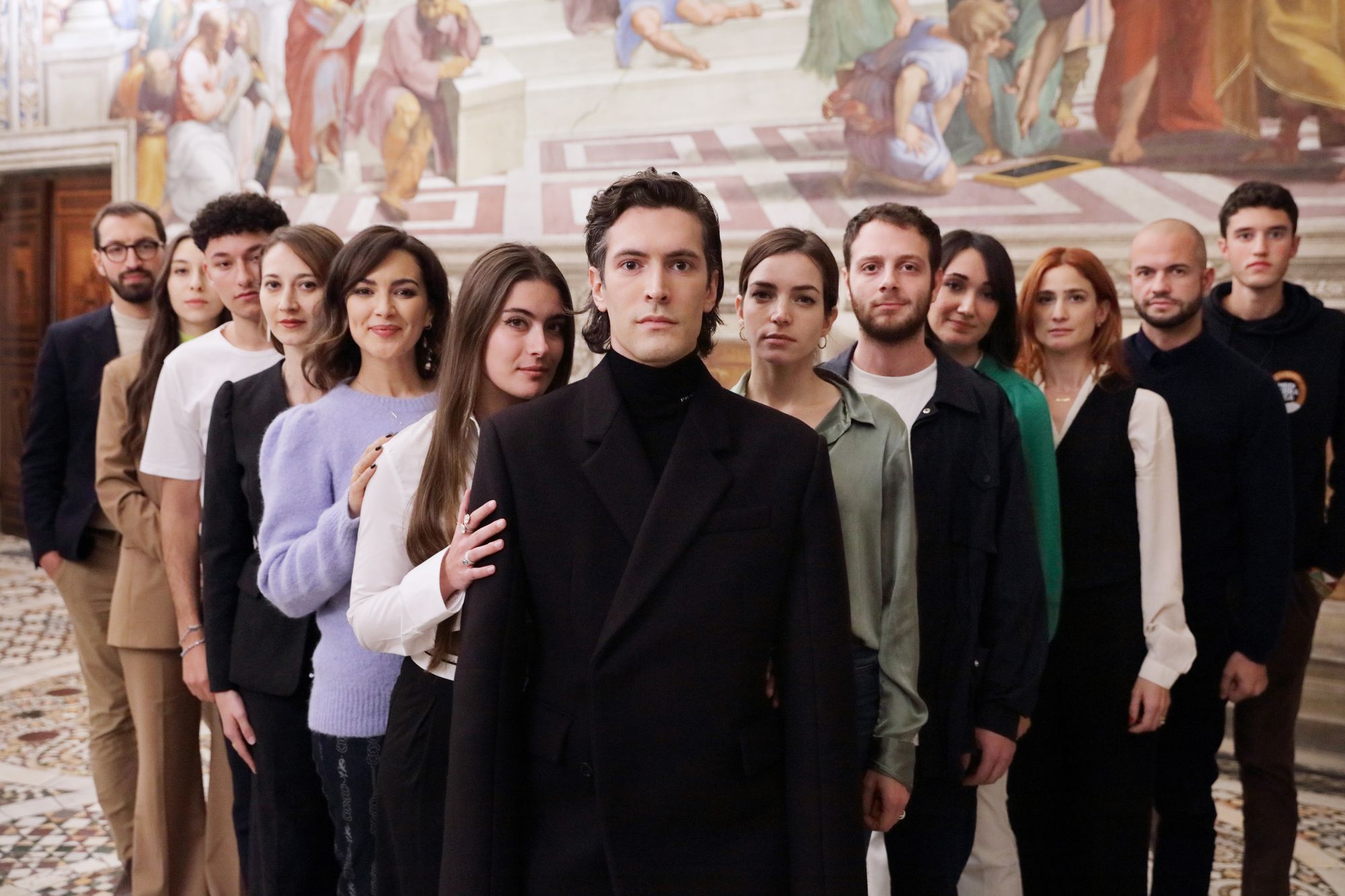
È nata così l’Agorà del cambiamento, un incontro all’interno della Stanza della Segnatura nei Musei Vaticani, in cui quindici ragazzi, in rappresentanza di quanti hanno partecipato al progetto, hanno condiviso le loro idee.
Affinché questa non rimanesse solo una riflessione teorica, consapevoli di non poter essere esaustivi, ispirati dalla Dichiarazione universale dei diritti umani, i giovani coinvolti hanno provato a redigere un elenco aperto dei valori in cui potersi riconoscere, per poi ipotizzare alcune proposte concrete che possano aiutare la società del futuro al raggiungimento delle prospettive e dei cambiamenti auspicati.
Sotto ogni elenco, dei puntini di sospensione, permettono ai lettori di appuntare le proprie idee o condividerle online utilizzando l’hashtag #ManifestoDelCambiamento.
Si tratta di un elenco in divenire, un punto di partenza, frutto dell’istinto genuino di centinaia di giovani sognatori.
The performance Agorà of Change
December 21, 2022
Youth involved: Agnese Di Lorenzo, Alessandro De Rosa, Andrea Caschetto, Anna Caputo, Aurora Ruffino, Daniele Pasquini, Giorgio Brizio, Giovanni Caccamo, Laura Rossi, Marco Anastasio, Mariangela De Luca, Mario Falanga, Rajae Bezzaz, Remon Karam, Silvia Parrino.
After travelling to universities, prisons and migrant reception centres throughout Italy, Giovanni felt that all these ideas needed to be connected somehow. For months, he reflected on what should actually emerge from this manifesto, in the hope of inspiring evolution and dialogue within the collective.
This reflection gave rise to the Agorà of Change, a meeting held inside the Stanza della Segnatura in the Vatican Museums, where fifteen young people, representing all the project participants, shared their ideas.
In order to move beyond mere theoretical reflection, and recognising that they could not cover every topic, these young people drew inspiration from the Universal Declaration of Human Rights to create an open list of values they identify with. Their aim was to develop concrete proposals to help future society achieve its goals and bring about the change they hope for.
Each list is followed by an ellipsis, allowing readers to add their own ideas or share them online using the hashtag #ManifestoDelCambiamento.
These lists are merely a starting point and are constantly evolving, the result of the genuine intuition of hundreds of young dreamers.
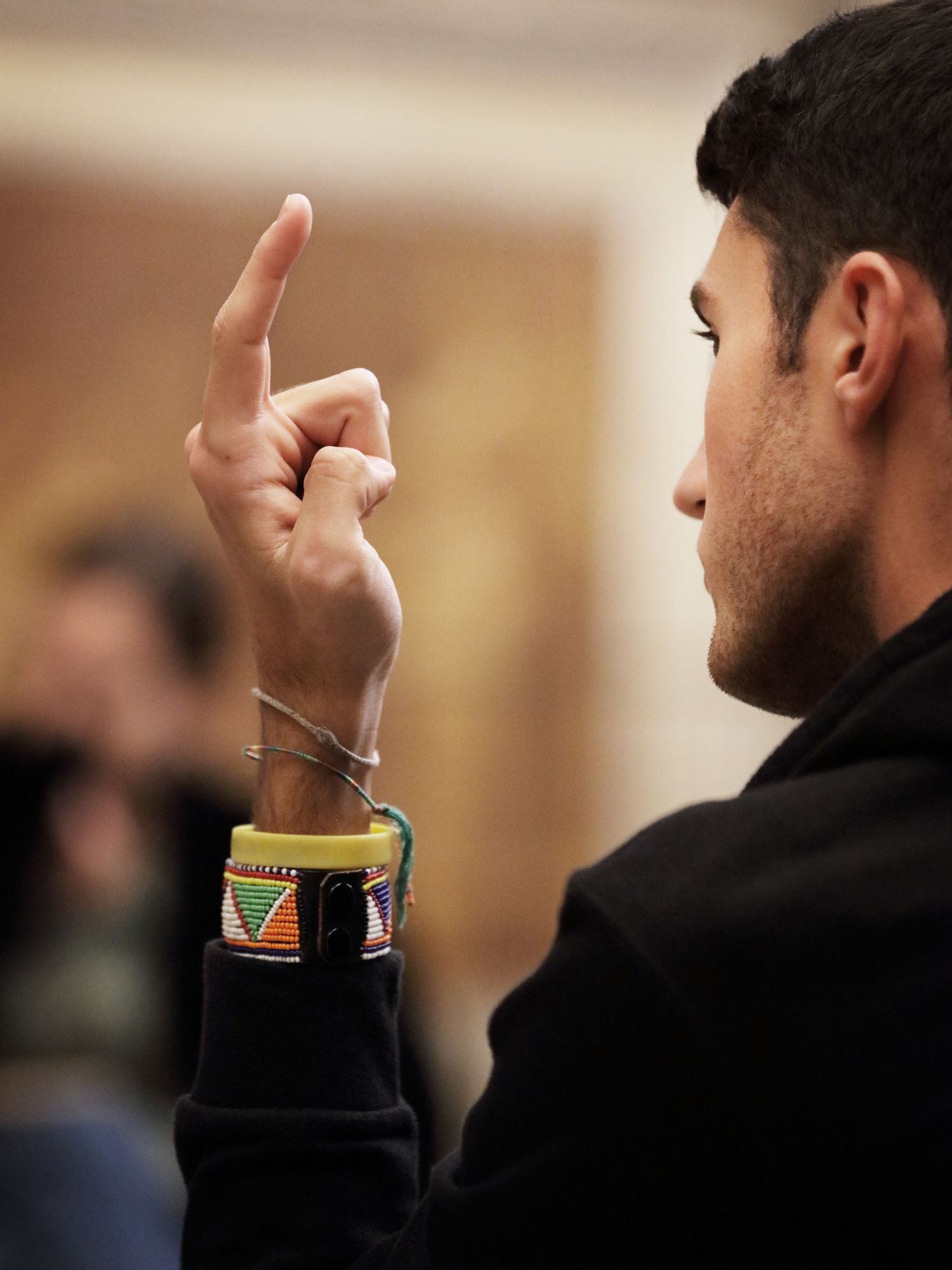
Messaggio di Papa Francesco
11 dicembre 2022
Cari giovani,
ai nostri giorni si avverte una grande paura del cambiamento perché non sappiamo tollerare l'incertezza e ci ritraiamo davanti ai pericoli, reali o immaginari. Questo timore manifesta una visione pessimistica della libertà umana e dei processi storici, come se non ci fosse più niente da fare per evitare la catastrofe. Non si riesce a vedere che dietro ogni crisi si nasconde anche un'opportunità.
D'altra parte, però, è anche vero che si parla troppo spesso e superficialmente della necessità di cambiare: è diventata una moda, alla quale ci stiamo abituando. E si inventano slogan, simboli, proclami. Si fa pubblicità col cambiamento, che alimenta egoismi e interessi di parte. La sfida è aperta allora: siate persone che cambiano il modo di cambiare!
C'è un poema popolare argentino a me molto caro, il Martin Fierro. È stato pubblicato molti anni fa, nel 1872, e tuttavia resta attuale per molti aspetti. Tra l'altro vi si legge: «Se cantate, fate in modo / di cantare con sentimento. / Non usate lo strumento / solo per il gusto di parlare / e cercate di cantare / solo ciò che val la pena».
Questo è il messaggio che voglio lasciarvi: in un mondo nel quale la comunicazione dà una forma al nostro vivere sociale e anche alle nostre scelte, voi siete chiamati a scavare parole dentro la vostra esperienza per esprimere il desiderio di un mondo nuovo. Evitate ogni canto che sia «solo per il gusto di parlare».
Esprimete parole di cambiamento, però in maniera che non sia un semplice cambiamento di parole. Impegnatevi a cambiare la vita delle persone che vi stanno accanto e che hanno bisogno di voi. Questa sarà la prova che volete fare sul serio.
«L'amore si deve porre più nei fatti che nelle parole», ha scritto sant'Ignazio di Loyola. Aveva ragione. Bisogna parlare con tutta la vita. In un tempo in cui la parola ha perso il proprio peso e le manca la «scintilla» che la rende viva, sarà la vita a dire se le vostre parole sono davvero autentiche: parlate con tutta la vostra vita!
Le parole che condividerete tra voi creino legami, capaci di esprimere le vostre idee e i vostri sentimenti, ma anche di spingervi all'azione, all'impegno, alla lotta. Scambiatele tra voi, ma anche con le persone più grandi di voi, specialmente con gli anziani. Voi sarete in grado di immaginare un mondo nuovo se sarete capaci di ascoltare i sogni dei vostri nonni. Tenete teso il filo delle generazioni, senza permettere di cadere in utopie vuote.
Dialogate, ma sappiate che si dialoga agendo insieme per il bene di tutti, altrimenti è «accademia». Dal lavorare insieme poi nascerà il confronto, il dibattito e la sempre maggiore comprensione reciproca, l'apertura alle prospettive degli altri.
Dove c'è vita ci sono cambiamenti, paure, ricerca, incertezza, speranza. Avanti, quindi, e con coraggio! .
Francesco
Message from Pope Francis to the Youth
December 11, 2022
Dear youth,
In our times, you can sense people’s deep fear of change because we cannot tolerate uncertainty and we shy away from danger, be it real or imagined. This fear uncovers a pessimistic view of human freedom and historical processes, as if nothing can be done to avoid catastrophe. Yet, we fail to see that behind every crisis lies an opportunity.
On the other hand, it is equally true that people talk too often and too superficially about the need for change. It has become a trend, one we are growing accustomed to. People come up with slogans, symbols, and declarations. Change is used as a marketing tool, feeding selfishness and narrow interests. So here is the challenge: become the ones who change the way change happens!
There is a popular Argentine poem that I hold dear, Martin Fierro. It was published long ago in 1872, yet it is still pertinent in many ways. Among other things, it says:
“Procuren, si son cantores, / El cantar con sentimiento, / No tiemplen el estrumento / Por solo el gusto de hablar, / Y acostúmbrense a cantar / En cosas de jundarnento.”
“Make sure, if you are singers, / to sing with feeling. / Don't tune your instrument / just for the sake of talking; / and always sing about things / that truly deserve to be sung about.”
This is the message I want to leave with you. In a world where communication shapes both our social being and our choices, draw words from your lived experience to voice your longing for a new world. Avoid all singing that is “just for the sake of talking.”
Speak words of change, but do so in a way that is more than just a change of words. Commit to transforming the lives of those around you who need you. This will be proof of your sincerity.
“Love must be placed more in deeds than in words,” wrote Saint Ignatius of Loyola. He was right. We must speak with our whole life. In a time when words have lost their weight and lack the “spark” that makes them meaningful, it will be life itself that proves whether our words are truly authentic. Speak with your whole life!
May the words you share with one another form bonds capable of expressing your ideas and feelings, but also of pushing you to take action, to commit, to fight. Share them with your peers, but also with those older than you, particularly the elderly. You will be able to envision a new world if you can listen to the dreams of your grandparents. Keep the thread of generations strong, and never allow dreams to slip into empty utopias.
Engage in dialogue, but know that dialogue truly happens when we act together for the common good. Otherwise, it is mere “academia.” By working together, comparisons and debates will arise, fostering greater mutual understanding, an openness to the perspectives of others.
Where life breathes there are changes, there are fears, quests, uncertainty, and hope.
So, onward, and with courage!
Francis
Il documentario Parola ai giovani
Primo settembre 2023
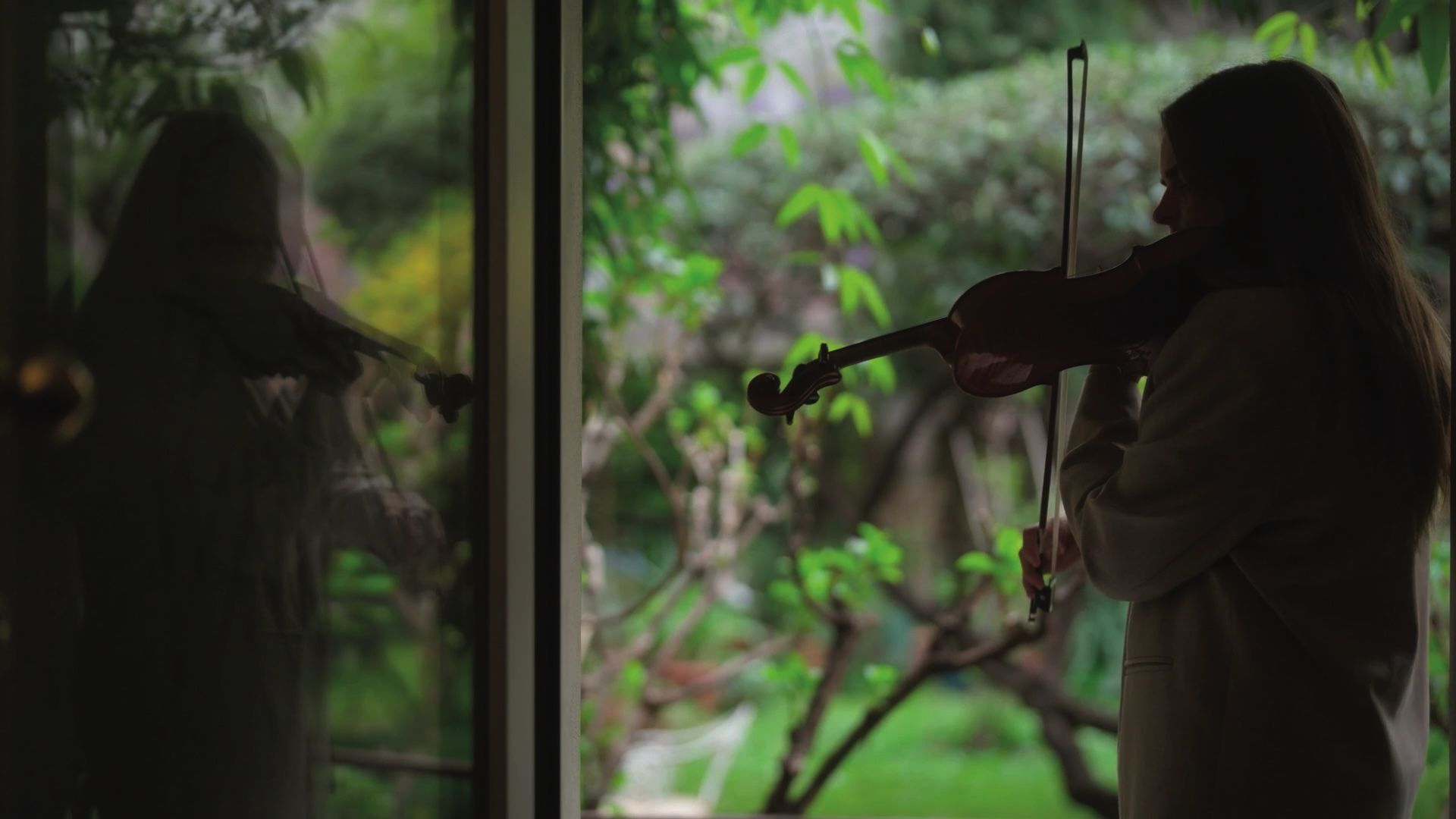
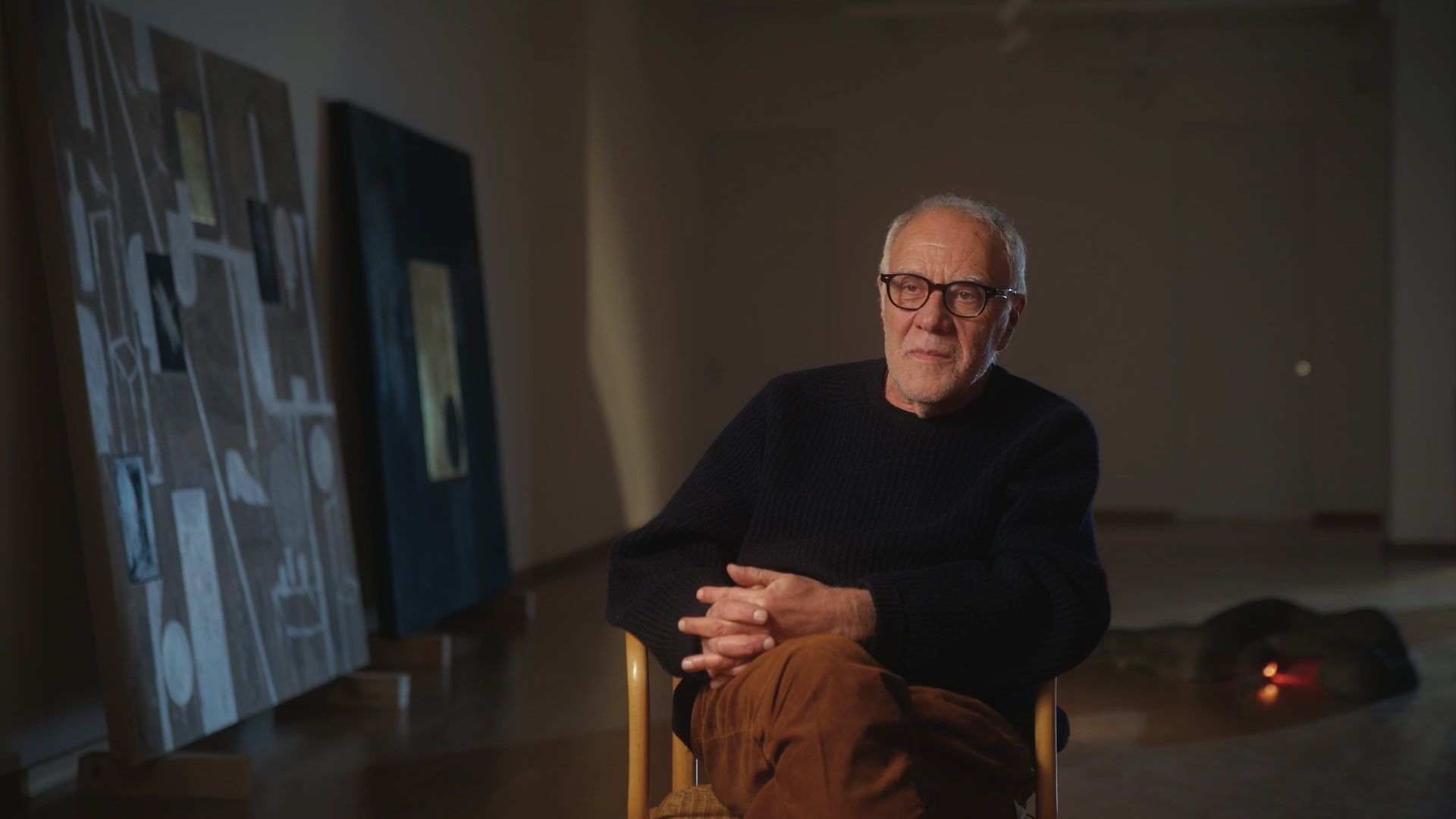
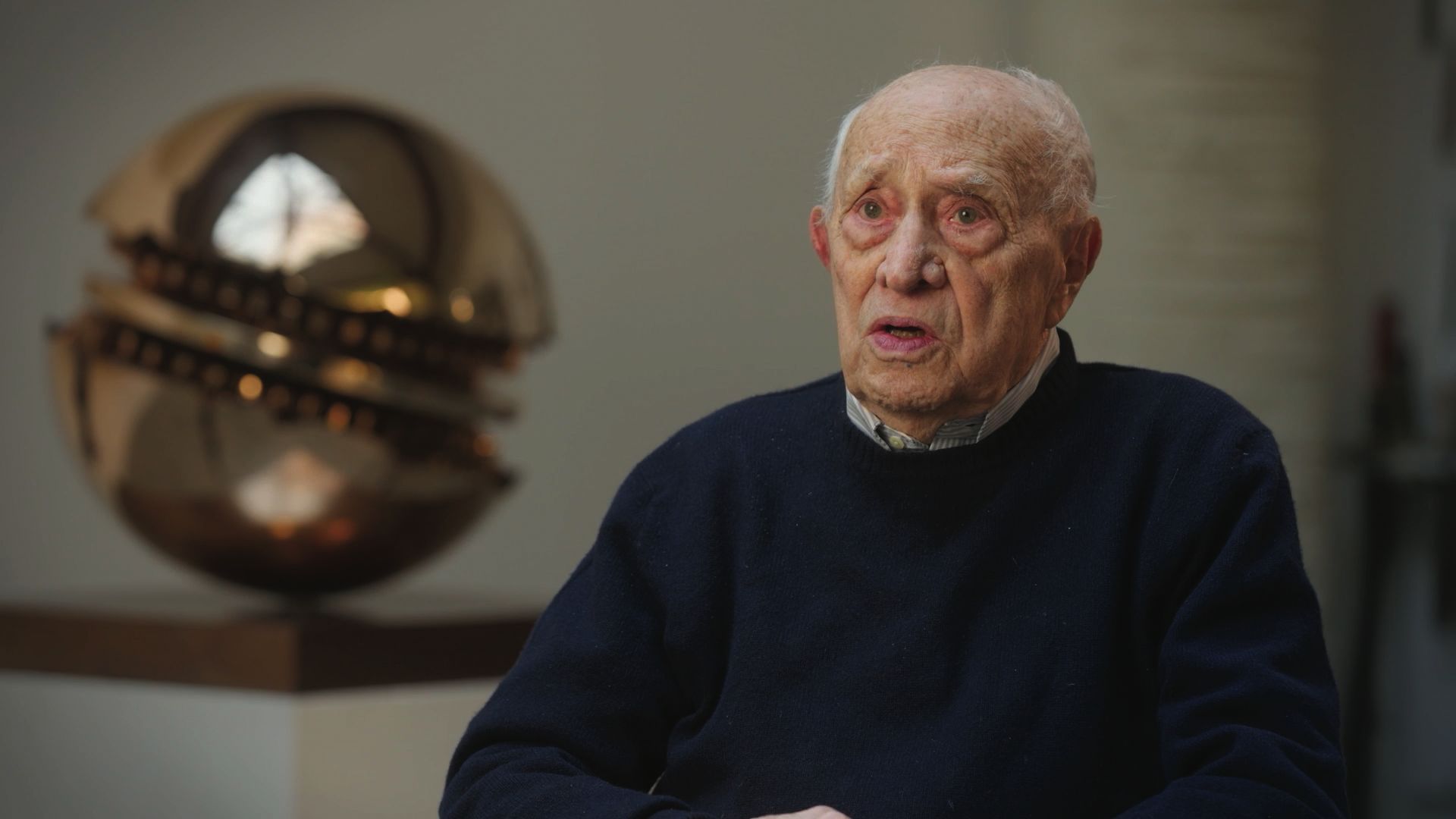
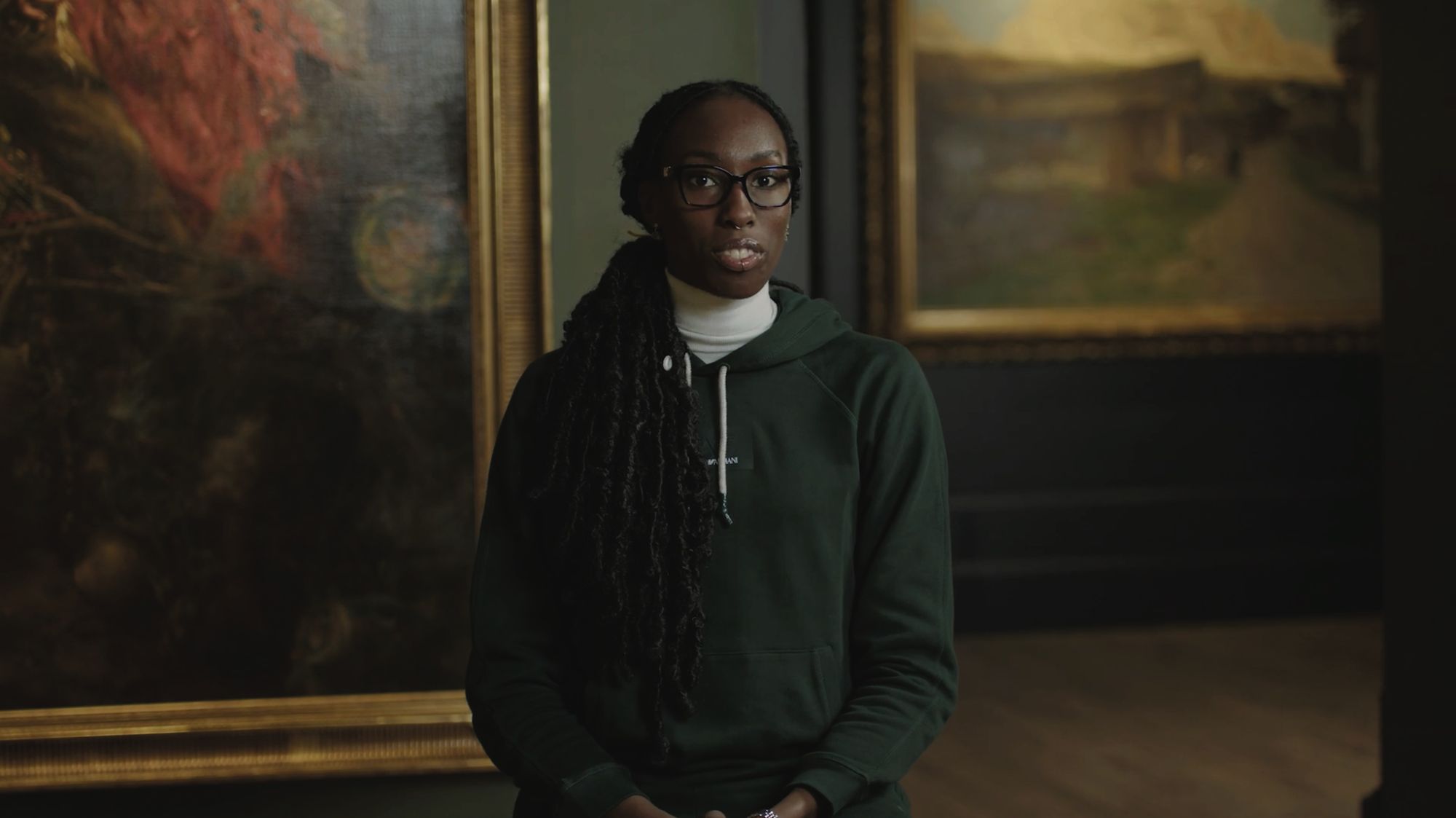
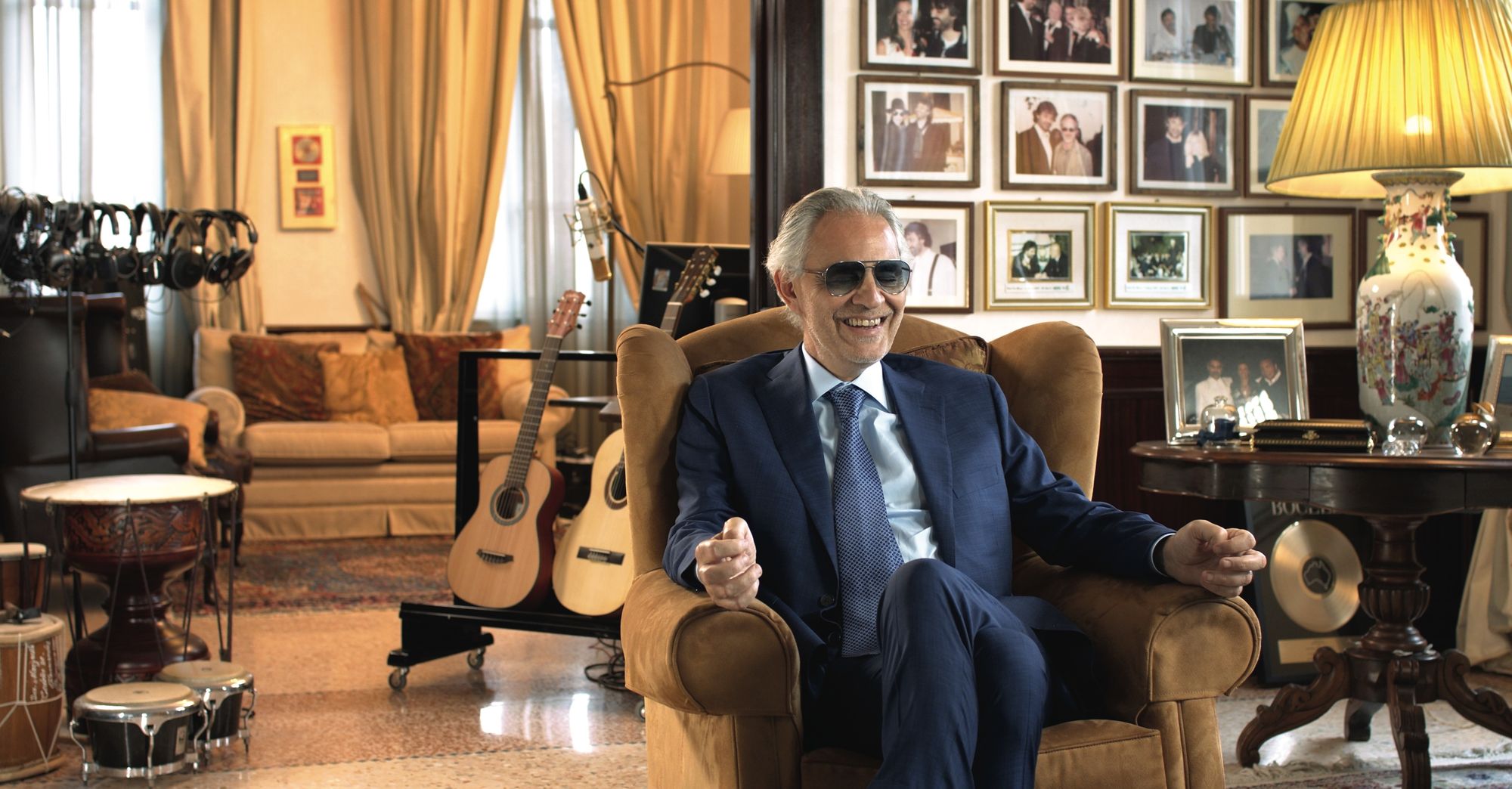
Il cast: Marco Anastasio, Andrea Bocelli, Guglielmo Castelli, Mario Ceroli, Mariangela De Luca, Agnese Di Lorenzo, Paola Egonu, Salvatore Esposito, Remon Karam, Laura Marzadori, Mimmo Paladino, Arnaldo Pomodoro, Filippo Scotti, Virginia Stagni, Jacopo Tissi, Riccardo Zanotti.
Sinossi:
Il documentario, presentato il primo settembre 2023 in anteprima nazionale alle Giornate degli Autori, sezione indipendente della Mostra del Cinema di Venezia, in collaborazione con Sky Arte, mette a fuoco l’importanza della parola e del cambiamento, attraverso un coro di voci, composto da giovani eccellenze italiane e Maestri per restituire allo spettatore un confronto generazionale sulle tematiche più urgenti e delicate della nostra società. Alienazione, Accoglienza, Conoscenza, Elettezza, Empatia, Gratitudine, Reset, Restituzione, Rinascita, Scuola, Senticeto, Sincerità, Tempo, sono le parole di cambiamento cardine di questa riflessione.
Luoghi eterni abitati da opere sublimi come i Musei Vaticani, il MAXXI – Museo Nazionale delle Arti del XXI Secolo, le Gallerie d’Italia, lo Studio Arnaldo Pomodoro, Casa Fornasetti, così come panorami mozzafiato, elementi naturali riletti come opere d’arte, diventano culla di parole, in risposta al nichilismo e all’oscurantismo che minacciano i sogni e le speranze delle nuove generazioni. Gli ospiti raccontano la loro storia, i loro fallimenti, rivelandoci quale sia la loro visione di cambiamento come virtù applicata al quotidiano, che possa permetterci di trasformare il nostro presente e costruire un futuro in evoluzione.
Crediti
© 2021 BMG Rights Management (Italy) Srl, Ala Bianca Group Srl ℗ 2021, Ala Bianca Group Srl
Documentario realizzato con il contributo del Fondo PSMSAD
The documentary Parola ai giovani
1 September 2023
Cast: Marco Anastasio, Andrea Bocelli, Guglielmo Castelli, Mario Ceroli, Mariangela De Luca, Agnese Di Lorenzo, Paola Egonu, Salvatore Esposito, Remon Karam, Laura Marzadori, Mimmo Paladino, Arnaldo Pomodoro, Filippo Scotti, Virginia Stagni, Jacopo Tissi, Riccardo Zanotti.
Synopsis:
This documentary, which premiered in Italy on 1 September 2023 at the Giornate degli Autori, an independent section of the Venice International Film Festival, in collaboration with Sky Arte, explores the importance of words and change through a chorus of voices, including inspiring young Italians and artists. It offers viewers a cross-generational perspective on some of the most pressing and sensitive issues facing our society. Alienation, Welcome, Knowledge, Elettezza, Empathy, Gratitude, Reset, Restitution, Rebirth, School, Senticeto, Sincerity, and Time are the key words of change at the heart of this reflection.
Timeless places housing sublime works of art, such as the Vatican Museums, MAXXI – Museo Nazionale delle Arti del XXI Secolo, Gallerie d’Italia, Studio Arnaldo Pomodoro, and Casa Fornasetti, as well as breathtaking landscapes and natural elements reinterpreted as works of art, inspire words that challenge the nihilism and obscurantism threatening the hopes and dreams of new generations. The guests share their stories, failures, and visions for change, presenting these as virtues that can be applied to everyday life. In doing so, they invite us to transform the present and build a new, evolving future.
Credits
© 2021 BMG Rights Management (Italy) Srl, Ala Bianca Group Srl ℗ 2021, Ala Bianca Group Srl
Documentary made possible with the contribution of Fondo PSMSAD
Press Office
Thanks to the following people for the archival footage: Umberto Costamagna, Studio Mimmo Paladino, Andrea Bocelli Foundation, Studio Arnaldo Pomodoro, Lorenzo Scurati, Volleyball World, Lega Pallavolo Serie A Femminile, DAO sport, Federazione Italiana Pallavolo
Il libro Manifesto del Cambiamento
12 maggio 2023
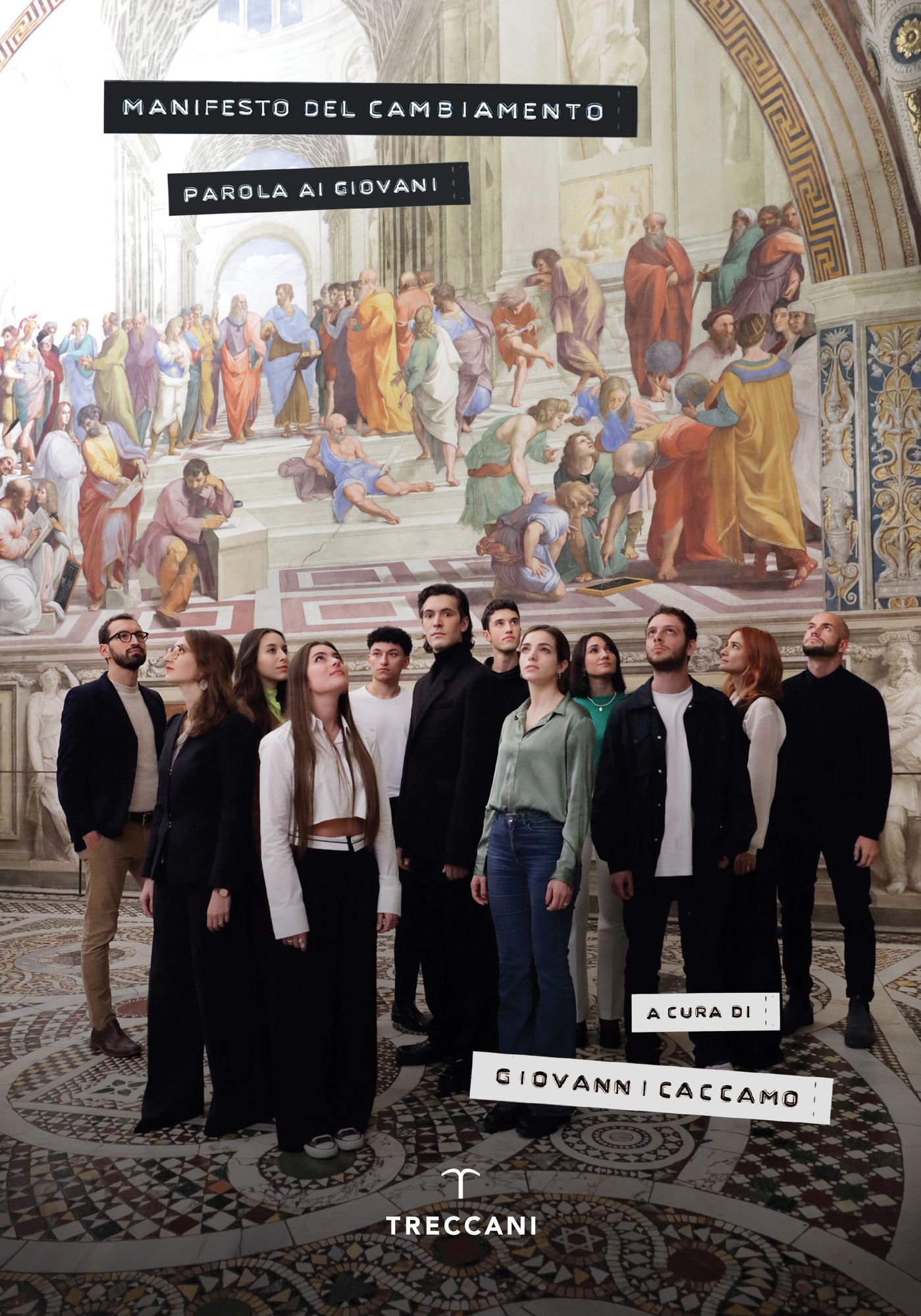
Sessanta giovani sognatori disegnano un futuro in evoluzione. La prima edizione italiana del Manifesto del Cambiamento, edito da Treccani, a cura di Giovanni Caccamo, è uscito il 12 maggio 2023. Il volume raccoglie i testi più significativi selezionati tra le centinaia di contributi raccolti in università, carceri e centri d’accoglienza in Italia, le opere dei maestri, le foto di l’Agorà del cambiamento nella Stanza della Segnatura nei Musei Vaticani e il testo del Manifesto redatto durante la performance.
Il 26 ottobre 2023, sotto l’egida della Senatrice a vita Liliana Segre, accolti dalla Vicepresidente del Senato Maria Domenica Castellone, il Manifesto del Cambiamento è stato affidato a tutti i gruppi parlamentari.
L’undici dicembre, in collaborazione con la Andrea Bocelli Foundation, il Manifesto del Cambiamento italiano è stato presentato alle Nazioni Unite, presso la sala ECOSOC Chamber durante l’evento Empowering Youth Through Music.
Il ricavato della vendita del Manifesto del Cambiamento è stato devoluto alla Andrea Bocelli Foundation – Ente Filantropico, a supporto della mission Empowering People and Communities.
Acquista il libro Manifesto del Cambiamento
Guarda il video della presentazione al Senato della Repubblica
Testi di: Agnese Di Lorenzo, Alan Cappelli Goetz, Alessandro De Rosa, Alice Pavarotti, Alice Zucca, Andrea Caschetto, Angelina Mango, Anna Caputo, Arianna Aurnia, Aurora Ruffino, Beatrice Canullo, Carlo Corallo, Daniele Magro, Daniele Pasquini, Davide Di Clemente, Davide Sabatino, Diego Gandolfo, Domenica Vitolo, Eduardo Tacconi, Federico Mecozzi, Flavia Carlini, Francesco Cafiso, Francesco Cicconetti, Frida Bollani Magoni, Giorgio Brizio, Jonathan Bazzi, Laura Rossi, Lorenzo Luporini, Luca Fol, Lucrezia Petti, Maddalena Morielli, Marco Anastasio, Marco Brugaletta, Marco Lodi, Marialaura Chinno, Mariangela De Luca, Mario Falanga, Marta Previato, Massimo Urban, Matteo Trapanese, Matteo Trapasso, Mattia Villardita, Michele D’Orazio, Nicola Vulpis, Noemi Solarino, Paola Egonu, Paolo Petrocelli, Pier Francesco Cordio, Rajae Bezzaz, Remon Karam, Roberto Lerda, Roberto Lipari, Silvia Parrino, Simone Corona, Simone Palazzolo, Sofia Croce, Teodoro Baù, Turi Benintende, Virginia Stagni.
Crediti
The book Manifesto del Cambiamento
12 May 2023
Sixty young dreamers envision an evolving future. The first Italian edition of the Manifesto del Cambiamento, published by Treccani and curated by Giovanni Caccamo, came out on 12 May 2023. This book is a collection of the most powerful texts selected from among hundreds gathered from universities, prisons, and migrant reception centres throughout Italy; artworks; photographs of the Agorà of Change in the Stanza della Segnatura in the Vatican Museums, as well as the Manifesto drawn up during the performance.
On 26 October 2023, under the aegis of Lifetime Senator Liliana Segre and received by the Vice-President of the Senate Maria Domenica Castellone, the Manifesto for Change was entrusted to all the parliamentary groups.
On 11 December, in collaboration with the Andrea Bocelli Foundation, the Italian edition of the Manifesto for Change was presented to the United Nations in the ECOSOC Chamber during the event Empowering Youth Through Music.
The proceeds from the sale of the Manifesto for Change have been donated to the Andrea Bocelli Foundation Philanthropic Organization to support the mission Empowering People and Communities.
Buy the book Manifesto del Cambiamento
Watch the video of the presentation to the Italian Senato della Repubblica
Texts by: Agnese Di Lorenzo, Alan Cappelli Goetz, Alessandro De Rosa, Alice Pavarotti, Alice Zucca, Andrea Caschetto, Angelina Mango, Anna Caputo, Arianna Aurnia, Aurora Ruffino, Beatrice Canullo, Carlo Corallo, Daniele Magro, Daniele Pasquini, Davide Di Clemente, Davide Sabatino, Diego Gandolfo, Domenica Vitolo, Eduardo Tacconi, Federico Mecozzi, Flavia Carlini, Francesco Cafiso, Francesco Cicconetti, Frida Bollani Magoni, Giorgio Brizio, Jonathan Bazzi, Laura Rossi, Lorenzo Luporini, Luca Fol, Lucrezia Petti, Maddalena Morielli, Marco Anastasio, Marco Brugaletta, Marco Lodi, Marialaura Chinno, Mariangela De Luca, Mario Falanga, Marta Previato, Massimo Urban, Matteo Trapanese, Matteo Trapasso, Mattia Villardita, Michele D’Orazio, Nicola Vulpis, Noemi Solarino, Paola Egonu, Paolo Petrocelli, Pier Francesco Cordio, Rajae Bezzaz, Remon Karam, Roberto Lerda, Roberto Lipari, Silvia Parrino, Simone Corona, Simone Palazzolo, Sofia Croce, Teodoro Baù, Turi Benintende, Virginia Stagni.
Credits
Il progetto internazionale Youth and Future
7 aprile 2024
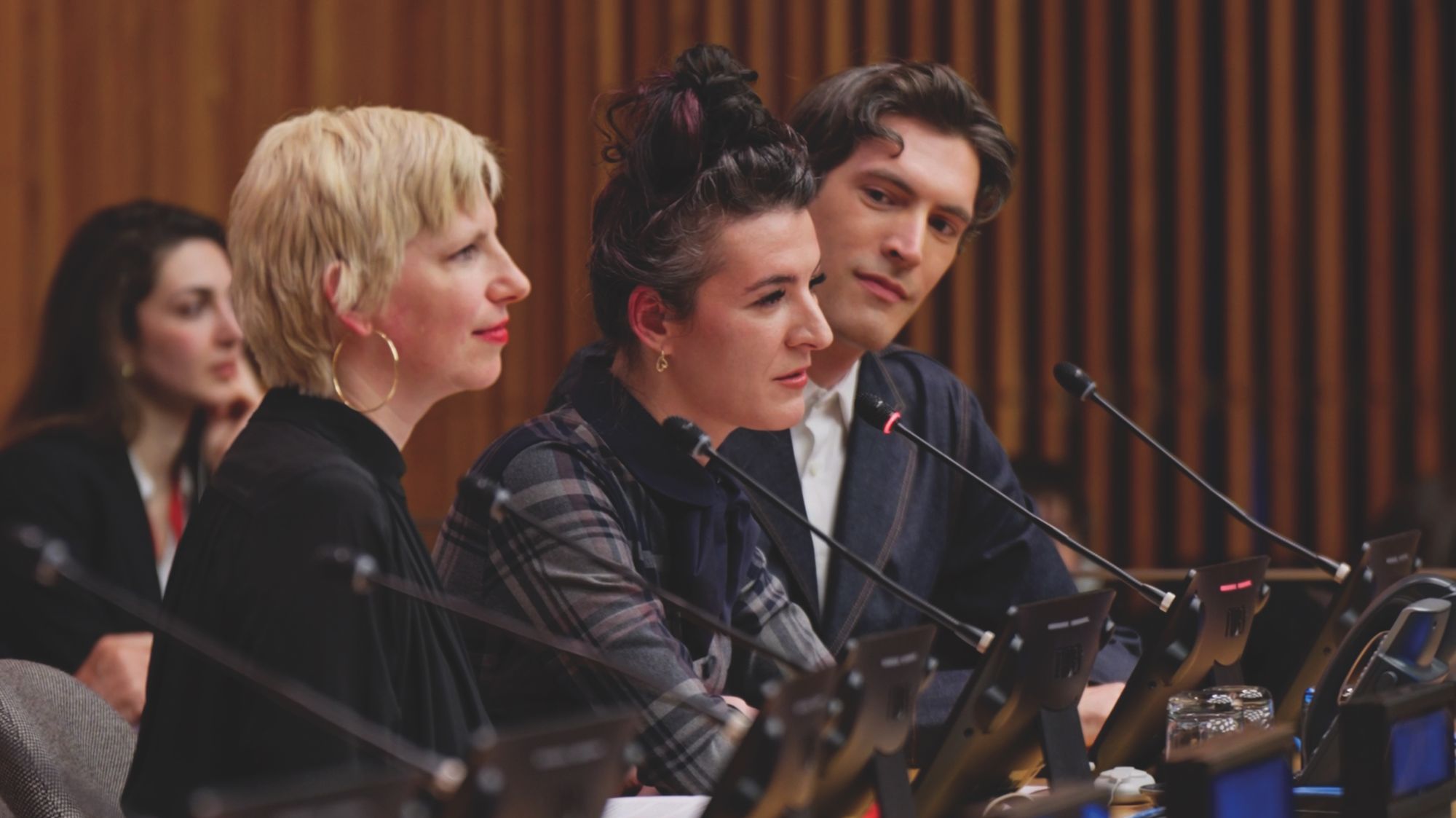
Dopo l’uscita del volume italiano Manifesto del Cambiamento, il 7 Aprile 2024 a New York, in occasione del forum internazionale dei giovani Change the World Model UN (CWMUN) presso la sala ECOSOC Chamber delle Nazioni Unite, Giovanni Caccamo insieme a Jesse Paris Smith, Antonio Spadaro, Rebecca Foon e una speciale video performance di Patti Smith, hanno lanciato Youth and Future, la riproposizione internazionale del progetto Parola ai giovani. In quest’occasione il concorso di idee è stato aperto a ragazze e ragazzi da ogni parte del mondo, di ogni religione, identità di genere ed estrazione sociale.
Nei mesi successivi Giovanni Caccamo ha tenuto simposi e tavole rotonde in alcuni tra i più prestigiosi Atenei del mondo che hanno aderito all’iniziativa: Yale University, Harvard University, Berklee College of Music, Wellesley College negli Stati Uniti; UNAM in Messico, UANIL e Universidade de São Paulo in Brasile, Tokyo University of Foreign Studies, raccogliendo oltre 3.000 testi in 6 lingue diverse.
The international project Youth and Future
7 April 2024
After the publication of the Italian edition of Manifesto del Cambiamento, on April 7, 2024 in New York, for the international youth forum Change the World Model UN (CWMUN) in the ECOSOC Chamber of the United Nations, Giovanni Caccamo, along with Jesse Paris Smith, Antonio Spadaro, Rebecca Foon, and including a special video performance by Patti Smith, launched Youth and Future, the international edition of the project Parola ai giovani. On this occasion, Giovanni’s contest of ideas was extended to young people from all over the world, of any religion, gender identity, and social background.
In the following months, Giovanni held symposiums and roundtable discussions in some of the most prestigious colleges and universities worldwide taking part in the initiative: Yale University, Harvard University, Berklee College of Music, Wellesley College in the USA; UNAM in Mexico; UANIL and Universidade de São Paulo in Brazil; and Tokyo University of Foreign Studies, collecting over 3,000 texts in six different languages.
Watch the video appeal from Youth and Future
Watch the video of the project’s launch at the United Nations
Il libro Manifesto for Change
21 marzo 2025
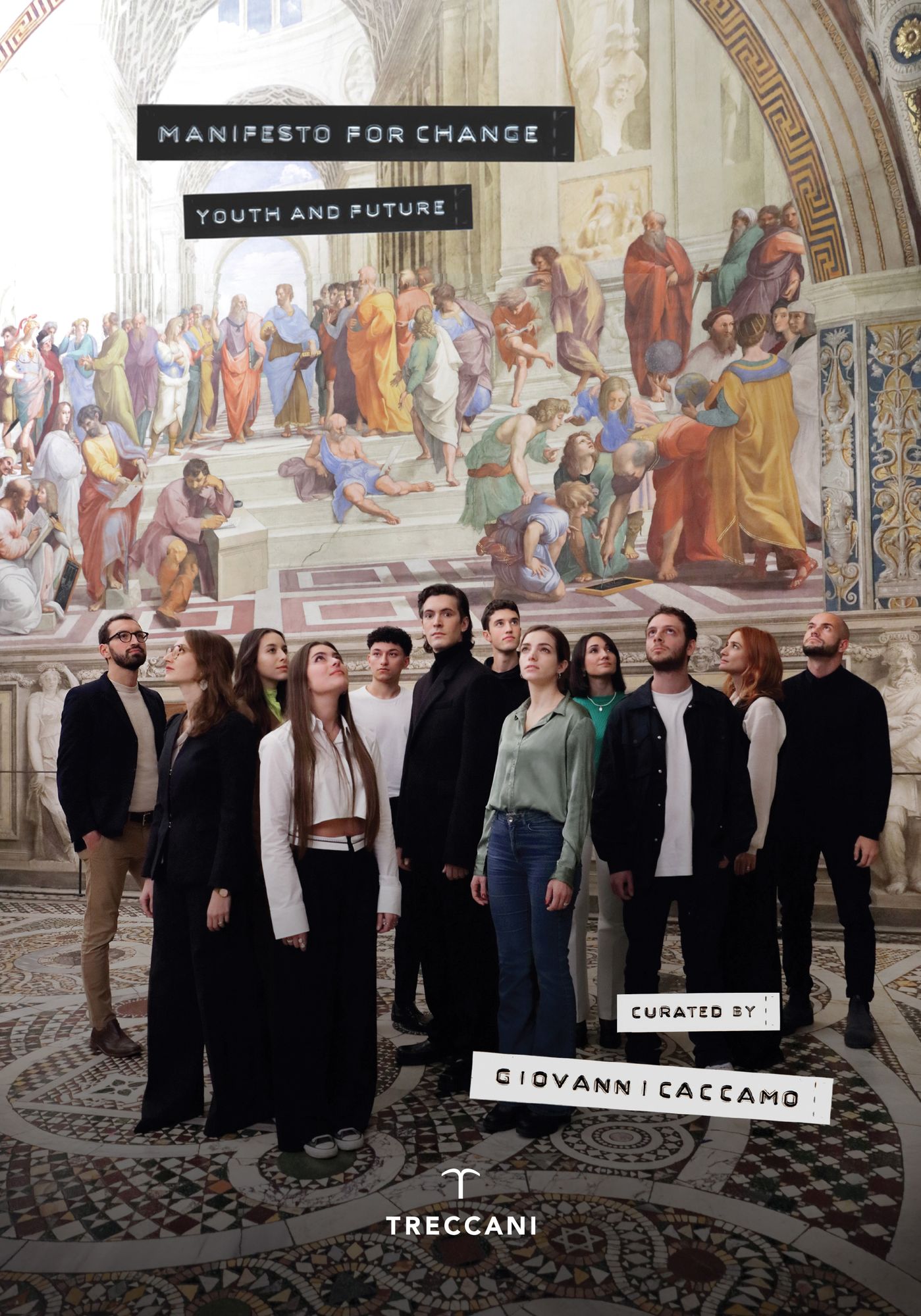
Il 21 marzo 2025 è stato pubblicato da Treccani Manifesto for Change, riedizione internazionale in lingua inglese del libro Manifesto del Cambiamento, con i settanta testi più emozionanti, selezionati tra quelli ricevuti.
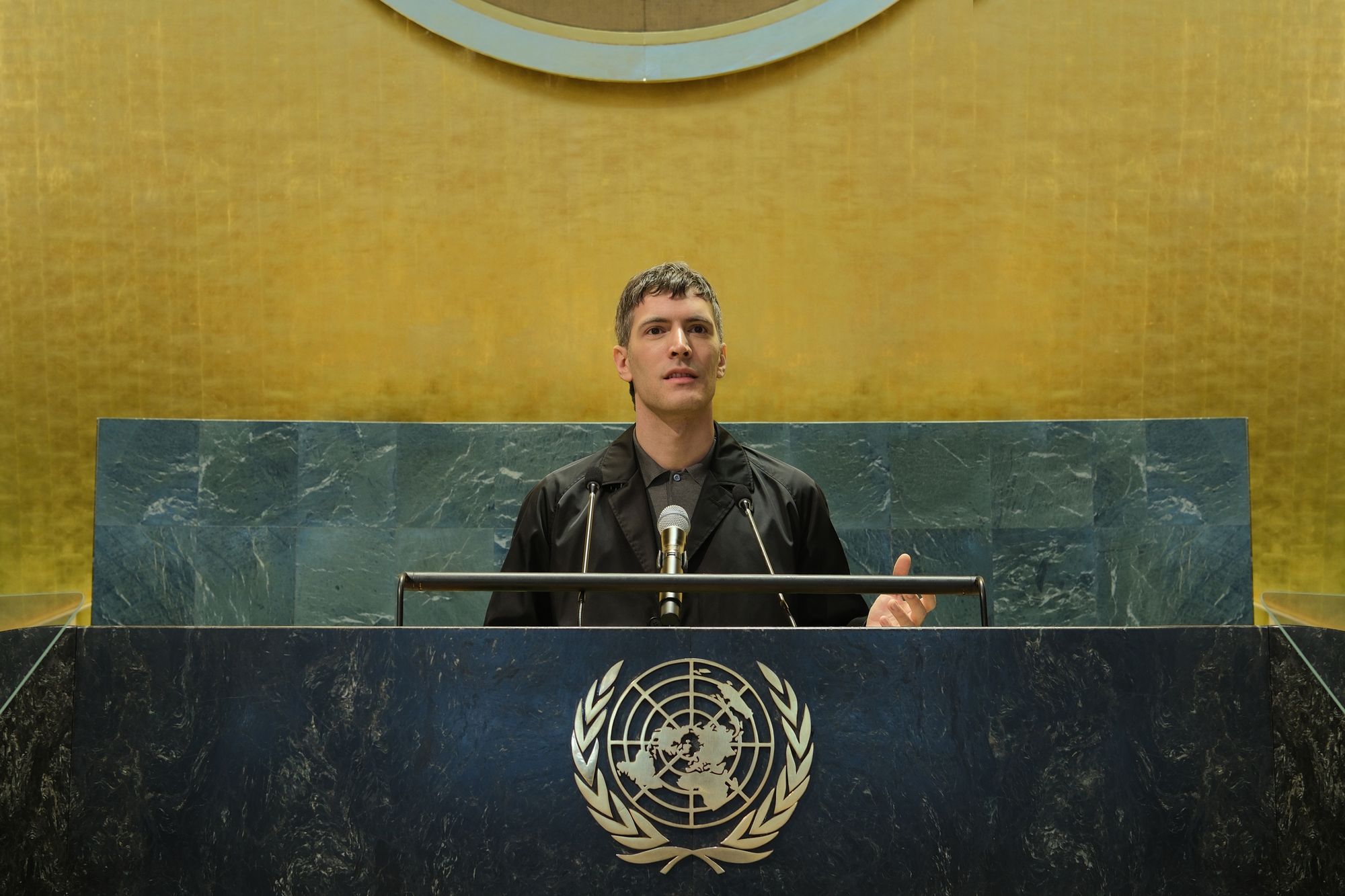
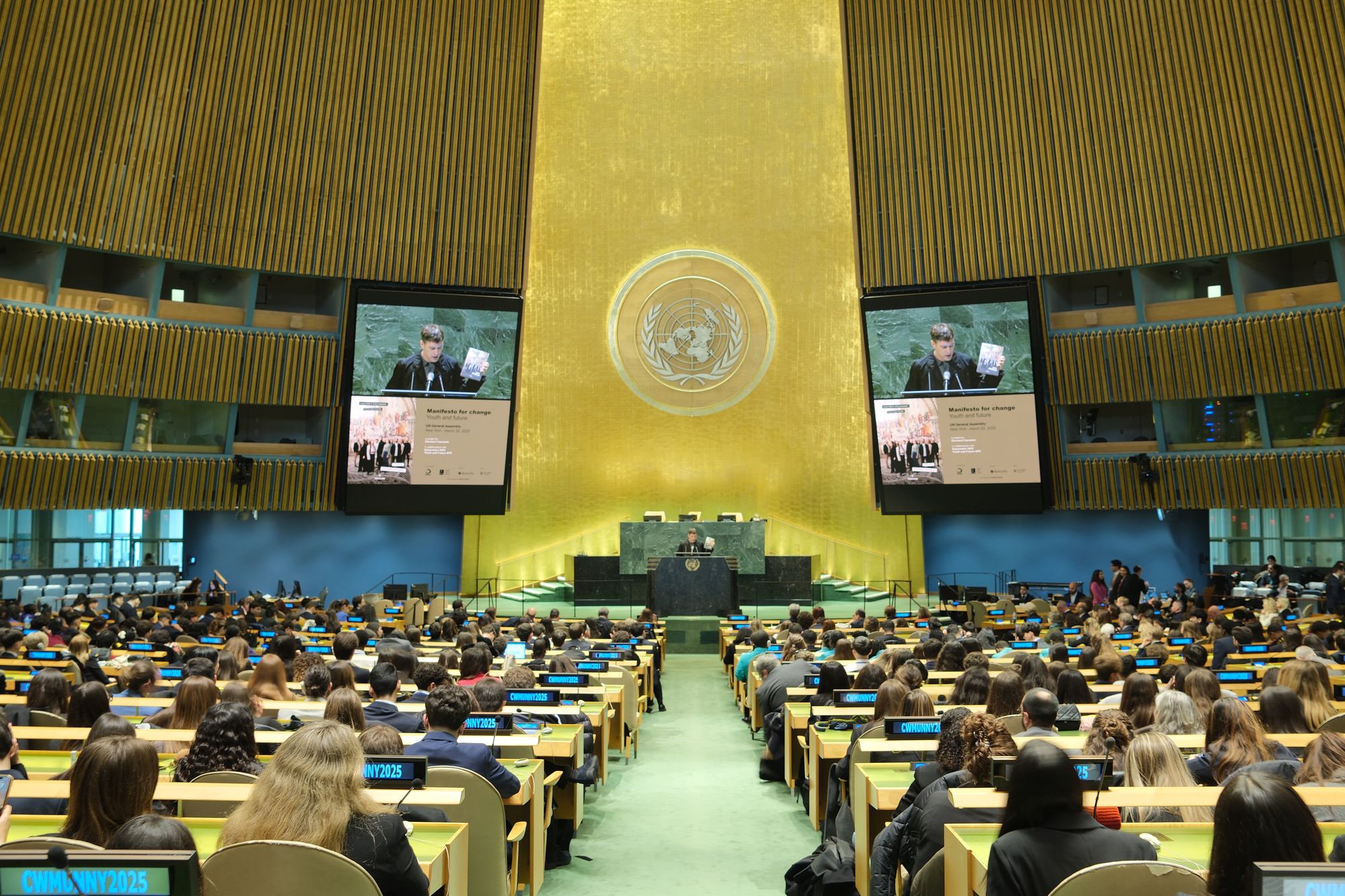
Il 20 marzo 2025, in collaborazione con Diplomatici ONG, il Manifesto for Change è stato presentato presso la General Assembly delle Nazioni Unite, in occasione del Change the World Model UN (CWMUN). Ad accoglierlo, oltre 5.000 giovani da più di centoquaranta paesi.
Il ricavato della vendita del Manifesto for Change è devoluto all’Associazione Youth and Future - Parola ai Giovani APS, a supporto di borse di studio per giovani in difficoltà e progetti culturali volti alla formazione, all’orientamento e alla valorizzazione dei giovani nella realizzazione dei loro sogni.
Acquista il libro Manifesto for Change
Crediti
in collaborazione con Diplomatici ONG (www.diplomatici.it)
The book Manifesto for Change
21 March 2025
On 21 March 2025, Treccani published Manifesto for Change, the new international English-language edition of the Italian book Manifesto del Cambiamento, featuring a selection of seventy of its most powerful and thought-provoking texts.
On 20 March 2025, in collaboration with Associazione Diplomatici, Manifesto for Change was presented at the United Nations General Assembly during the Change the World Model UN (CWMUN), to an audience of more than 5,000 young people from over one-hundred-forty countries.
The proceeds from the sale of Manifesto for Change are being donated to Associazione Youth and Future - Parola ai Giovani APS to fund scholarships for disadvantaged young people, as well as cultural projects dedicated to supporting, guiding and empowering young people as they pursue their aspirations and fulfil their dreams.
Buy the book Manifesto for Change
In collaboration with Associazione Diplomatici (www.diplomatici.it)
Le opere del progetto internazionale
La partecipazione degli artisti della comunità internazionale dell’arte a supporto del Bosco del Cambiamento e Arte x la Riforestazione
2025/2026
Nel giugno del 2025, dopo l’incontro tra Giovanni Caccamo e Mario Cristiani, si apre un’intensa collaborazione tra Youth and Future e Associazione Arte Continua e si procede a sviluppare – grazie al lavoro svolto nel tempo da quest’ultima e al contributo di Eduardo Cycelin – un coinvolgimento sistematico degli artisti della comunità internazionale dell’arte. Così come accaduto nella prima parte del progetto italiano e in condivisone con Mario Cristiani, sono state date agli artisti varie possibilità di intervento sui nuovi testi raccolti. Gli artisti hanno deciso di contribuire liberamente sui testi selezionati.
Queste opere, unitamente alle prime e a tutti gli ulteriori capitoli del progetto, vengono esposte per la prima volta alla Sala delle Cariatidi di Palazzo Reale a Milano dal 17 ottobre al 1° novembre 2026.
Il ricavato della vendita delle nuove opere su carta sosterrà le attività di Youth and Future - Parola ai Giovani APS, Associazione Arte Continua e Fondazione Sylva per la realizzazione di alcuni Boschi del Cambiamento e Arte x la Riforestazione, che uniranno natura, arte contemporanea della comunità internazionale dell’arte, le parole e i pensieri dei giovani.
The artworks of the international project
The participation of artists from the international art community in support of Forest for Change and Art for Reforestation.
2025/2026
In June 2025, after a meeting between Giovanni Caccamo and Mario Cristiani, Youth and Future and Associazione Arte Continua began working intensely together to develop – thanks to the work carried out by Associazione Arte Continua over time and the contribution of Eduardo Cycelin – the systematic involvement of artists from the international art community. As in the first phase of the Italian project and in collaboration with Mario Cristiani, the artists were given various opportunities to engage with the new texts. The artists decided to freely contribute to the selected texts.
These artworks, along with all the other artworks of the project, will be displayed for the very first time in the Hall of the Caryatids inside the Royal Palace of Milan from October 17 to November 1, 2026.
The proceeds from the sale of the new artworks on paper will go to support the activities of Youth and Future - Parola ai Giovani APS, Associazione Arte Continua, and Fondazione Sylva to create Forests for Change and Art for Reforestation, bringing together nature, contemporary art from the international art community, and the words and thoughts of today’s youth.
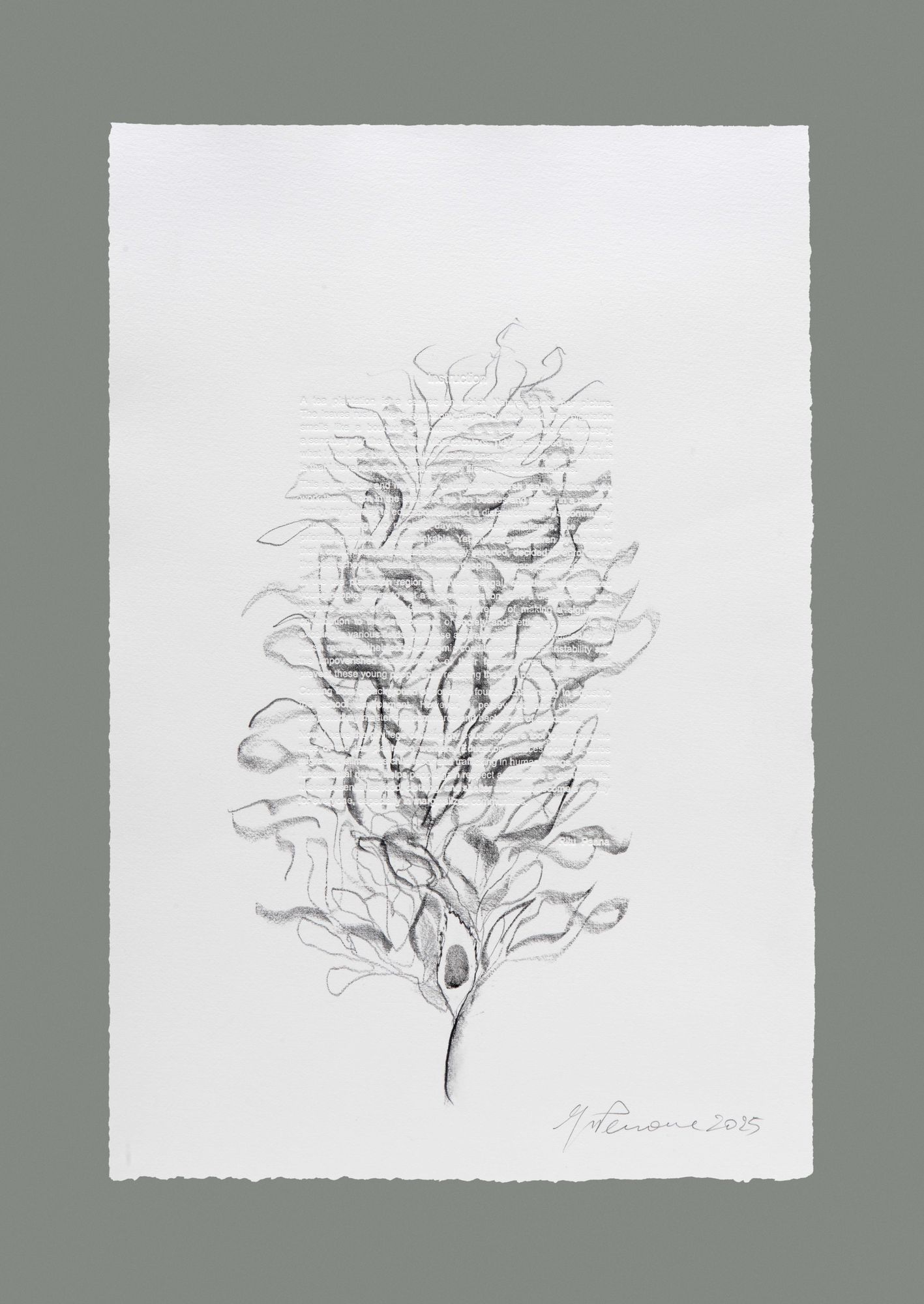
Giuseppe PenoneYouth and Future, 2025inchiostro tipografico e grafite su carta cotone / printing ink and graphite on cotton paper40 x 60 cmTesto “Education” di Ritu Panna / Text “Education” by Ritu Panna 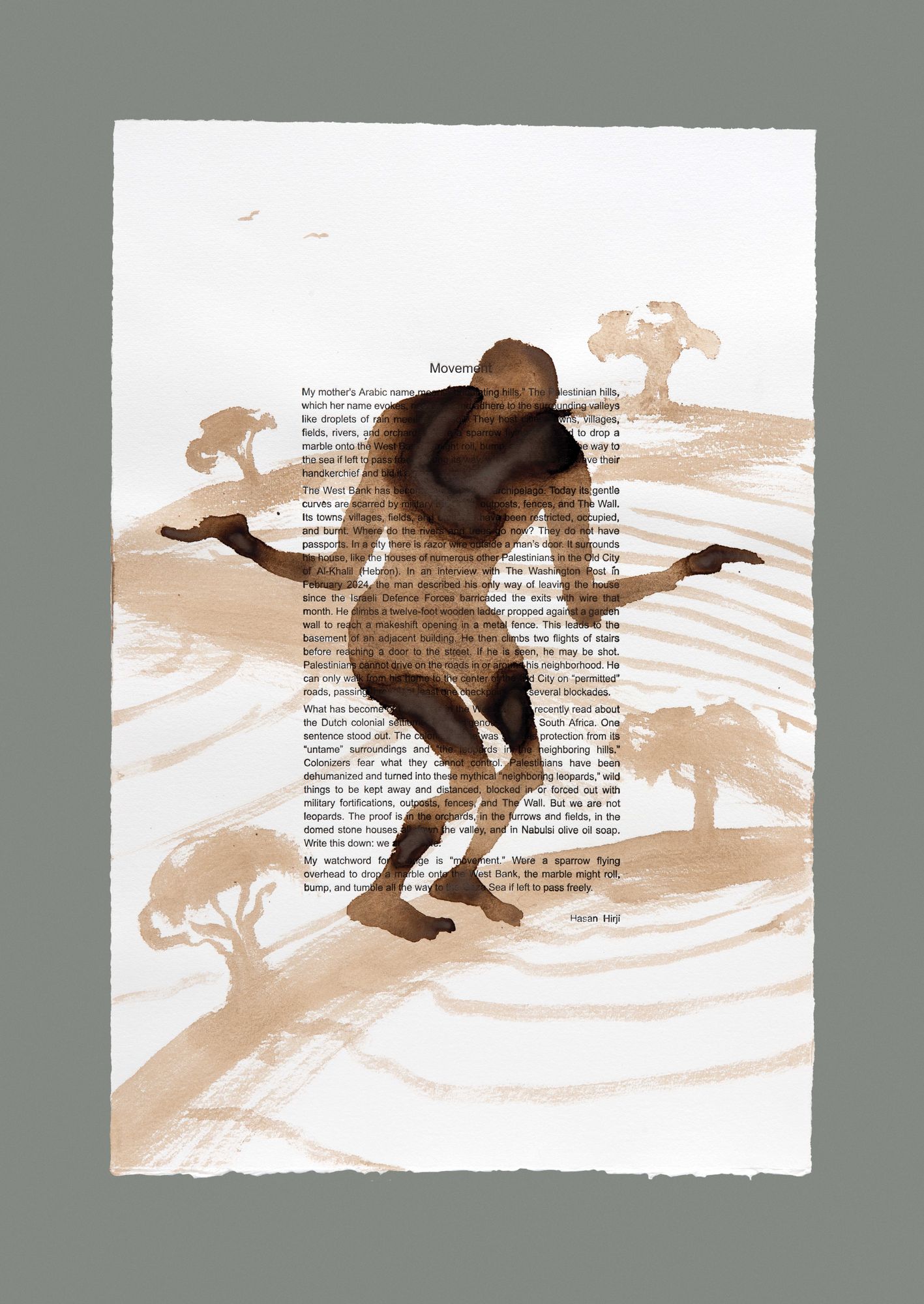
Antony GormleyMovement, 2026Walnut ink su carta cotone / walnut ink on cotton paper40 x 60 cmTesto di Hasan Hirji / Text by Hasan Hirji 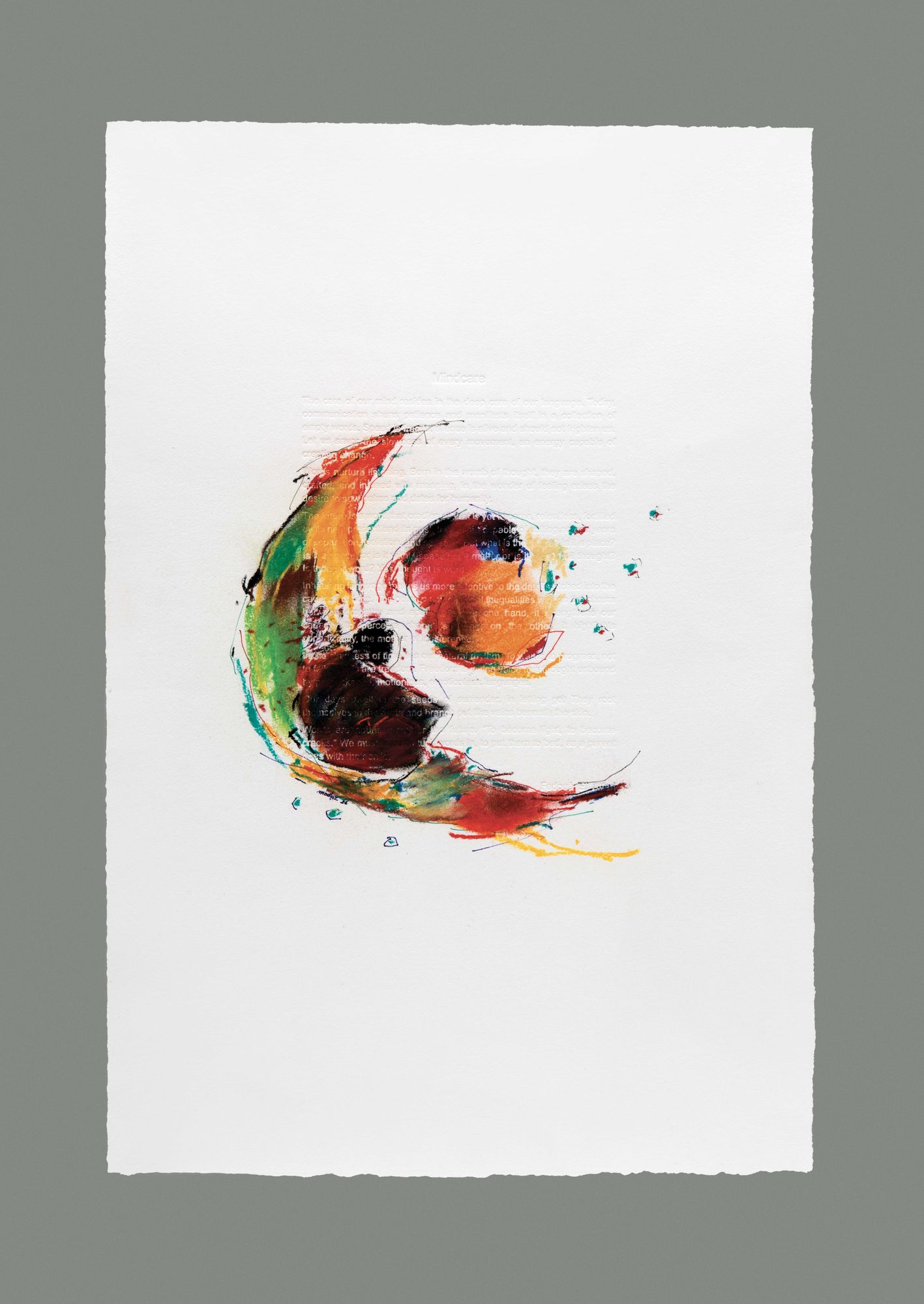
Moataz NasrMindcare, 2026pastelli su carta cotone / pastels on cotton paper40 x 60 cmTesto di Feduà El Attari / Text by Feduà El Attari 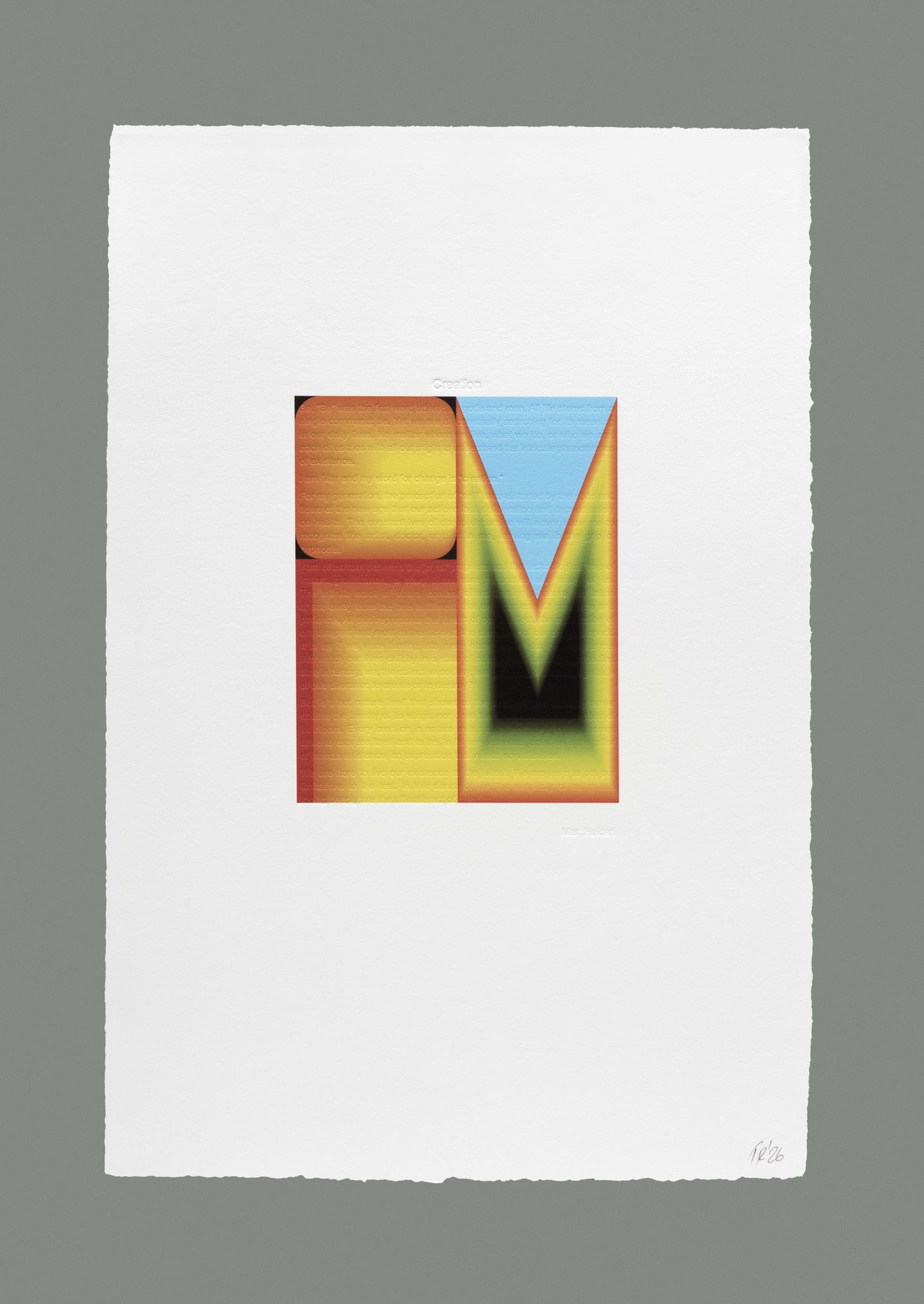
Tobias RehbergerCreation, 2026stampa digitale su carta cotone / digital print on cotton paper40 x 60 cmTesto di Mar Heidari / Text by Mar Heidari 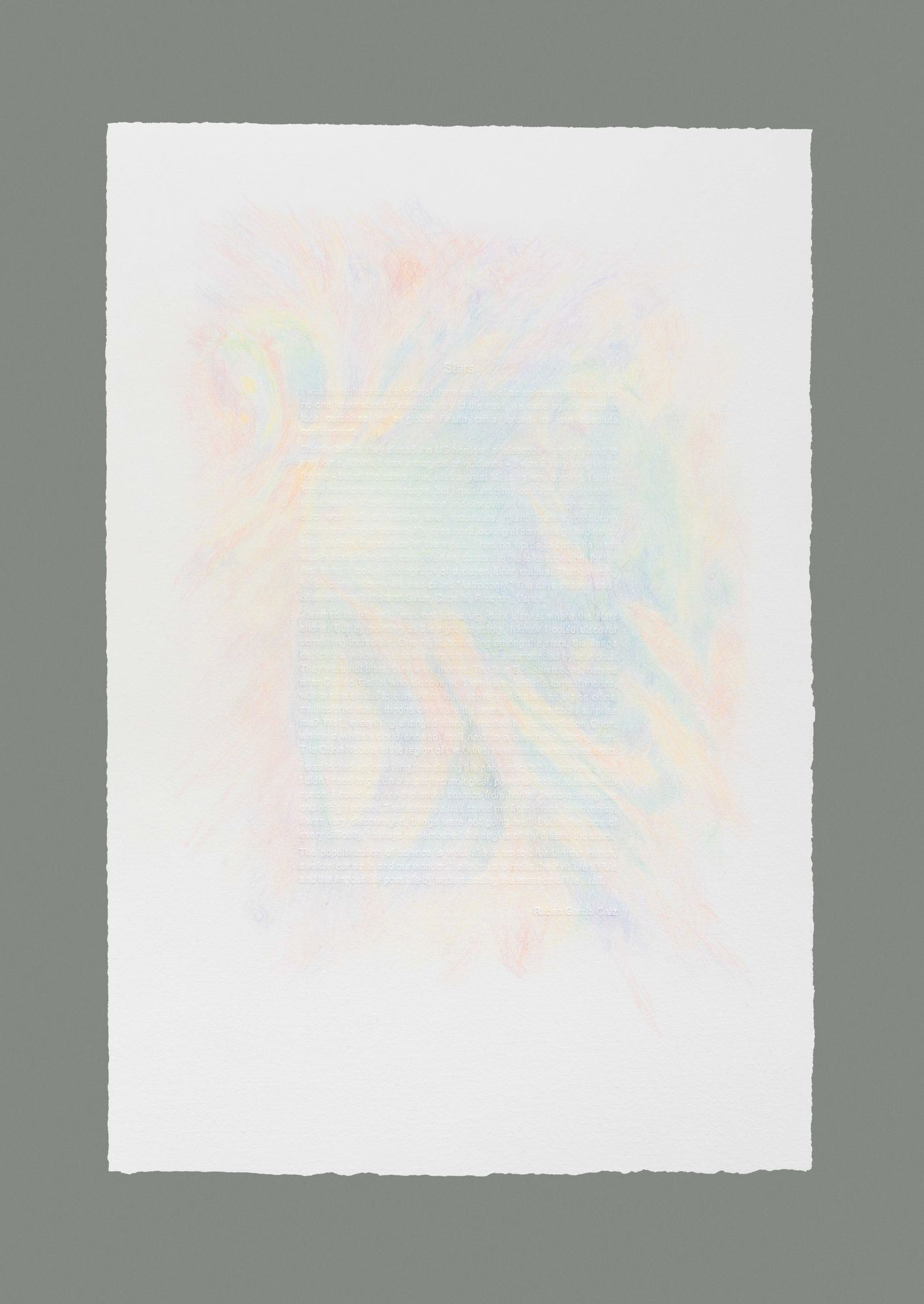
Kiki SmithStars, 2026hand colored with Faber-Castell pencil / hand coloured with Faber-Castell pencil40 x 60 cmTesto di Ruben Garcia Cruz / Text by Ruben Garcia Cruz 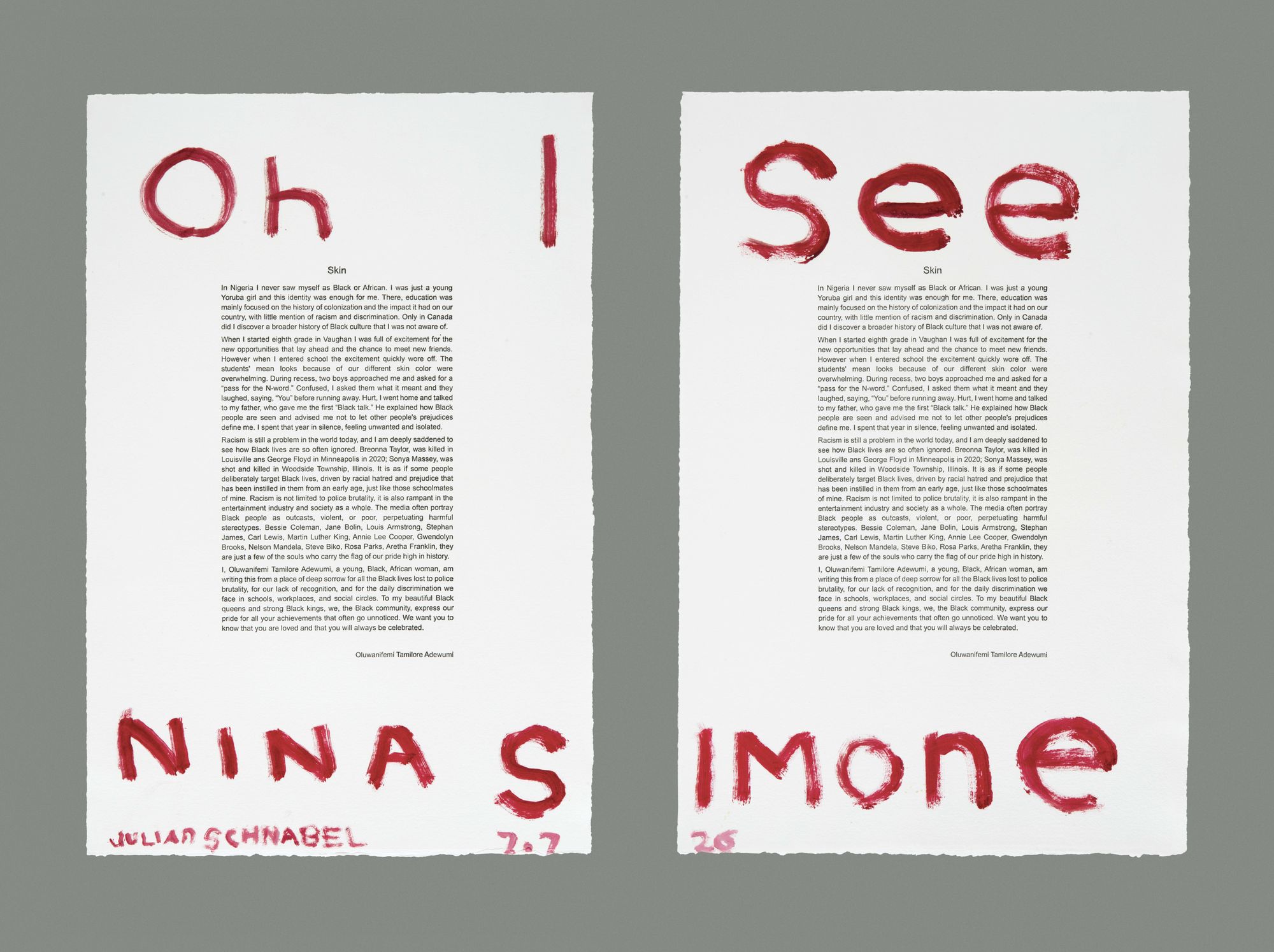
Julian SchnabelSkin, 2026tempera su carta cotone / tempera on cotton paperdue fogli di 40 x 60 cm / two sheets, 40 x 60 cmTesto di Oluwanifemi Tamilore Adewumi / Text by Oluwanifemi Tamilore Adewumi 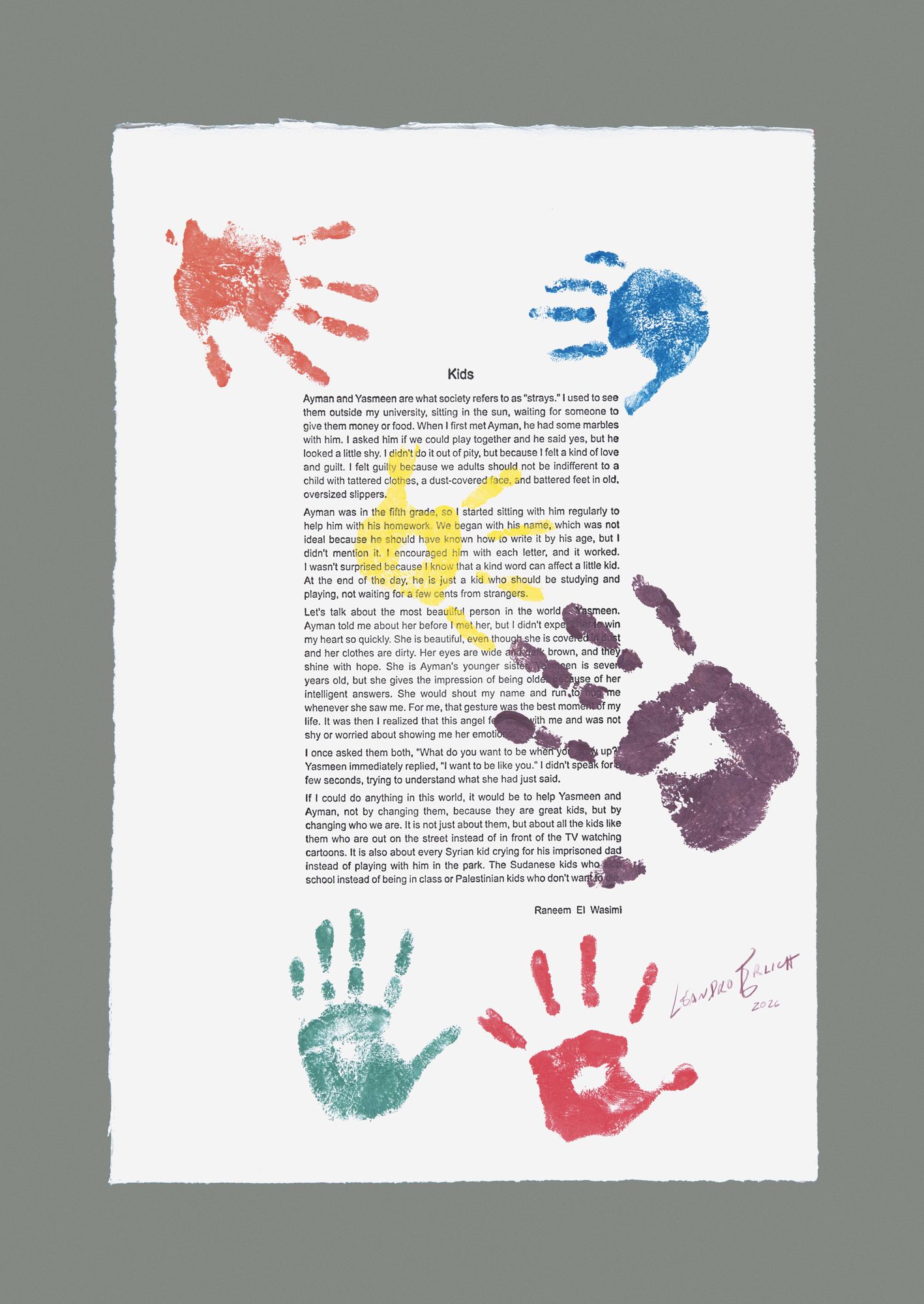
Leandro ErlichKids, 2026acrilico su carta cotone / acrylic on cotton paper40 x 60 cmTesto di Raneem El Wasimi / Text by Raneem El Wasimi 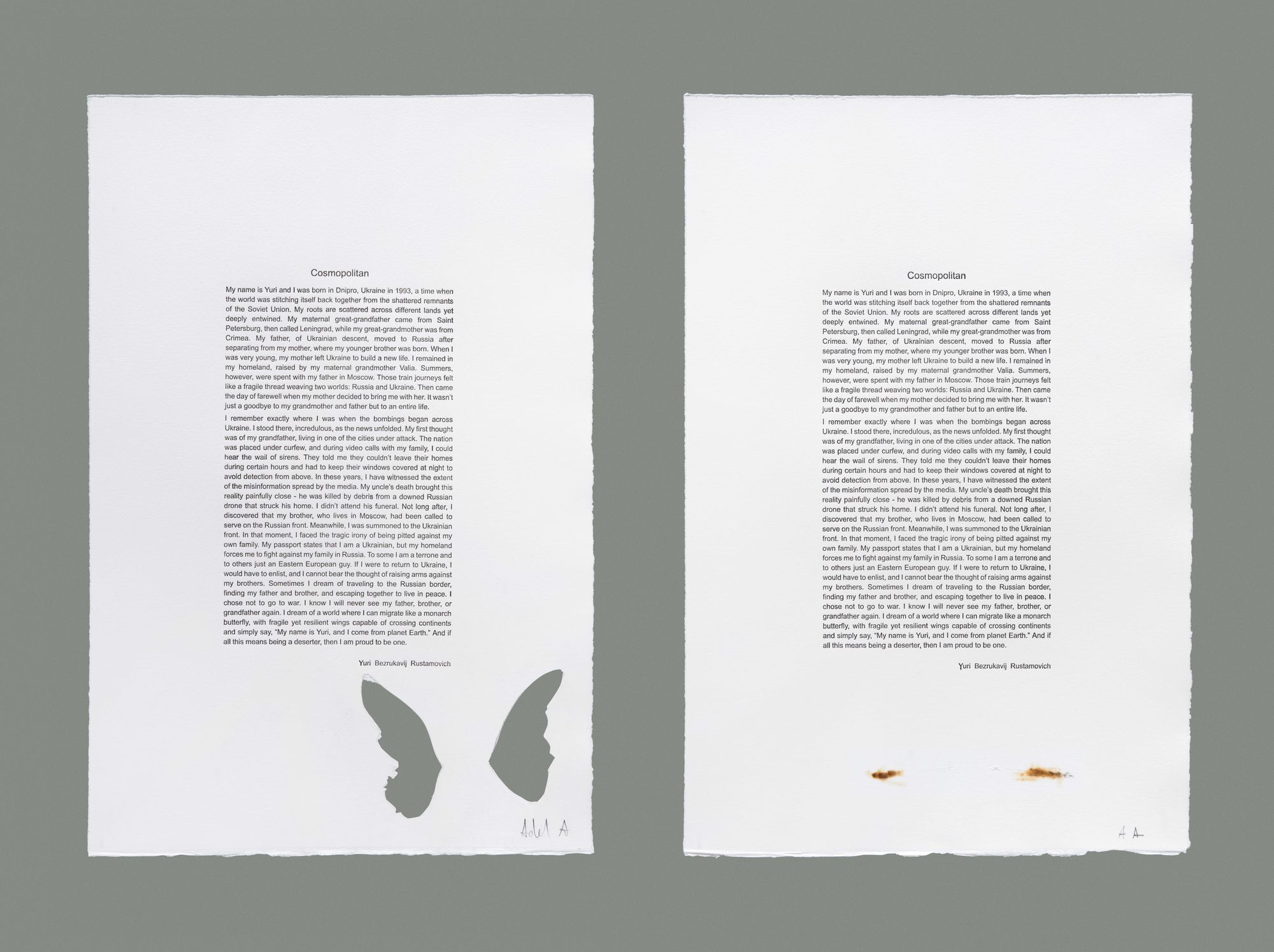
Adel AbdessemedCosmopolitan, 2026tecnica mista su carta cotone / mixed media on cotton paperdue fogli di 40 x 60 cm / two sheets, 40 x 60 cmTesto di Yuri Bezrukavij Rustamovich / Text by Yuri Bezrukavij Rustamovich 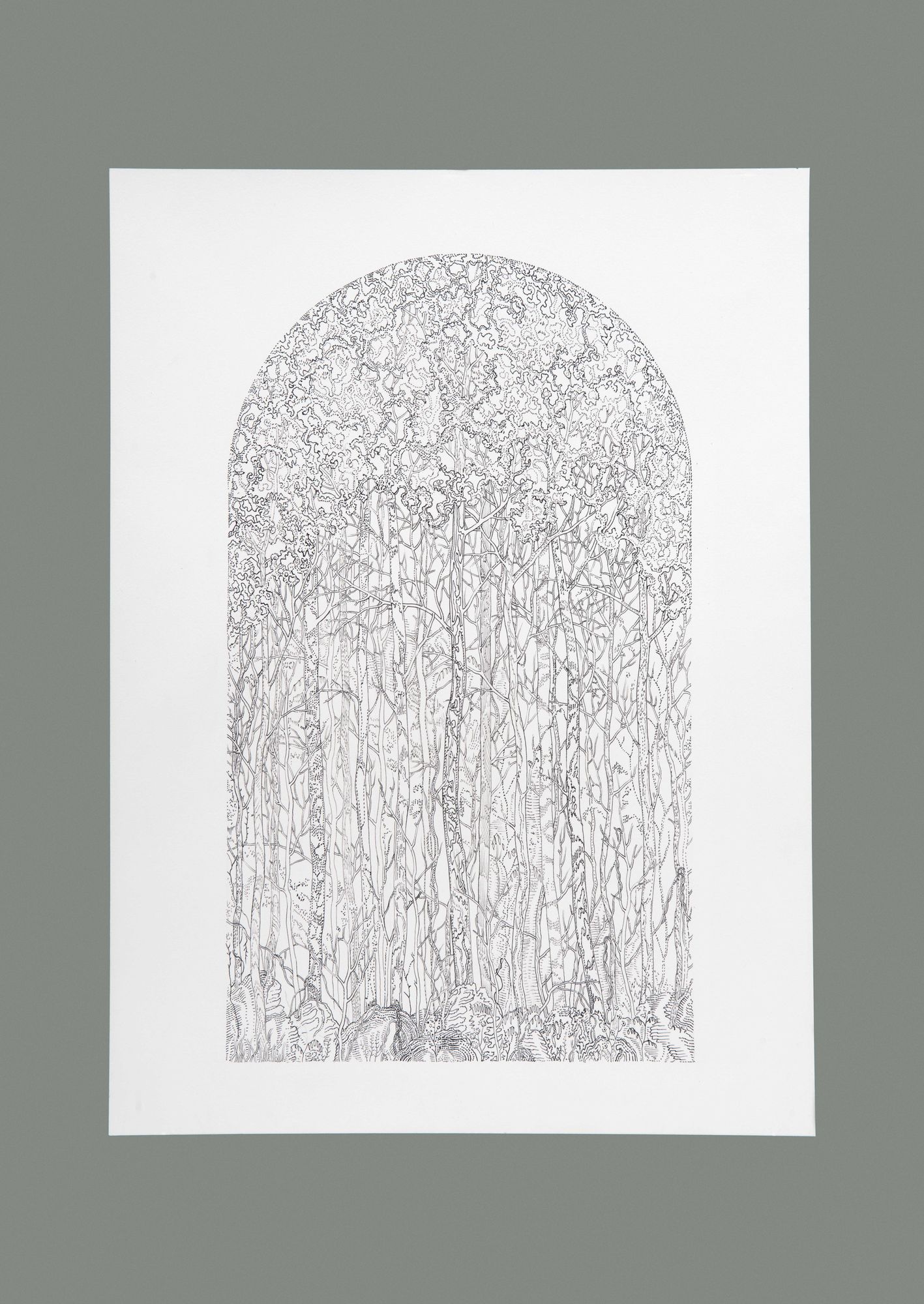
Eva JospinCanopée, 2025inchiostro su carta cotone / ink on cotton paper31 x 41 cmTesto “War” di Valeriia / Text “War” by Valeriia 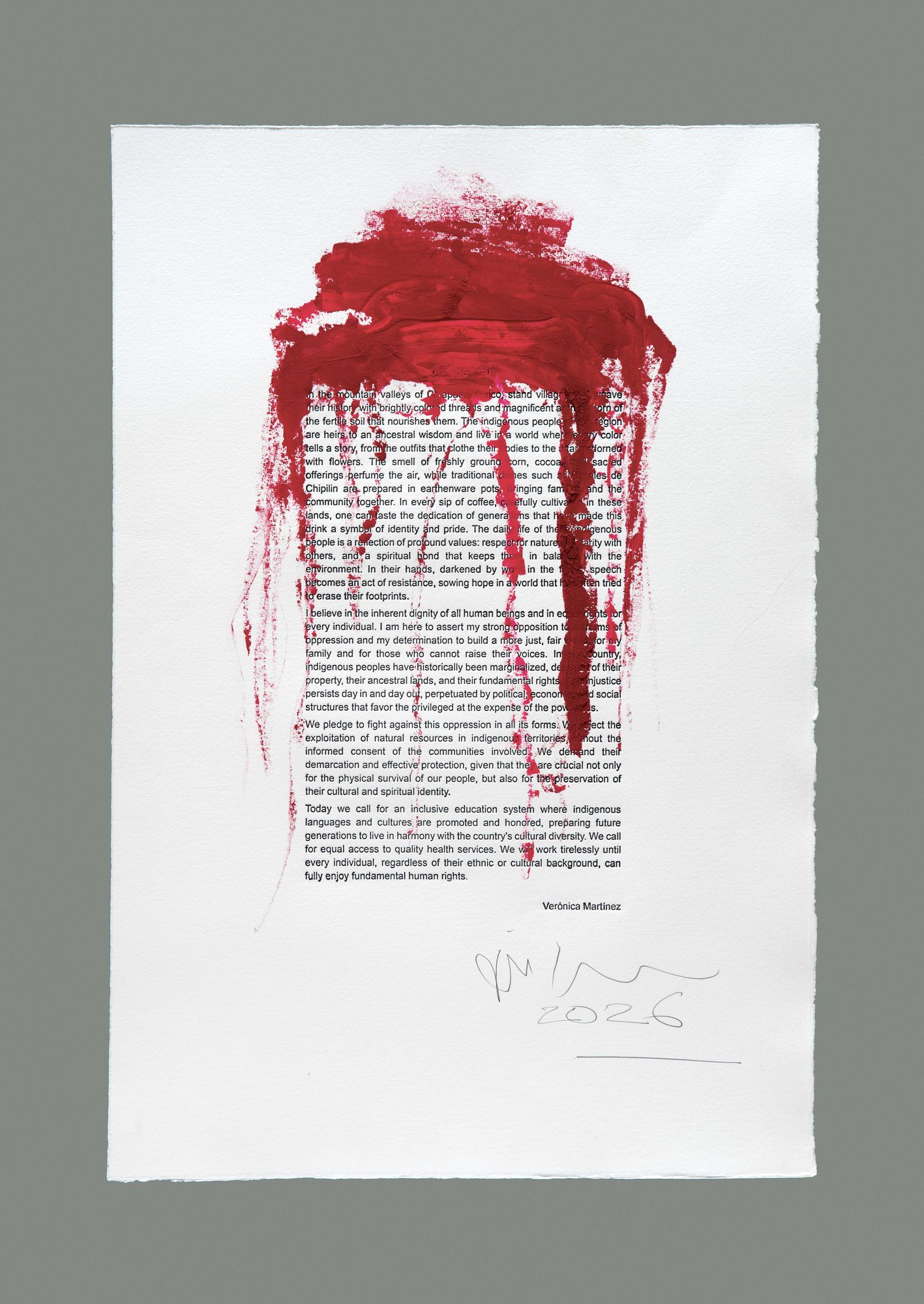
Anish KapoorIndigenous, 2026olio su carta cotone / oil on cotton paper40 x 60 cmTesto di Verónica Martínez / Text by Verónica Martínez 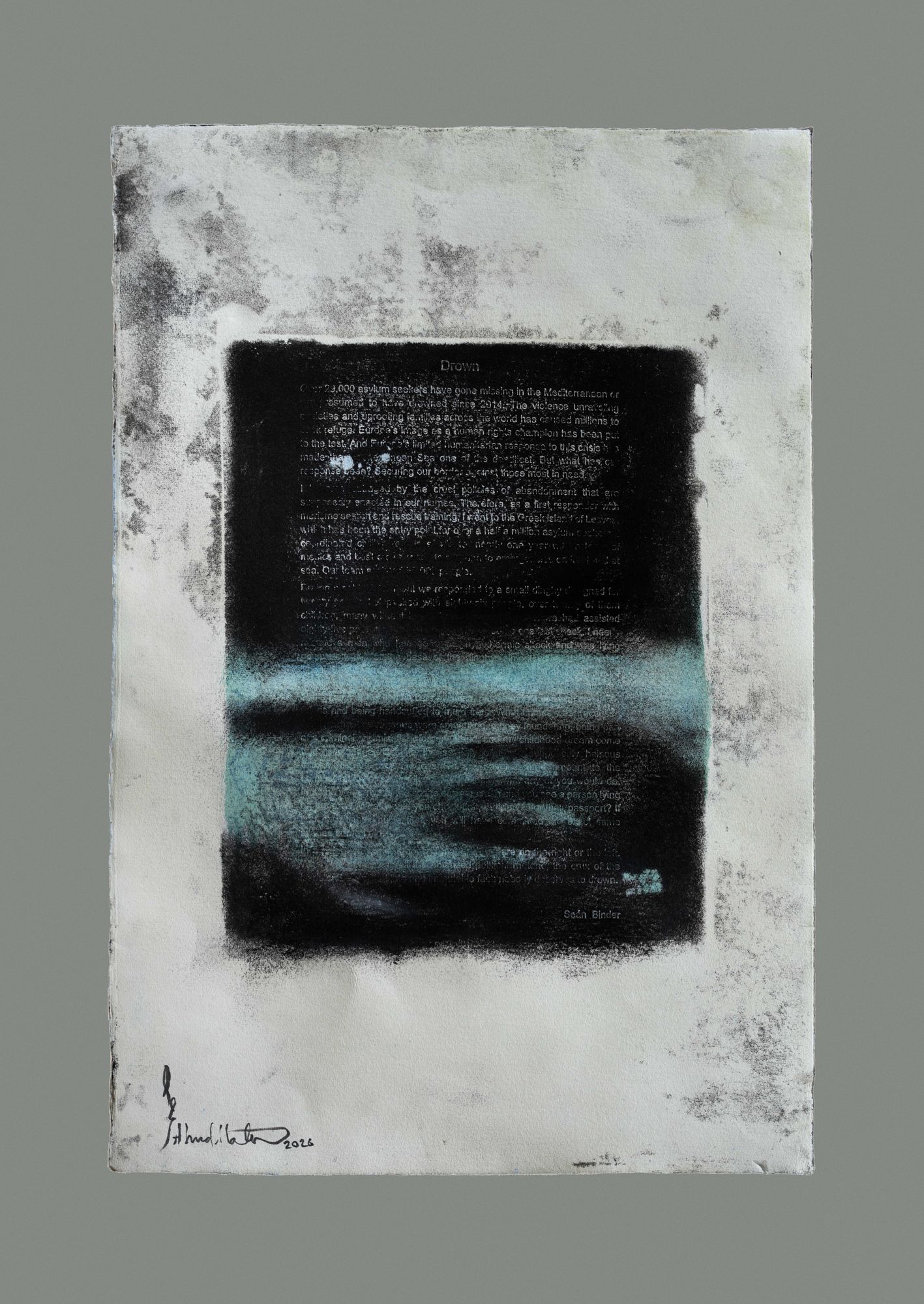
Ahmed MaterDrown, 2026tecnica mista su carta cotone / mixed media on cotton paper40 x 60 cmTesto “Irishness” di Sean Binder / Text “Irishness” by Sean Binder La performance The Ark of Change
2-20 marzo 2026
Giovani coinvolti: Plestia Alaqad (Palestina); Sean Binder (Irlanda); Francesco Cicconetti (Italia); Federico Gambedotti (Italia, Eritrea); Drukmo Gyal (Tibet, Cina); Andrew Johnson Raphael (Malawi); Ayumi Kuramae Izioka (Brasile, Giappone, Paesi Bassi); Manisha Maharjan (Nepal, Newar); Chris Mansa Laporte (Francia, Haiti).
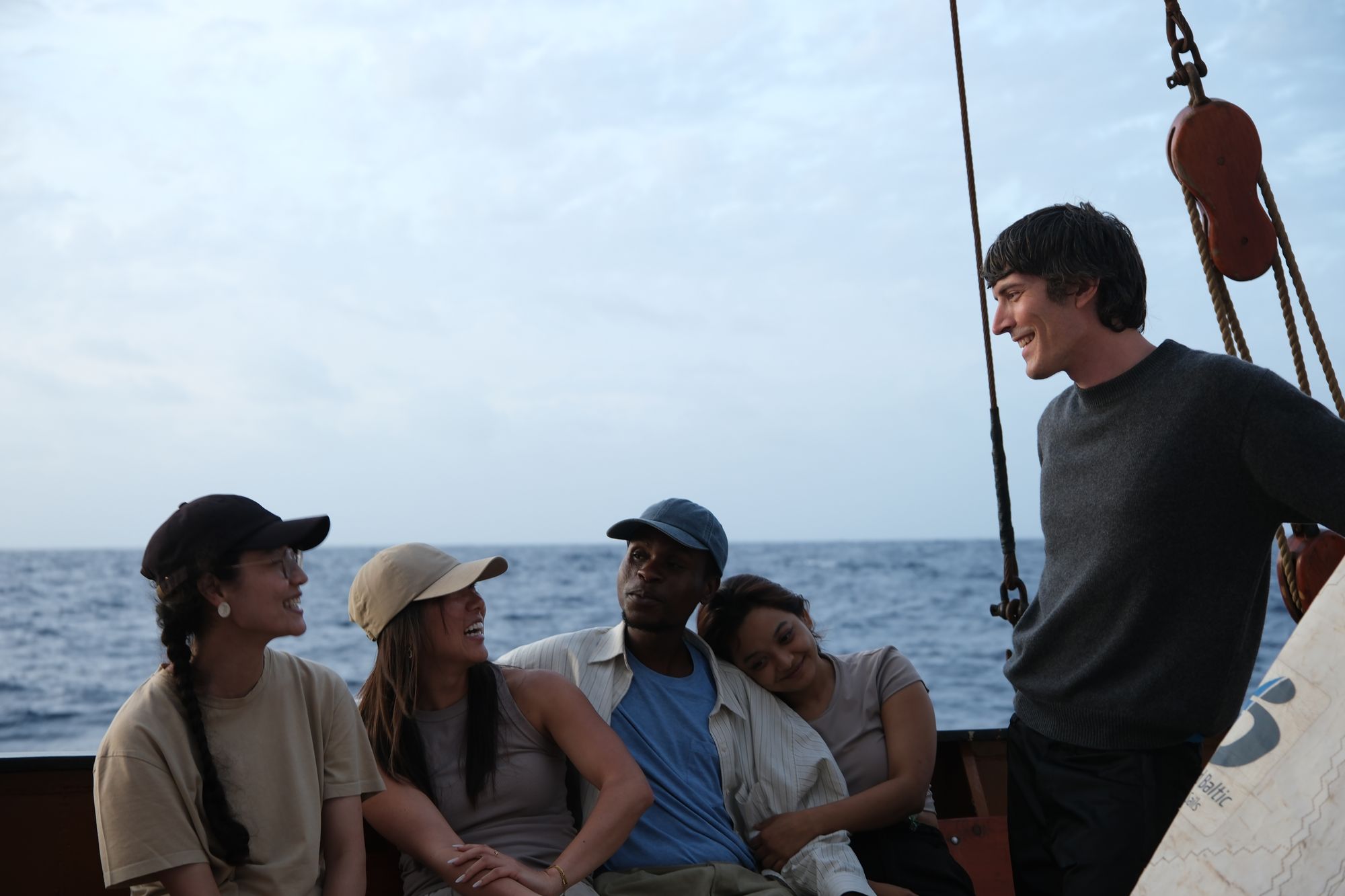
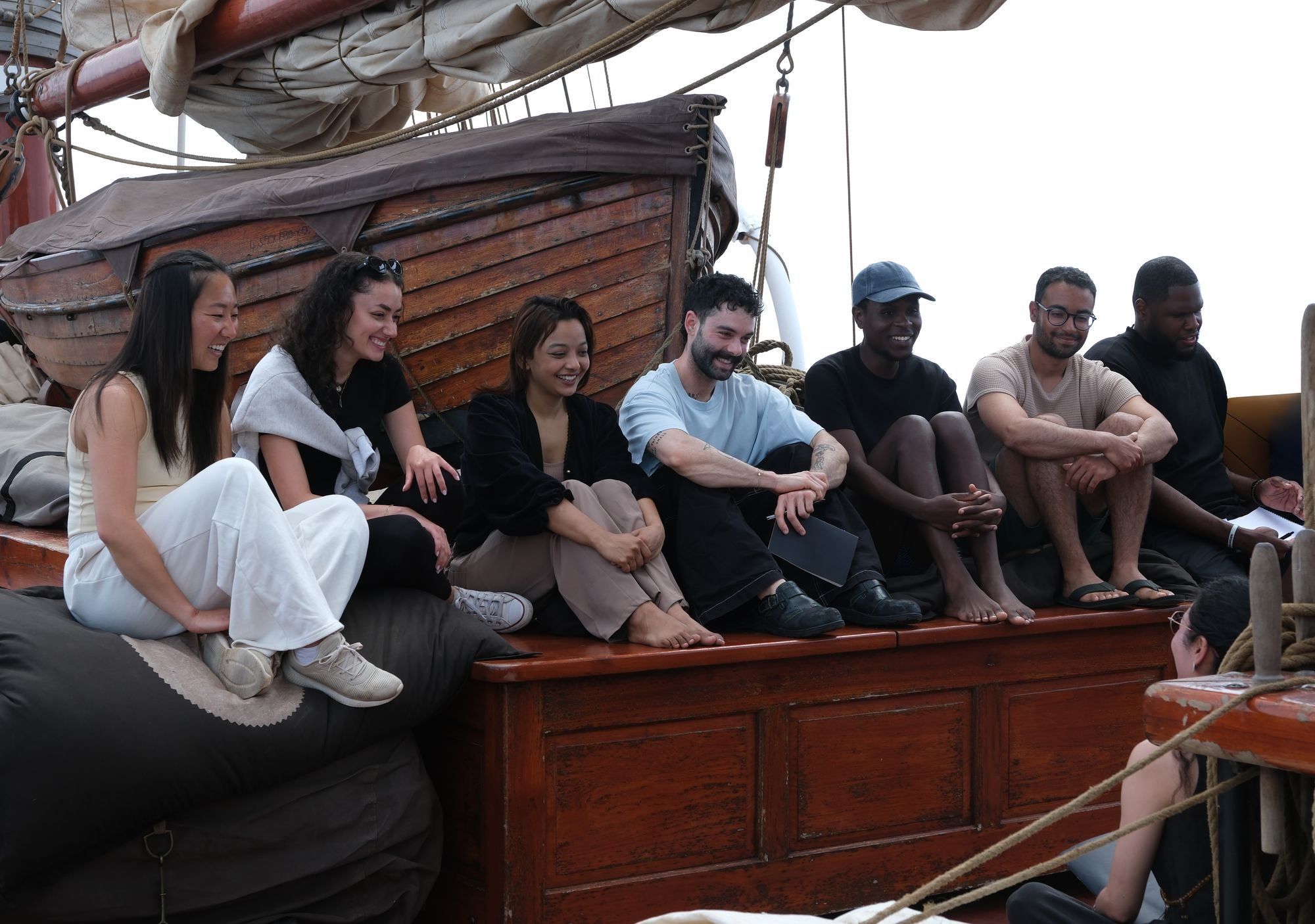
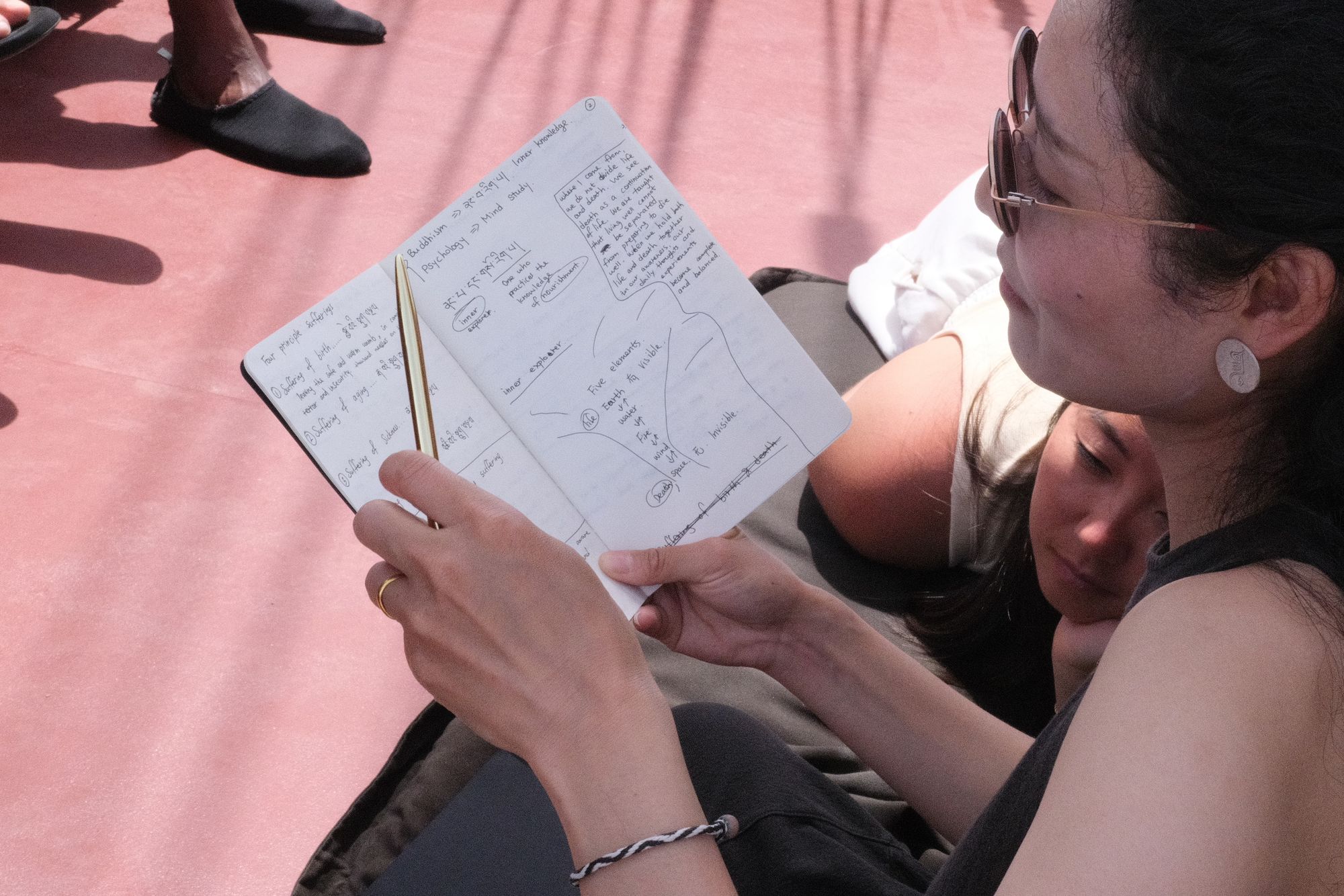
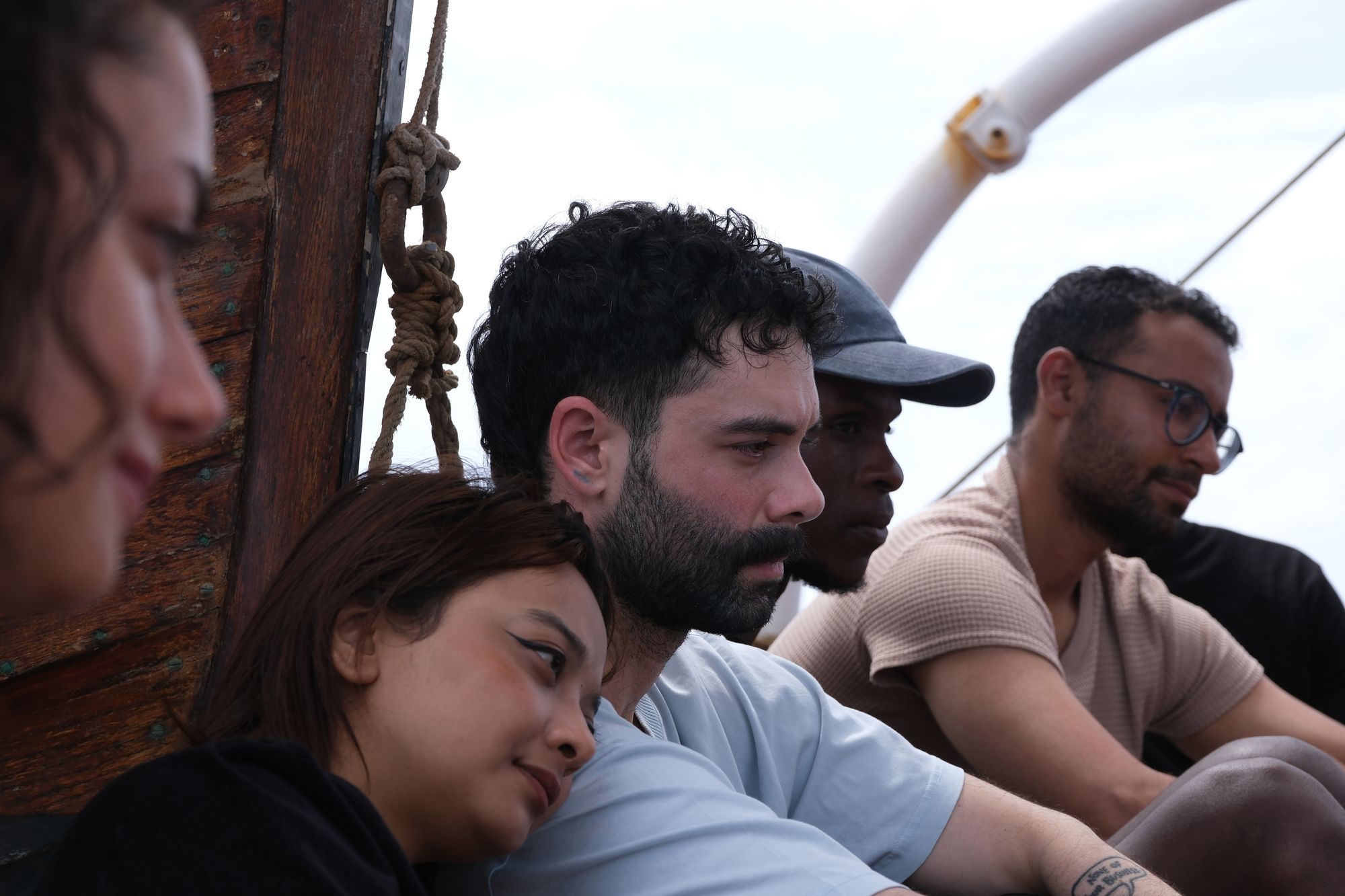
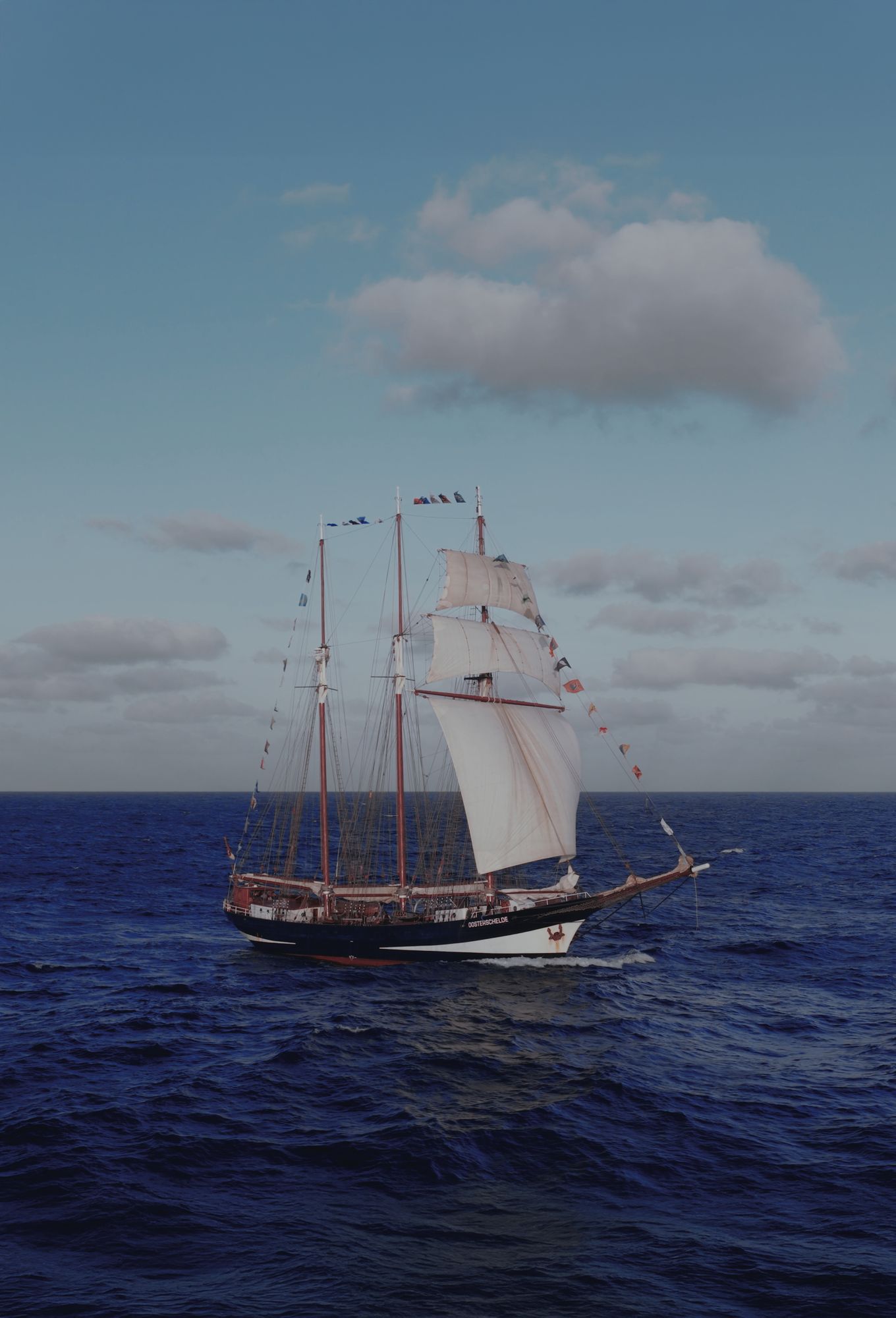
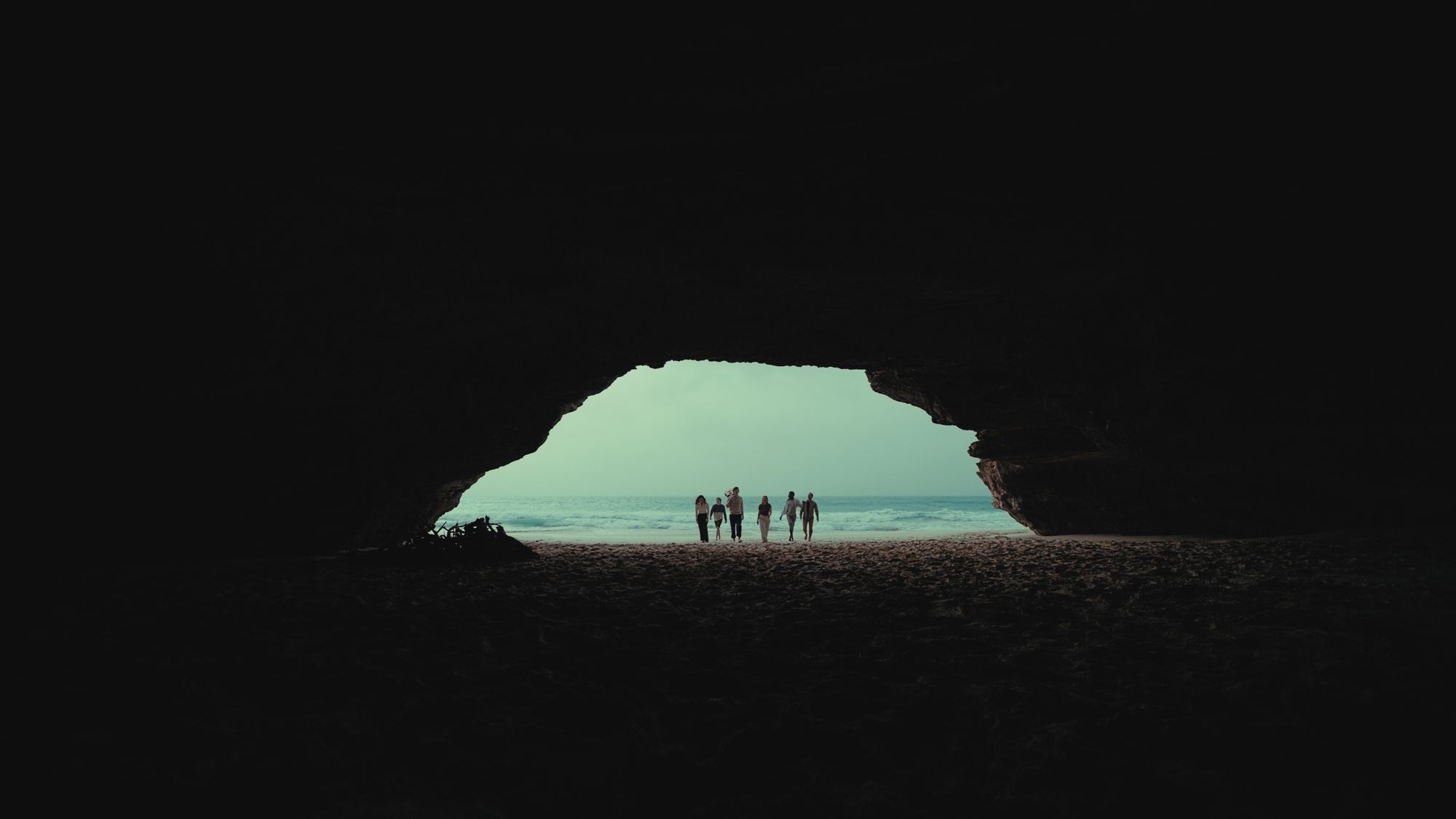
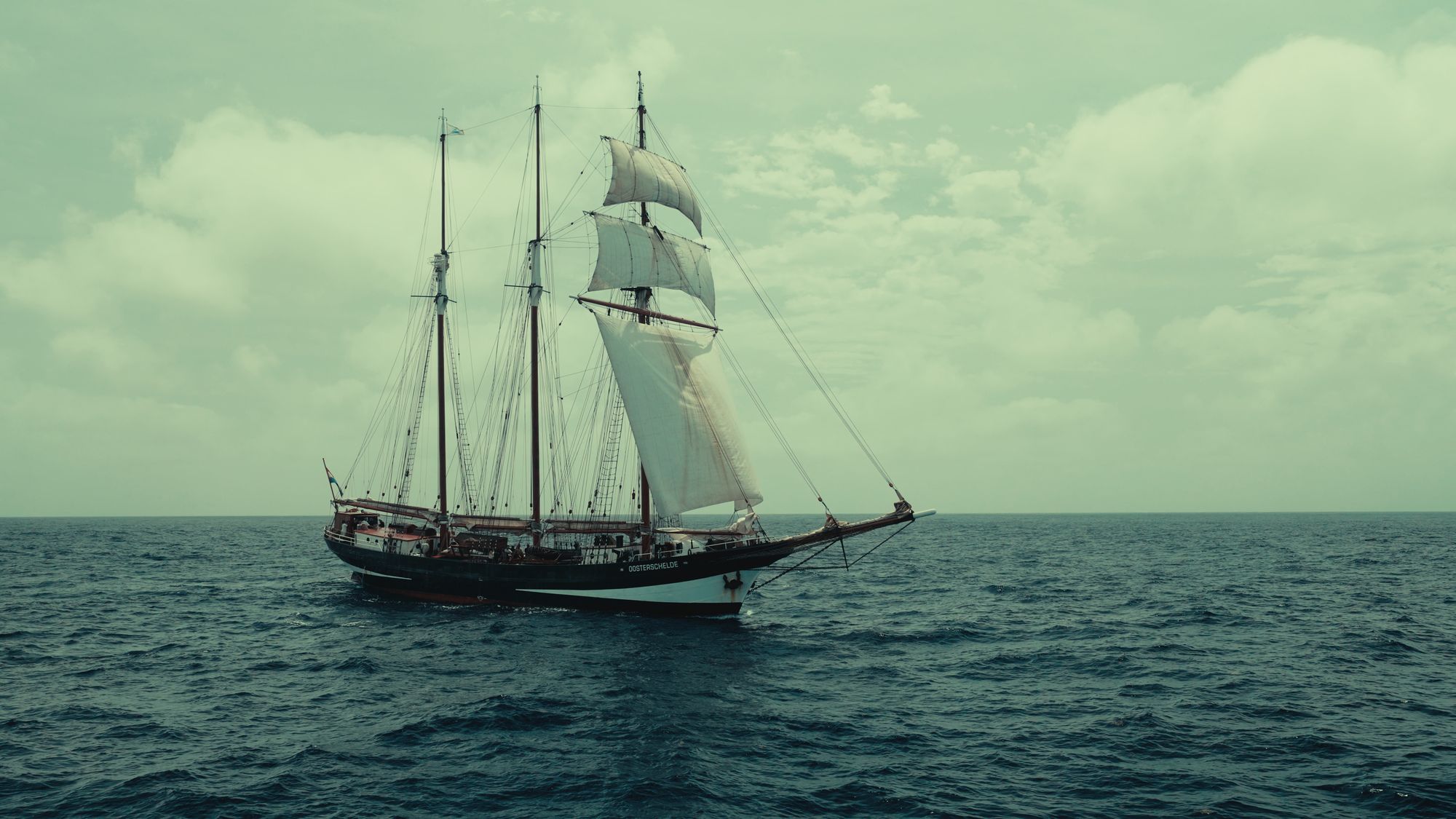
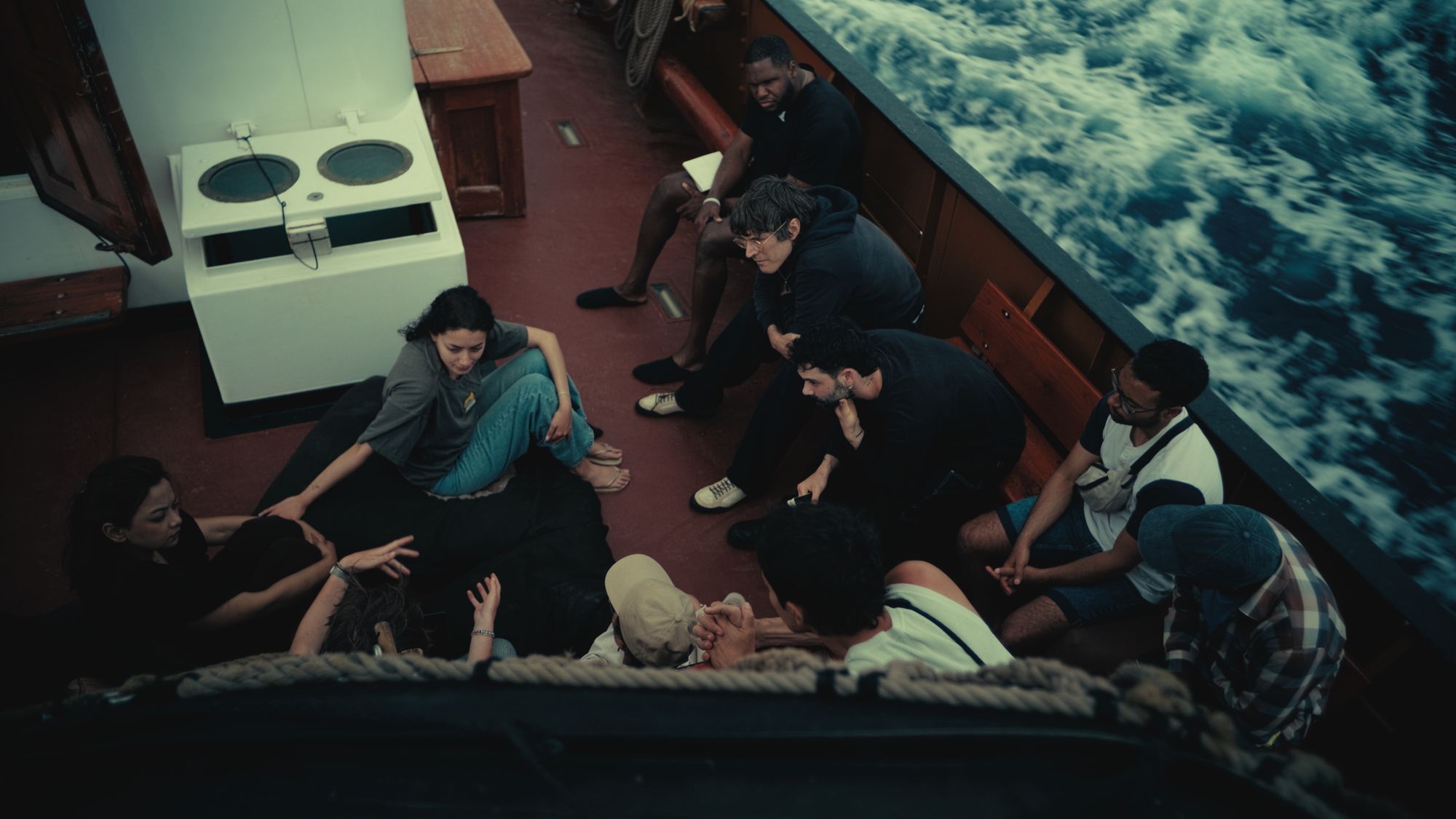
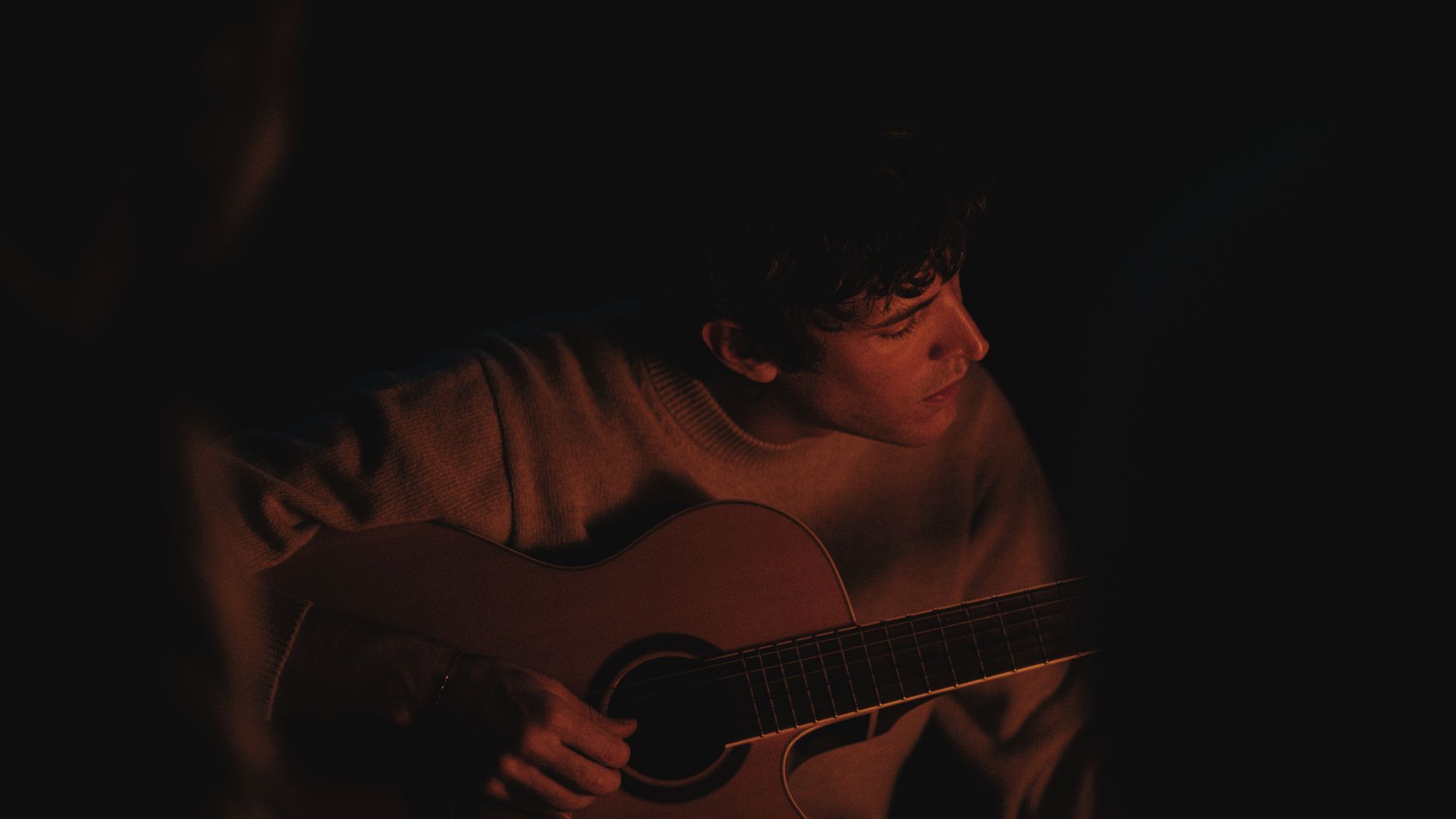
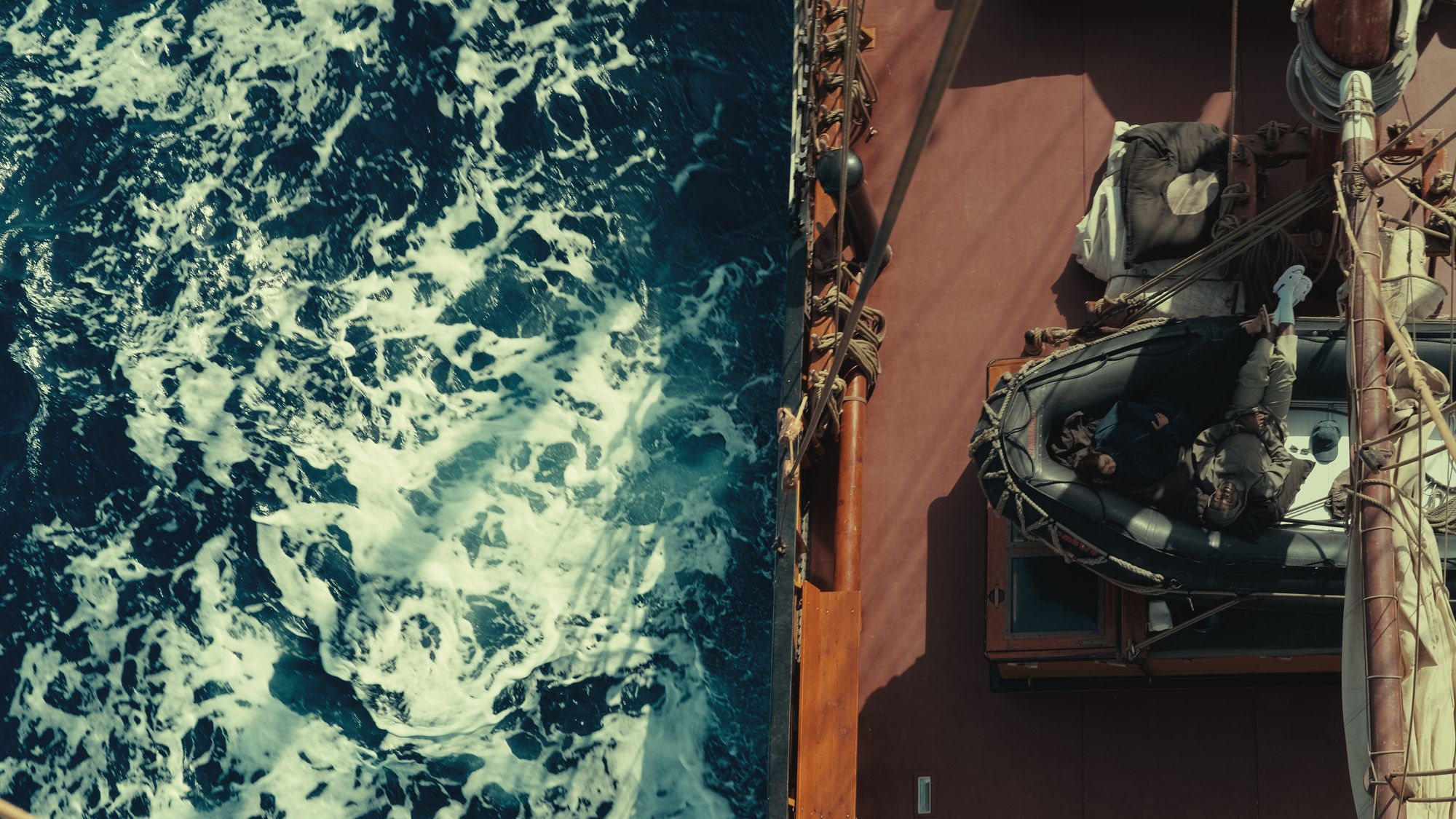
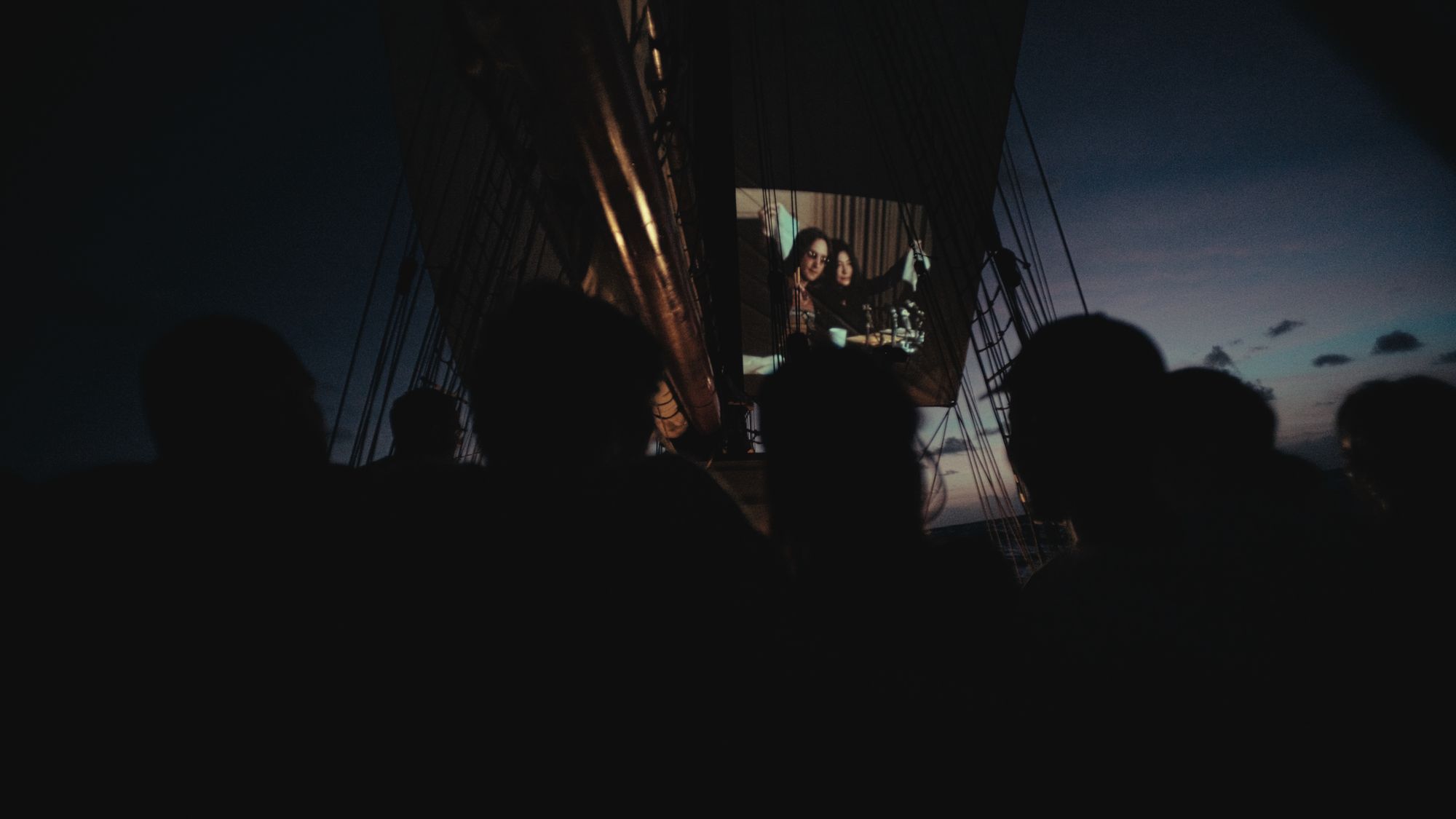
Dopo l’Agorà del cambiamento e la pubblicazione internazionale del Manifesto for Change, nasce l’idea di The Ark of Change. Un viaggio in mare, unico, che ha unito arte, natura e impegno sociale. Dieci giovani “eroi senza superpoteri” hanno attraversato l’Oceano Atlantico da Capo Verde al Suriname a bordo della Oosterschelde, un veliero olandese del 1918, in un viaggio simbolico che ha ripercorso la tratta atlantica degli schiavi collegando i due polmoni del mondo.
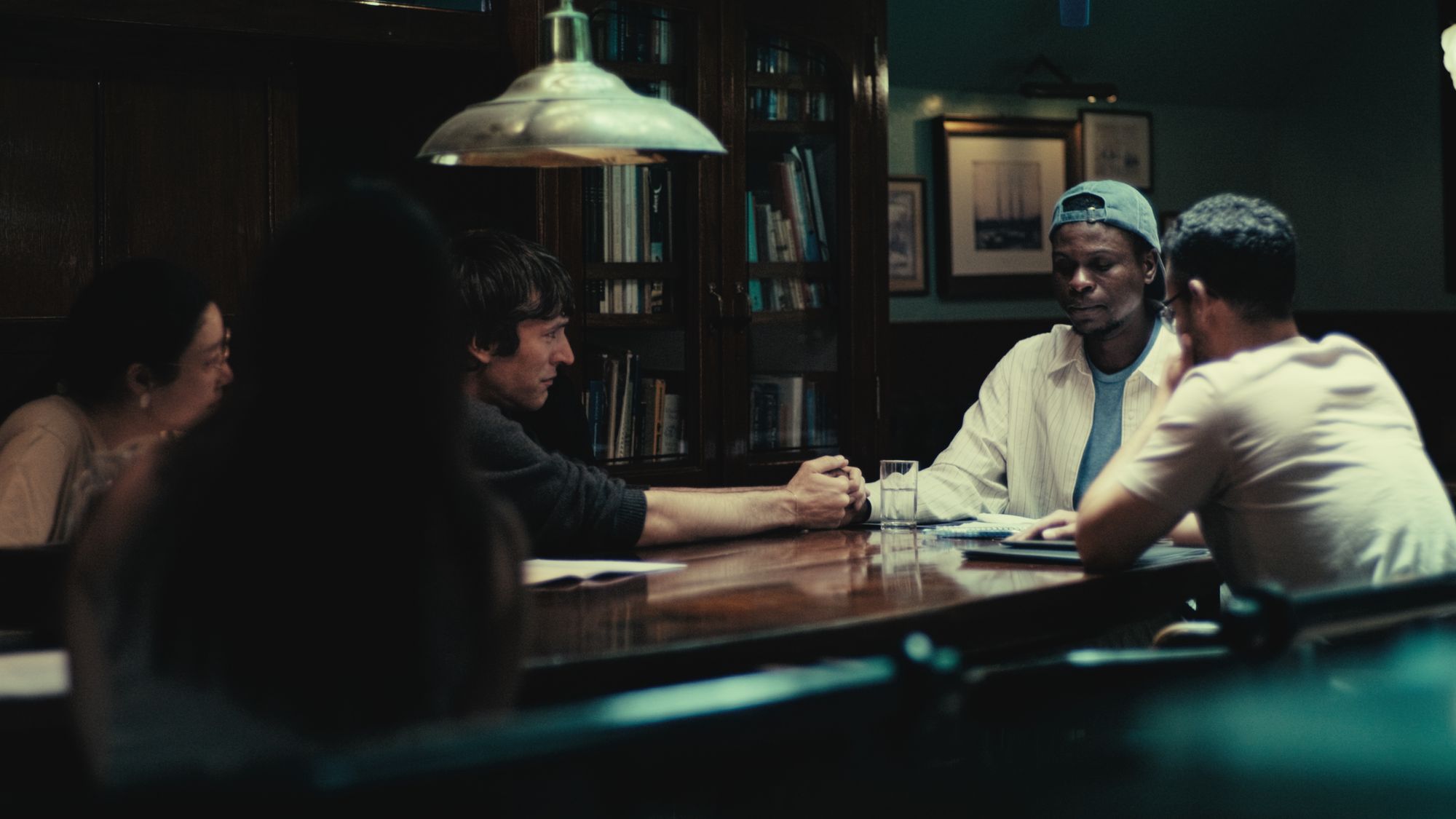
Durante i diciotto giorni di viaggio i dieci partecipanti hanno discusso di numerosi temi: diritti umani, convivenza pacifica e disarmo, crisi climatica, mondo virtuale, salute mentale, identità di genere. Hanno aggiornato in chiave universale il Manifesto italiano redatto nella Stanza della Segnatura di Raffaello.
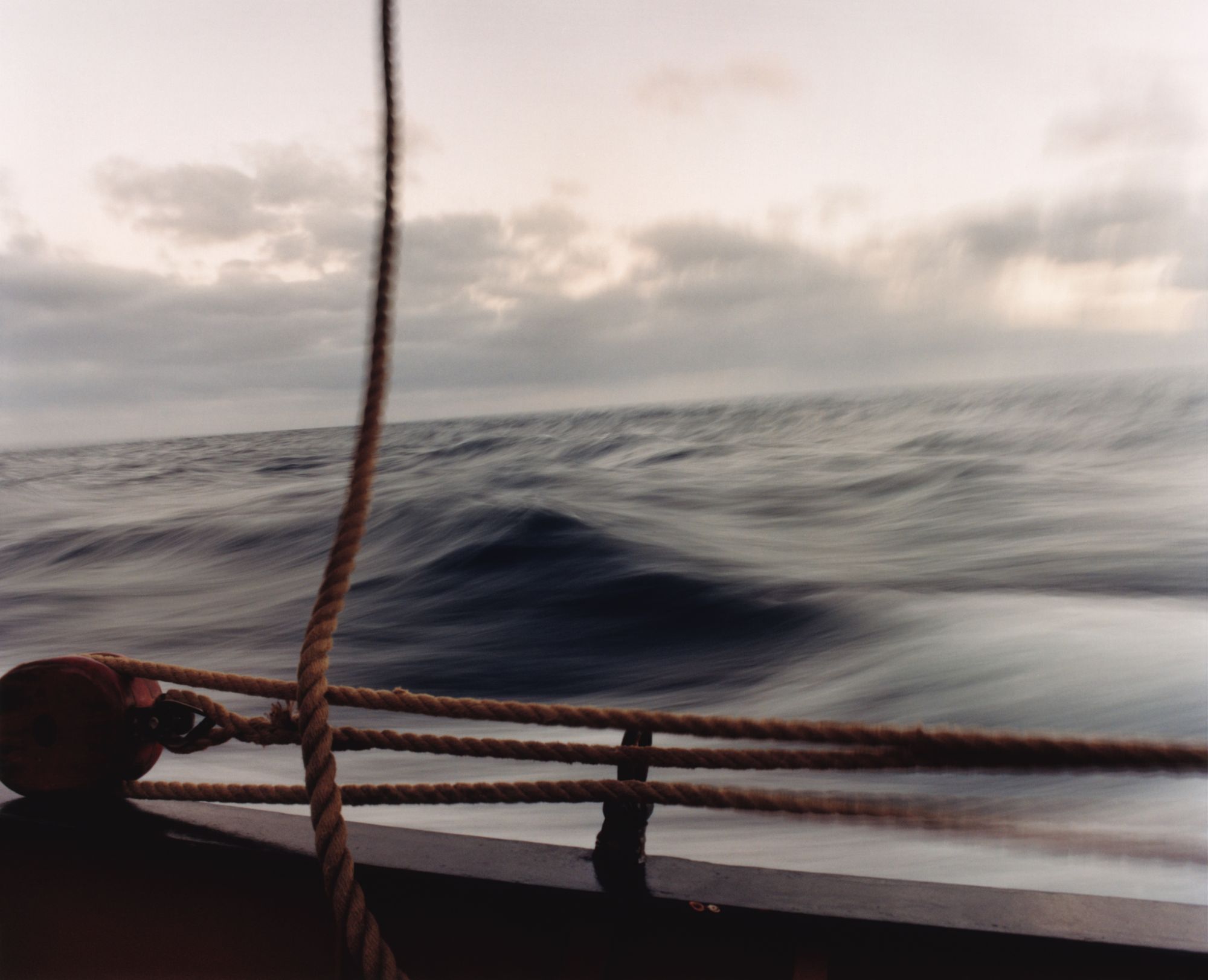
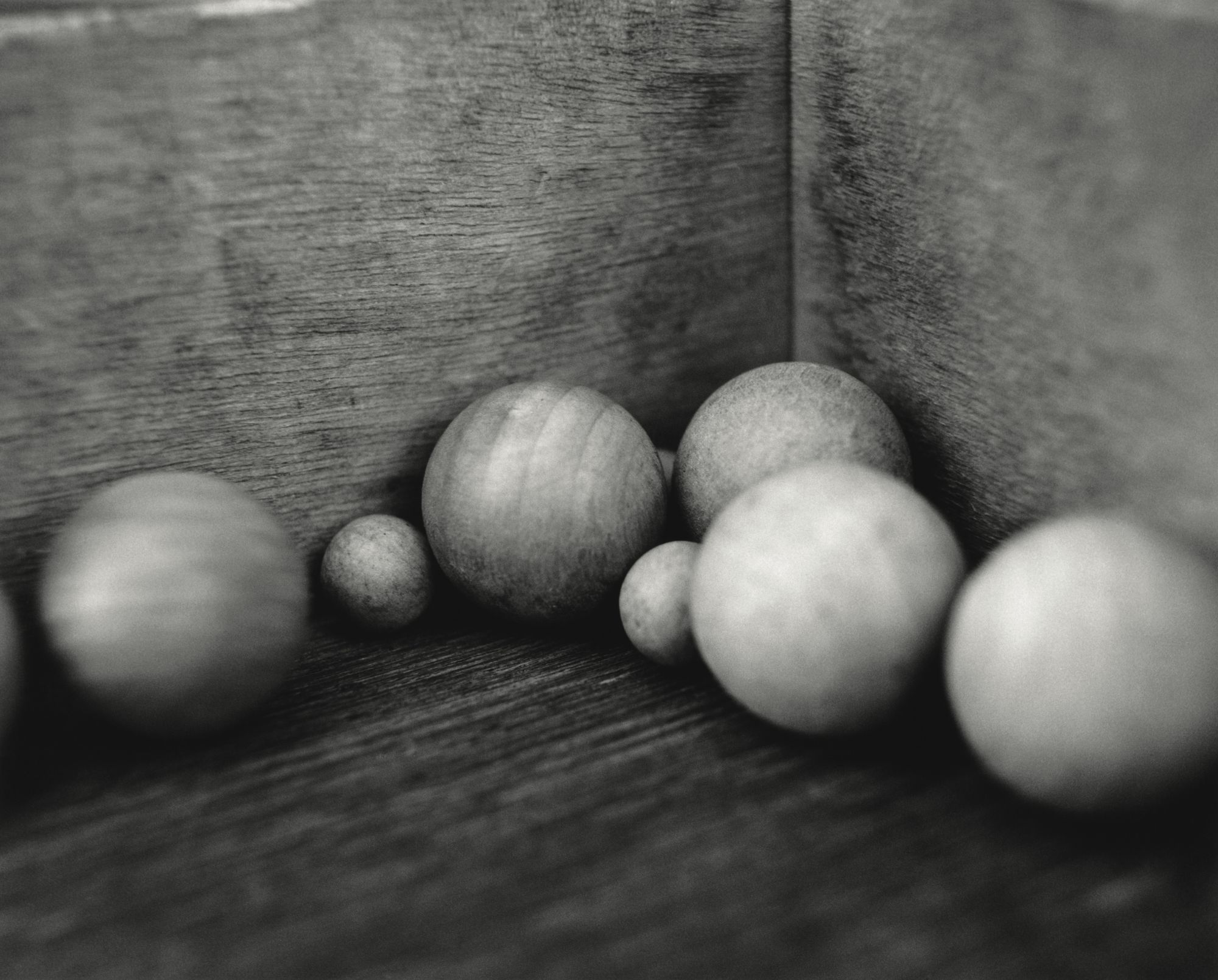
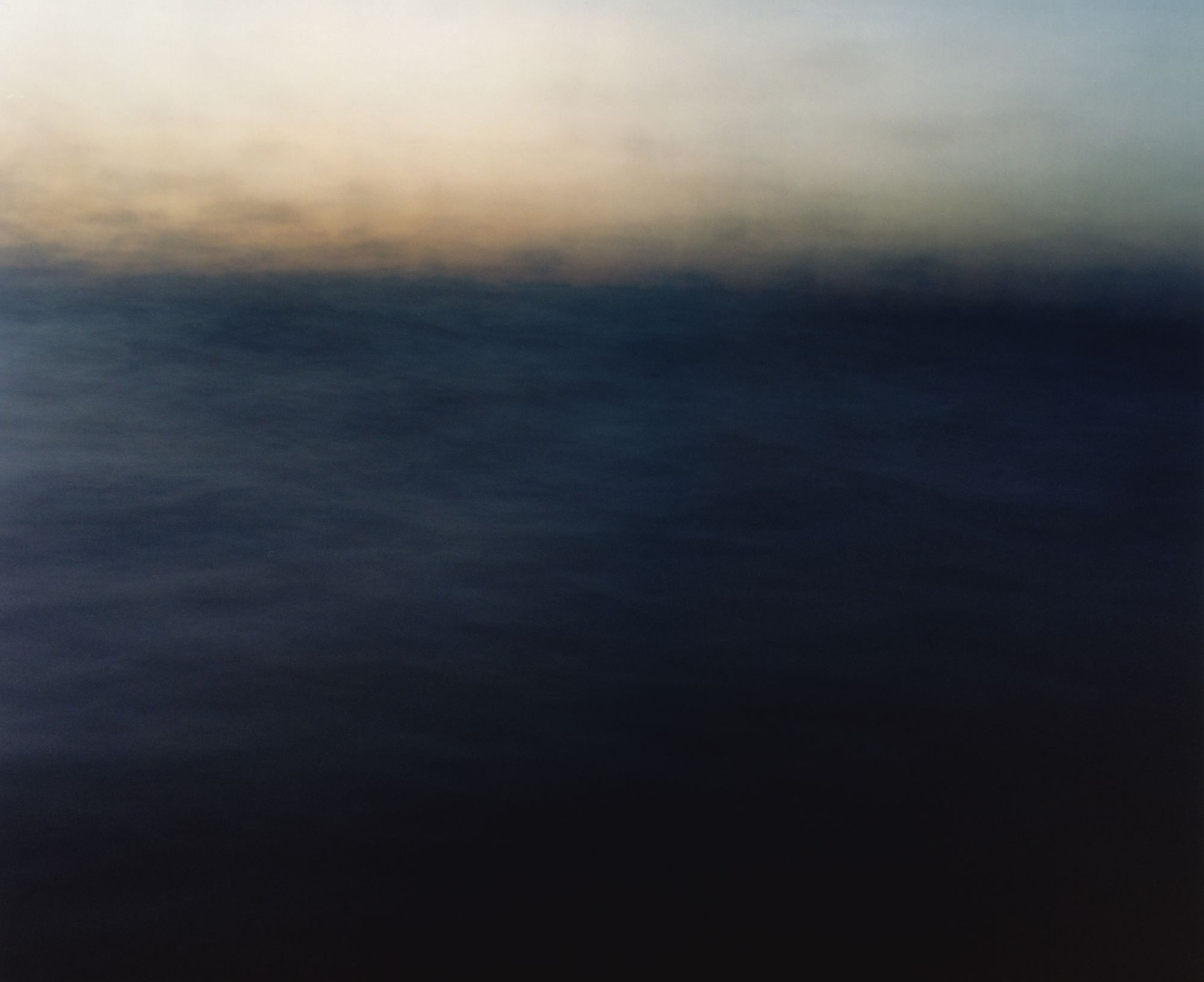
Il viaggio è raccontato in un film diretto dal regista Premio Oscar Luc Jacquet e negli scatti analogici di Jamie Hawkesworth.
The performance The Ark of Change
2 to 20 March 2026
Youth involved: Plestia Alaqad (Palestine); Sean Binder (Ireland); Francesco Cicconetti (Italy); Federico Gambedotti (Italy, Eritrea); Drukmo Gyal (Tibet, China); Andrew Johnson Raphael (Malawi); Ayumi Kuramae Izioka (Brazil, Japan, the Netherlands); Manisha Maharjan (Nepal, Newar); Chris Mansa Laporte (France, Haiti).
The Agorà of Change and the international edition of Manifesto for Change were the inspiration behind the idea for The Ark of Change: a once-in-a-lifetime sea voyage bringing together art, nature, and social activism. Ten young “heroes without superpowers” crossed the Atlantic Ocean from Cape Verde to Suriname on board the Oosterschelde, a Dutch sailing ship from 1918, on a symbolic journey retracing the Atlantic leg of the slave trade route and connecting the two green lungs of the world.
Ten participants spent eighteen days at sea discussing numerous issues, such as human rights, peaceful cohabitation and disarmament, the climate crisis, the virtual realm, mental health, and gender identity. They updated the Italian edition of the Manifesto drawn up in Rafael’s Stanza della Segnatura to enhance its universality.
This voyage is portrayed in a film by Oscar-winning director Luc Jacquet and in the analogue photographs of Jamie Hawkesworth.

Le foto di Jamie Hawkesworth
2-20 marzo 2026
The photographs of Jamie Hawkesworth
2 to 20 March 2026
Il Gran Pavese di Mimmo Paladino
2-20 marzo 2026
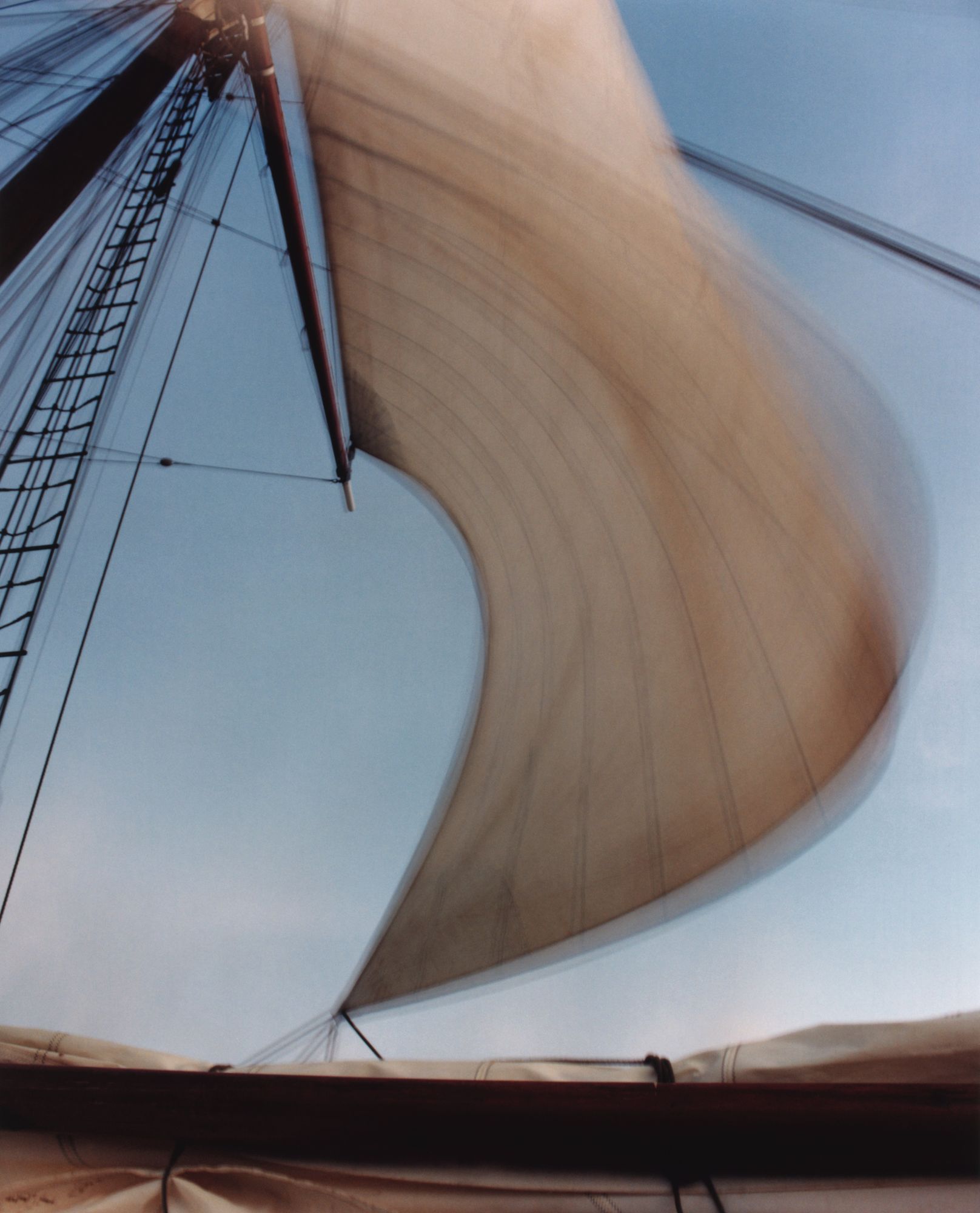
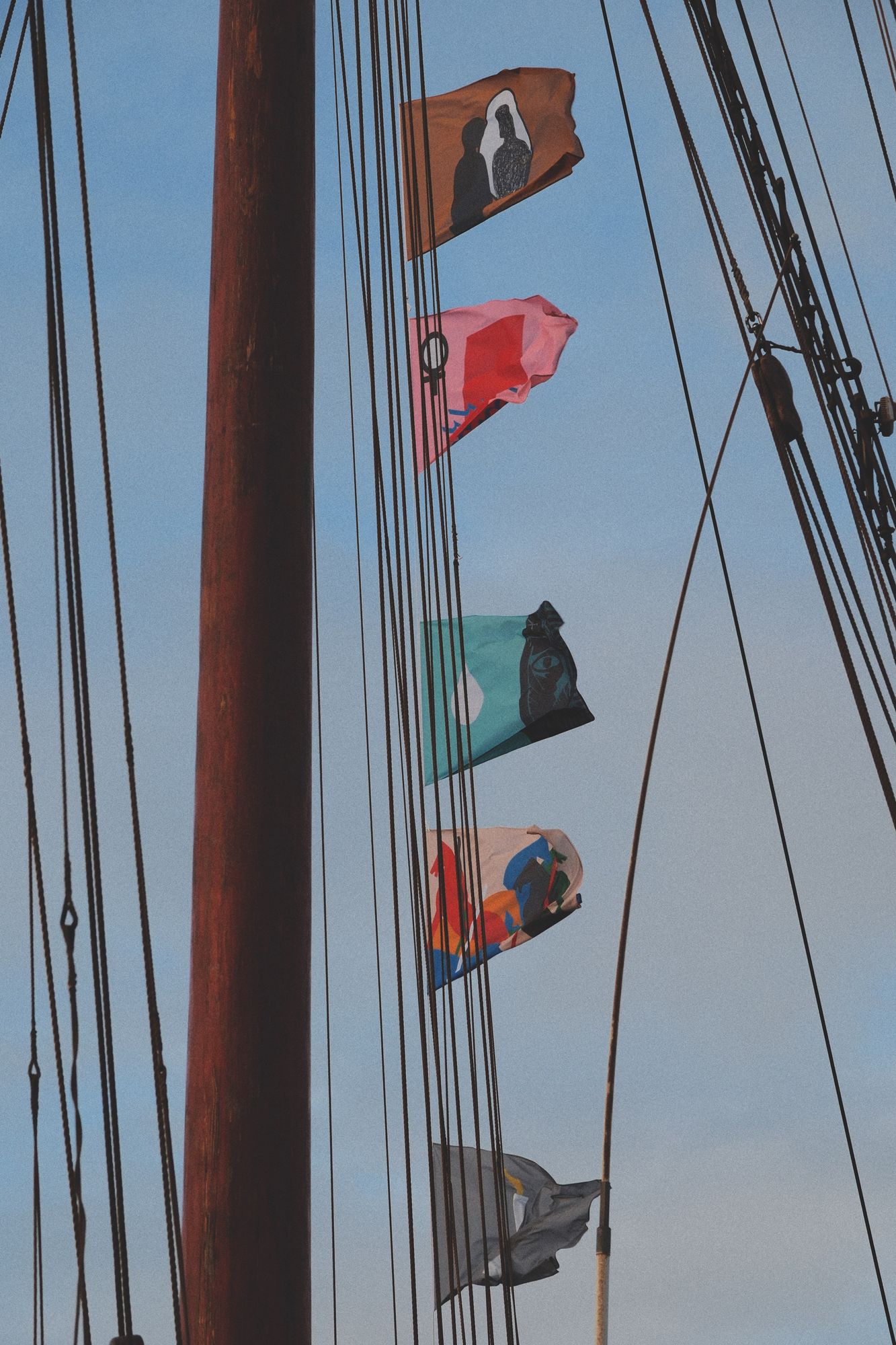
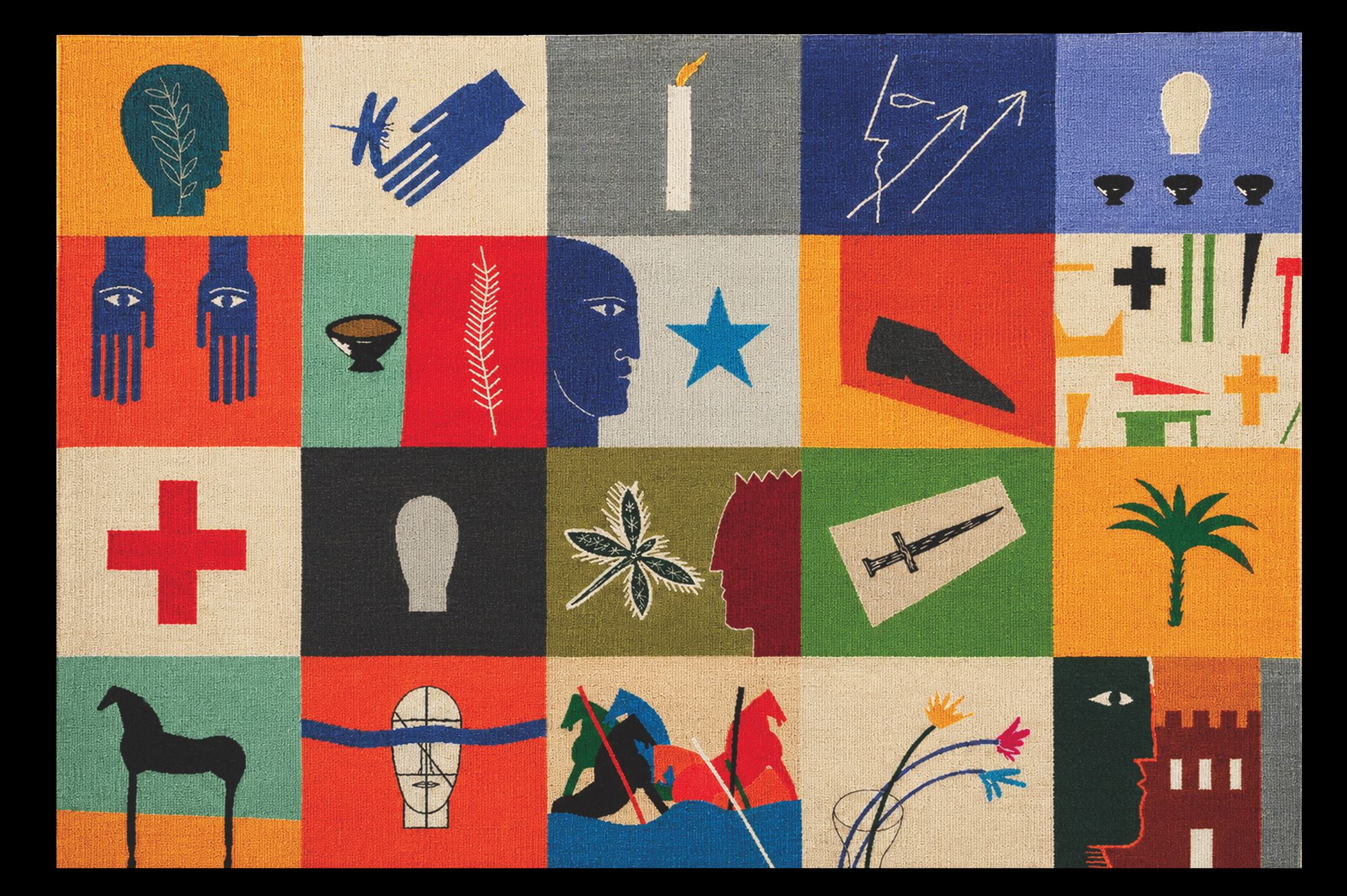
In occasione della performance The Ark of Change, Mimmo Paladino, artista, pittore, scultore e incisore italiano, noto in tutto il mondo come principale esponente della transavanguardia, ha trasformato il veliero in un’opera d’arte galleggiante realizzando quaranta tavole che rappresentano gli archetipi dei valori e delle parole di cambiamento delle nuove generazioni. Le tavole sono state poi trasformate nelle bandiere che hanno formato un Gran Pavese di 80 metri che ha collegato gli alberi della nave, una guida simbolica di grande valore artistico e filosofico, di straordinario impatto scenico.
In occasione della mostra antologica Youth and Future alla Sala delle Cariatidi di Palazzo Reale, Mimmo Paladino ha realizzato un arazzo di 5 metri per 2 con alcune delle bandiere più significative del Gran Pavese.
Nota tecnica:
Il Gran Pavese, denominato più tecnicamente Gran Gala di Bandiere, è formato solitamente da una serie di bandiere rappresentanti il Codice Internazionale dei Segnali. Include 26 bandiere alfabetiche, 10 numeriche e alcune speciali, disposte in ordine specifico da prua a poppa, issate per celebrazioni e gala, estendendosi sopra tutti gli alberi e affiancando la bandiera nazionale. Le navi lo innalzano in caso di particolari solennità.
Mimmo Paladino’s Gran Pavese
2 to 20 March 2026
For the performance of The Ark of Change, Mimmo Paladino, an Italian artist, painter, sculptor, and printmaker, known the world over as a pioneer of the Transavantgarde movement, has transformed a sailing ship into a floating artwork of art. Paladino created forty panels representing archetypes of the values and words of change for the new generations. These panels were then transformed into flags to create an 80 metre long ‘Gran Pavese’ connecting the ship masts, a symbol of great artistic and philosophical value and extraordinary visual impact.
For the anthological exhibition Youth and Future held in the Hall of Caryatids in the Royal Palace of Milan, Paladino created a 5 × 2 metre banner using some of the Gran Pavese’s most significant flags.
Technical note:
‘Gran Pavese’ refers the dressing lines hoisted from bow to stern during celebrations and gala events. These dressing lines feature the flags of the International Code of Signals (including twenty-six alphabetical flags, ten numerical pennants, and other special flags arranged in a specific order). They connect all the masts and fly alongside national flags. Ships traditionally hoist dressing lines on especially solemn occasions.
Banner created in collaboration with cc-tapis
I Manifesti cancellati di Emilio Isgrò
2026
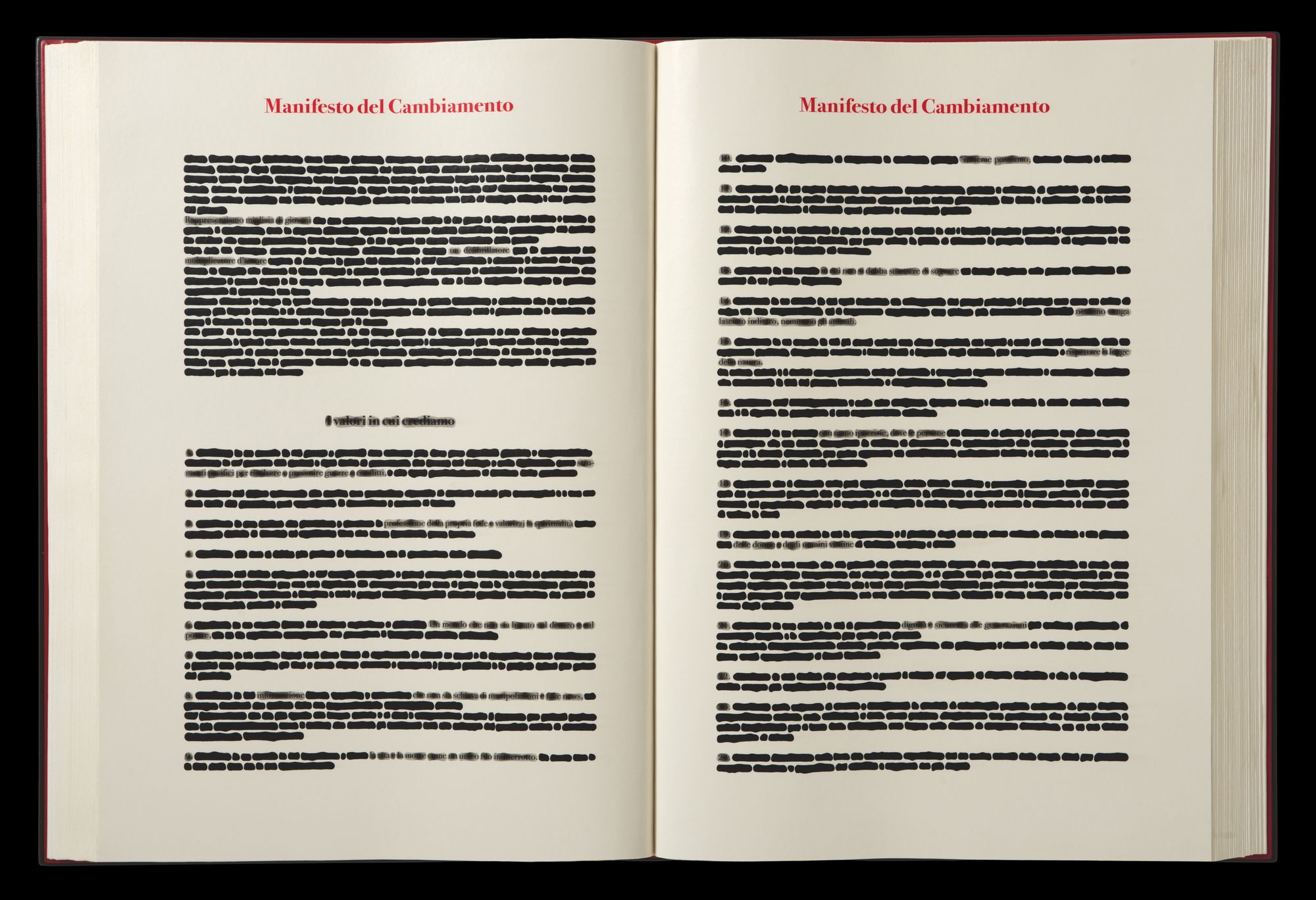
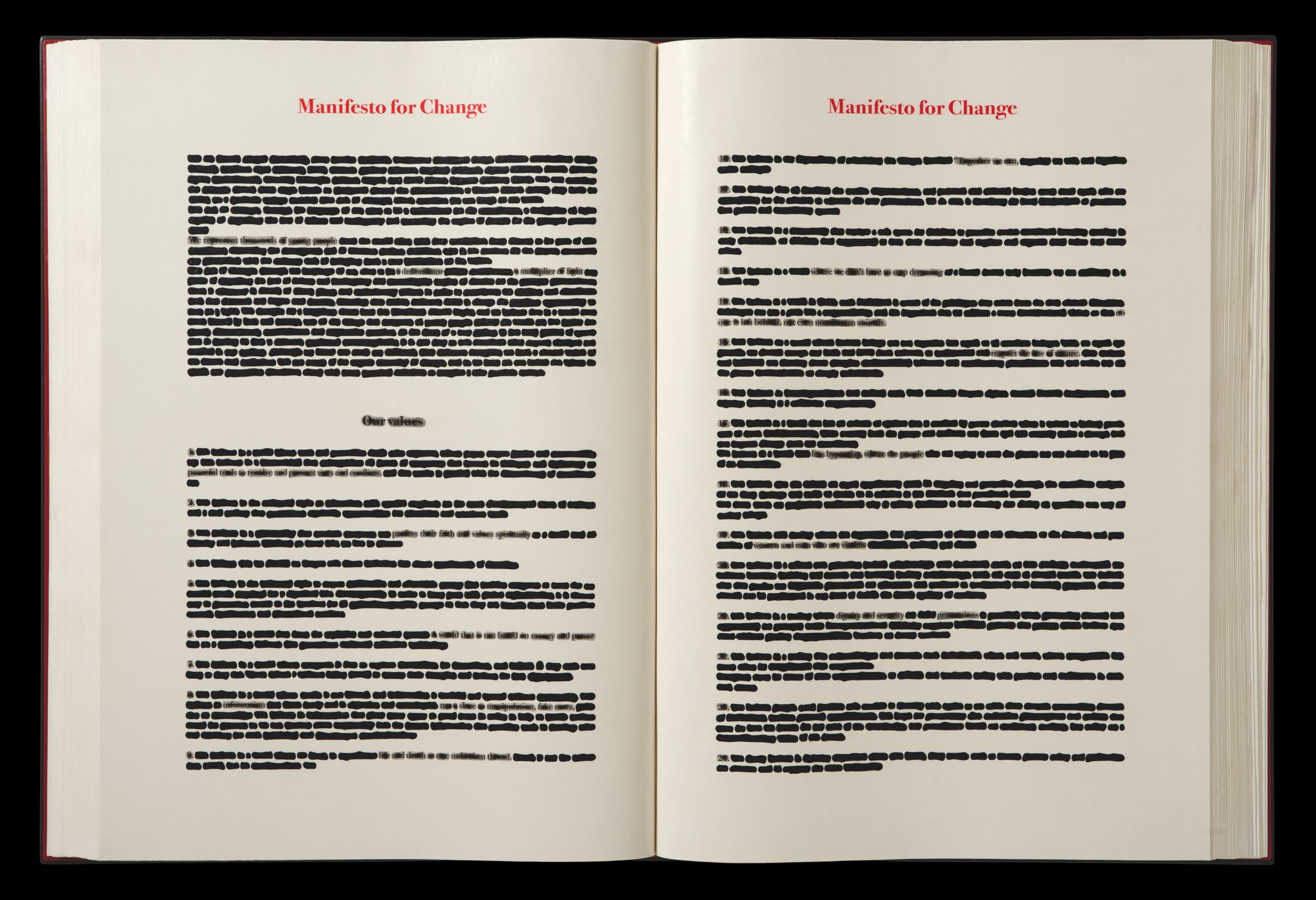
Artista concettuale e pittore – ma anche poeta, scrittore, drammaturgo e regista – Emilio Isgrò a partire dagli anni Sessanta crea la Cancellatura, uno dei linguaggi più rivoluzionari degli ultimi decenni. Per la mostra antologica Youth and Future, l’artista ha cancellato il testo del Manifesto del Cambiamento e del Manifesto for Change, cuore del lavoro e della dedizione di tutti i ragazzi coinvolti nel progetto.
The Erased Manifestos by Emilio Isgrò
2026
A conceptual artist and painter – as well as a poet, writer, playwright and director –, starting in the sixties, Emilio Isgrò began creating his ‘erasures’, one of the most revolutionary artistic mediums to emerge in the last few decades. For the anthological exhibition Youth and Future, Isgrò erased the text from the two books Manifesto del Cambiamento and Manifesto for Change, representing the hard work and dedication of all the young people involved in the project.
These two unique artworks measure 70 × 100 cm each.
Onde di Michelangelo Pistoletto
2026
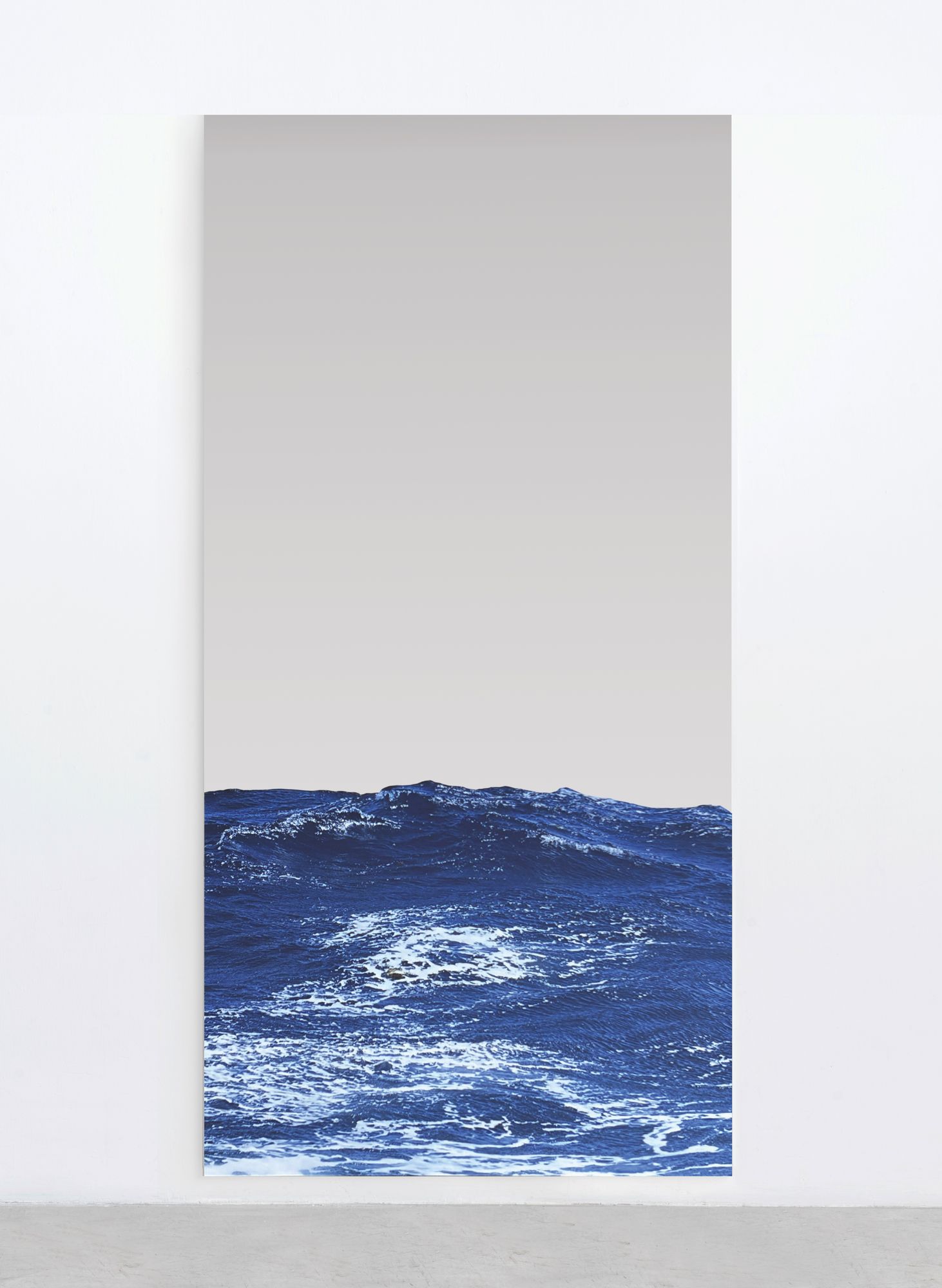
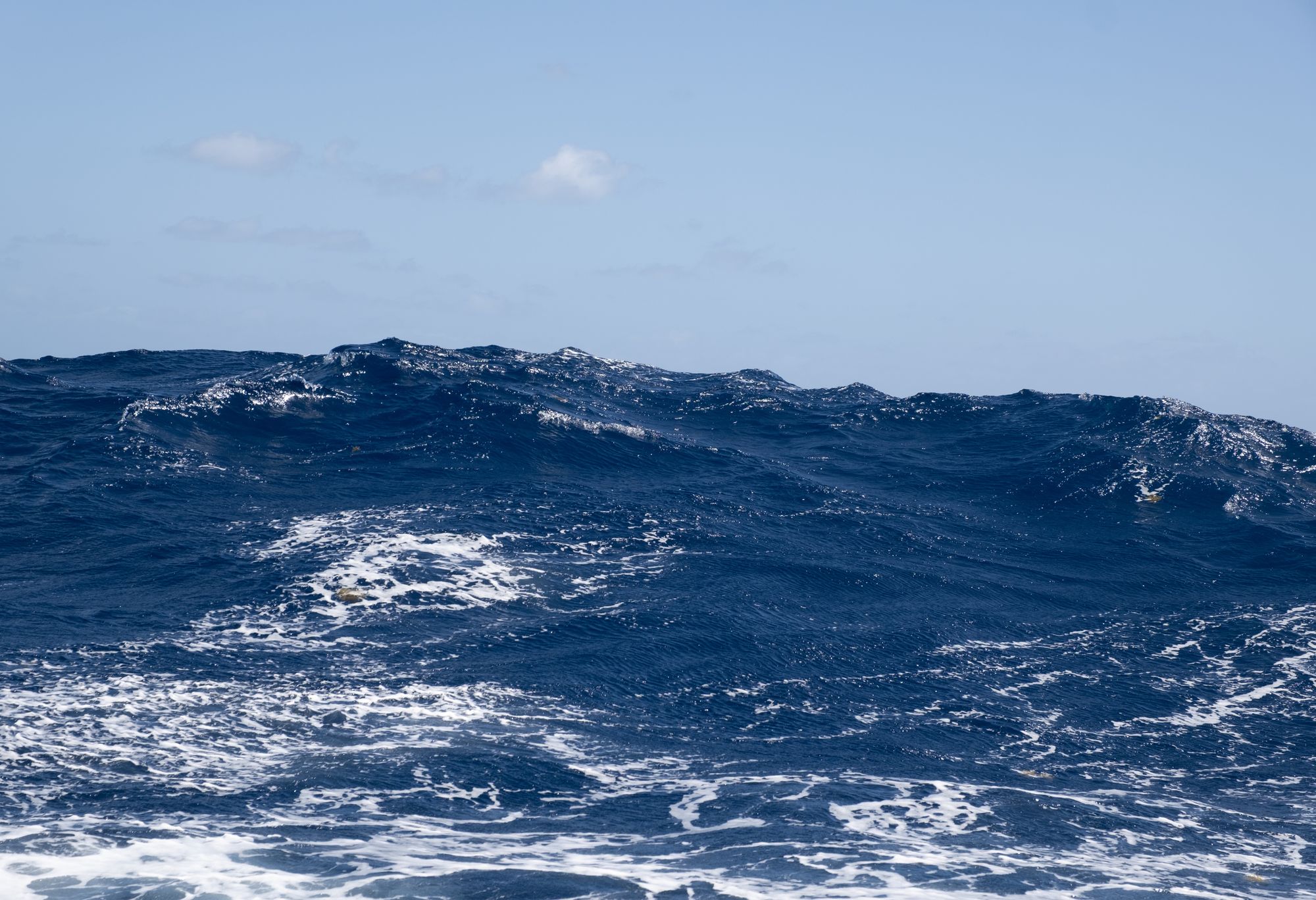
Per la mostra antologica Youth and Future, Michelangelo Pistoletto concepisce una straordinaria opera specchiante. Nell’eterna oscillazione tra ombra e luce, bene e male, l’artista cattura e coinvolge lo spettatore, immergendolo tra le onde dell’Oceano e rendendolo così parte del viaggio.
Waves by Michelangelo Pistoletto
2026
For the anthological exhibition Youth and Future, Michelangelo Pistoletto has conceived an extraordinary mirror painting. In the eternal oscillation between light and dark, good and evil, Pistoletto captivates viewers and draws them in, immersing them in ocean waves so that they become part of the journey.
Il film The Ark
2027
Crediti
Youth and Future ringrazia Avv. Cristiana Massaro
The film The Ark
2027
Credits
A MasiFilm Production
General Manager of MasiFilm and Executive Producer: Aurelia Musumeci Greco
Youth and Future would like to thank lawyer Cristiana Massaro
Nato a Costantina, in Algeria, nel 1971, vive e lavora a Parigi, in Francia. Adel Abdessemed utilizza una grande varietà di linguaggi e media, tra cui disegno, scultura, performance, video e installazione. Il suo lavoro affronta spesso temi quali la guerra, la violenza e la religione ed è caratterizzato da immagini di forte impatto che cercano di rappresentare la violenza intrinseca del mondo contemporaneo. Memoria, trauma, conflitto, ebbrezza e lucidità: l’artista francese di origine berbera Adel Abdessemed costruisce da oltre trent’anni un corpus di opere impegnato e incandescente, che ha rapidamente trovato risonanza sulla scena internazionale.
Fuggì dall’Algeria dopo l’inizio della guerra civile del 1992, portando con sé la memoria del conflitto e il peso delle atrocità vissute. «Ho sperimentato in modo molto diretto la violenza di cui parlo. Ancora oggi le ferite rimangono aperte e le domande senza risposta: gli incendi, gli stupri, gli omicidi impuniti». Come afferma lo scrittore Kamel Daoud parlando di Adel Abdessemed: «Bisogna provenire da un Paese d’origine come quello di Adel, con simboli terribili ancora vivi e capaci di avere conseguenze reali sulla vita e sulla morte, per comprendere che l’indignazione dell’artista è una necessità, più che una scelta estetica».Arrivato in Francia, ha studiato all’École nationale supérieure des Beaux-Arts di Lione. Nutrito di cultura classica, letteratura e poesia, e appassionato di musica, Abdessemed ha fatto propri diversi linguaggi e strumenti espressivi, trasformando l’arte in un luogo in cui la società mette a nudo la propria violenza e fragilità. Kounellis afferma che la sua veemenza rappresenta un baluardo contro il conformismo e l’uniformità del pensiero dominante.
È proprio questa necessità di mescolare tutte le forme dell’espressione culturale che lo ha portato a collaborare con scrittori e poeti come Hélène Cixous, Julia Kristeva, Christophe Ono-dit-Biot e Adonis, con i quali ha pubblicato diverse opere congiunte, ma anche con architetti come Jean Nouvel e Jean-Michel Wilmotte.
Nel XVIII secolo, Lessing aveva definito il grido come qualcosa di irrappresentabile nell’arte e come un tabù per tutte le arti visive. Attraverso il suo lavoro, Abdessemed ha trasformato l’arte in un organo del grido collettivo: un esercizio di libertà, un invito a liberarci una volta per tutte dalla nostra barbarie.
Dalla sua prima mostra personale nel 2001, ha esposto in numerose istituzioni, tra cui: MoMA PS1; il MIT List Visual Arts Center; CNAC - Le Magasin; Parasol unit; Fondazione Sandretto Re Rebaudengo; Centre Pompidou (con la mostra Adel Abdessemed Je suis innocent, 2012); Centro de Arte Contemporáneo de Málaga; Montreal Museum of Fine Arts (con Adel Abdessemed: Conflict, 2017); MAC's Grand-Hornu con Otchi Tchiornie; e il Musée d'Art Contemporain de Lyon con L’Antidote.
Il lavoro di Adel Abdessemed è stato presentato tre volte alla Biennale di Venezia (2003, 2009, 2015), oltre che alle Biennali di Istanbul (2017), L’Avana (2009), Gwangju (2008), Lione (2007) e San Paolo (2006). Nel 2017 ha partecipato alla Triennale Milano con The Restless Earth e all’Oku-Noto Triennale in Giappone.Nel 2020 l’artista ha esposto alla Fondation Louis Vuitton nell’ambito della mostra collettiva Crossing Views. Nel marzo 2022 ha inaugurato An Imperial Message, una grande mostra personale distribuita su cinque piani presso il Rockbund Museum.
Born in Constantine, Algeria in 1971, Adel Abdessemed lives and works in Paris, France.
Abdessemed embraces a wide variety of media, including drawing, sculpture, performance, video, and installation. His work often deals with the themes of war, violence, and religion and is characterized by brutal imagery that attempts to depict the inherent violence of the contemporary world.
Memory, trauma, conflagration, intoxication, lucidity. A French artist of Berber origin, Abdessemed has been building a committed and incandescent body of work for more than thirty years, which has quickly found an echo on the international scene.
He fled Algeria after the beginning of the 1992 civil war, taking with him the memory of the war and its many atrocities. “I’ve experienced very directly the violence that I talk about. Even today, the wounds remain open and the questions unanswered: the arson, the rapes, the unpunished murders.” As writer Kamel Daoud says: “You have to come from a country of origin like Adel’s, with terrible symbols that are still alive, capable of real life and death, to understand that the artist’s indignation is a necessity, not an aesthetic.”
Once in France, he studied at the École Nationale Supérieure des Beaux-Arts in Lyon. Steeped in classical culture, literature, and poetry and with a passion for music, Abdessemed has appropriated various media and languages to make art the place where a society exposes its violence and fragility. Kounellis asserts that his vehemence is a bulwark against conformism and the uniformity of the bien-pensance.
It is this need to mix all forms of cultural expression that has led him to collaborate with writers and poets such as Hélène Cixous, Julia Kristeva, Christophe Ono-dit-Biot, and Adonis, with whom he has published several joint works, but also architects such as Jean Nouvel and Jean Michel Wilmotte.
In the eighteenth century, Gotthold Ephraim Lessing argued that the outcry was unrepresentable in art and a taboo in all visual arts. Through his work, Abdessemed has turned art into an organ of collective outcry: an exercise in freedom, an exhortation to free ourselves once and for all from our barbarity.
Since Abdessemed’s first solo exhibition in 2001, he has had others at: PS1/MoMA, New York; MIT List Visual Arts Center, Cambridge, MA, USA; CNAC – Le Magasin (Centre National d’Art Contemporain), Grenoble, France; the Parasol Unit, London; Fondazione Sandretto Re Rebaudengo, Turin, Italy; Centre Pompidou, Paris (Adel Abdessemed Je suis innocent, 2012); CAC, Málaga, Spain; the Montreal Museum of Fine Arts, Canada (Adel Abdessemed, Conflict, 2017); Otchi Tchiornie at MAC’s, Grand-Hornu, Belgium; L’Antidote at MAC, Musée d’Art Contemporain, Lyon, France .
Adel Abdessemed’s work has been shown at the Venice Biennale three times (2003, 2009, 2015) as well as at the Biennial of Istanbul (2017), Havana (2009), Gwangju (2008), Lyon (2007), and Saõ Paulo (2006). In 2017 he participated in the Triennale di Milan, The Restless Earth and the Oku-Noto Triennale in Japan.
In 2020 the artist exhibited at the Fondation Louis Vuitton in Paris as part of the group show Crossing Views, and in March 2022 he inaugurated An Imperial Message, a major solo show over five floors at Rockbund Museum in Shanghai.
Marco Anelli (Roma, 1968) è un fotografo italiano che vive e lavora a New York. Da oltre trent'anni sviluppa progetti fotografici di lungo periodo dedicati al ritratto e al rapporto tra persone, arte e luoghi. Lavora principalmente con la luce naturale e costruisce i suoi progetti nel tempo, privilegiando l'osservazione e l'incontro con le persone.
Nel corso della sua attività ha realizzato progetti dedicati alla Basilica di San Pietro in Vaticano, al Duomo di Milano e agli studi di artisti contemporanei, raccolti nel volume Artist Studios New York (Damiani, 2020), frutto di oltre nove anni di lavoro negli spazi creativi di artisti internazionali. Ha inoltre realizzato un ampio ciclo di ritratti dei principali direttori d'orchestra ospiti dell'Accademia Nazionale di Santa Cecilia.
Il ritratto costituisce il nucleo centrale della sua ricerca. Tra i suoi lavori più conosciuti vi è Portraits in the Presence of Marina Abramović, realizzato durante la storica performance The Artist Is Present al Museum of Modern Art di New York nel 2010. In quasi tre mesi Anelli ha fotografato oltre 1.500 partecipanti, dando vita a un corpus di immagini che documenta l'esperienza emotiva dello sguardo e della presenza.
Dal 2015 porta avanti I Do, New York, dedicato ai matrimoni civili celebrati al City Hall di Manhattan, mentre dal 2018 sviluppa First American Portrait, un progetto sui nuovi cittadini statunitensi ritratti subito dopo la cerimonia di naturalizzazione. Entrambi i lavori esplorano i momenti di trasformazione dell'identità personale attraverso il linguaggio del ritratto, affrontando temi quali appartenenza, memoria e costruzione della comunità.
Le sue fotografie sono state esposte e pubblicate a livello internazionale e fanno parte di importanti collezioni pubbliche e private.
Marco Anelli (Rome, 1968) is an Italian photographer based in New York. For more than thirty years, he has developed long-term photographic projects centered on portraiture and the relationship between people, art, and place. Working primarily with natural light, he builds his projects over time, privileging observation and direct encounters with his subjects.
Over the course of his career, Anelli has created major bodies of work devoted to St. Peter's Basilica in Vatican City, the Duomo of Milan, and the studios of contemporary artists, culminating in the book Artist Studios New York (Damiani, 2020), the result of more than nine years spent photographing the creative spaces of internationally renowned artists. He has also produced an extensive series of portraits of leading international conductors invited to perform at the Accademia Nazionale di Santa Cecilia.
Portraiture lies at the core of Anelli's artistic practice. Among his best known works is Portraits in the Presence of Marina Abramović, created during the landmark performance The Artist Is Present at the Museum of Modern Art in New York in 2010. Over the course of nearly three months, Anelli photographed more than 1,500 participants, creating a body of work that documents the emotional experience of presence and the exchange of the gaze.
Since 2015 he has been developing I Do, New York, a long term project documenting civil weddings at Manhattan's City Hall. Since 2018 he has also been working on First American Portrait, a series portraying newly naturalized U.S. citizens immediately after their oath ceremony. Both projects explore moments of personal transformation through portraiture, addressing themes of belonging, memory, and the construction of community.
Anelli's photographs have been widely exhibited and published internationally and are held in important public and private collections.
Dopo la laurea in Lettere a Filosofia alla Sapienza di Roma, si diploma in cinema al VCA di Melbourne. Regista e produttore, ha scritto e diretto varie serie, show televisivi e docufilm. Finalista del Globo d'oro con Il Carattere Italiano sull'Orchestra dell'Accademia Nazionale di Santa Cecilia, ha prodotto numerosi lavori per la RAI che hanno avuto grande risalto mediatico tra cui i ritratti biografici dedicati a Ezio Bosso, Franco Battiato, Enrico Mattei e Lucio Battisti.
Documentari e docufilm
After graduating in literature and philosophy from La Sapienza University in Rome, Angelo Bozzolini obtained a diploma in film from the VCA in Melbourne. A director and producer, Bozzolini has written and directed various series, television programs, and documentary films. A finalist for the Globo d’Oro award for Il Carattere Italiano on the Orchestra dell’Accademia Nazionale di Santa Cecilia, he has produced numerous programs for the Italian public broadcaster RAI that have received widespread media coverage, including biographical portraits of Ezio Bosso, Franco Battiato, Enrico Mattei, and Lucio Battisti.
Documentaries and docufilms
Artista scoperto da Franco Battiato.
Più volte protagonista al Festival di Sanremo.
Ha collaborato, tra gli altri, con Willem Dafoe, Phil Collins, Patti Smith, Lang Lang, Antony and the Johnsons, Franco Battiato, Andrea Bocelli, Silvio Rodriguez, Elisa, Patty Pravo, Michele Placido, Carmen Consoli, Malika Ayane, Elodie.
A settembre 2015 presta la sua voce per il corto Disney Pixar Lava.
Il 14 Gennaio 2017 viene nominato Ambasciatore Unesco Giovani.
Il 26 Aprile, rappresenta l’Italia al Festival Pathway to Paris: Earth Day 50, con Michael Stipe, Patti Smith, Johnny Depp, Flea dei Red Hot Chili Peppers, Ben Harper e altri. Il concerto, organizzato da Jesse Paris Smith e Rebecca Foon, ha celebrato il 50° anniversario della Giornata della Terra.
È ideatore e promotore del progetto collettivo Parola ai giovani - Youth and Future in Italia e nel mondo. Il 21 Dicembre 2022 è stato autore de l’Agorà del cambiamento, una performance artistica all’interno della Stanza della Segnatura nei Musei Vaticani, sotto il celebre dipinto Scuola di Atene di Raffaello.
Dal 2023 è direttore artistico del palinsesto culturale della Fondazione Arnaldo Pomodoro.
Il 18 maggio 2024 interpreta la Messa Arcaica di Franco Battiato al Duomo di Milano e il 18 maggio 2025 al Pantheon di Roma.
Il 21 marzo 2025 alla General Assembly delle Nazioni Unite di New York, in occasione del Change The World Forum, alla presenza di 5.000 giovani da oltre 142 paesi, presenta il Manifesto for Change, riedizione internazionale del Manifesto del Cambiamento, con una commovente prefazione di Papa Francesco, realizzata in collaborazione con le Università di Yale, Harvard, il Berklee College of Music, la Tokyo University Of Foreign Studies, UNIVALI, UANL e diverse organizzazioni giovanili internazionali, con i quali sono stati organizzate tavole rotonde e simposi per la redazione del libro.
Nel 2024 fonda la sua associazione no-profit Youth and Future - Parola ai Giovani APS.
Ad oggi la sua musica e i suoi concerti hanno toccato Europa, Stati Uniti, Sud America, Cina, Africa e Giappone.
Giovanni Caccamo is an Italian artist who was discovered by Franco Battiato.
Caccamo has appeared at the Sanremo Music Festival several times.
He has collaborated with Willem Dafoe, Phil Collins, Patti Smith, Lang Lang, Antony and the Johnsons, Franco Battiato, Andrea Bocelli, Silvio Rodriguez, Elisa, Patty Pravo, Michele Placido, Carmen Consoli, Malika Ayane and Elodie, among others.
In September 2015, he lent his voice to the Disney Pixar short film Lava.
On 14 January 2017, he was named a UNESCO Youth Ambassador.
On 26 April, he represented Italy at the Pathway to Paris: Earth Day 50 Festival alongside Michael Stipe, Patti Smith, Johnny Depp, Flea of the Red Hot Chili Peppers, Ben Harper, and others. The concert, organized by Jesse Paris Smith and Rebecca Foon, celebrated the 50th anniversary of Earth Day.
He is the creator and promoter of the collective project Parola ai giovani – Youth and Future in Italy and around the world. On 21 December 2022, he created and hosted the Agorà del cambiamento (Agorà of Change), an artistic performance in the Stanza della Segnatura in the Vatican Museums, beneath Raphael's famous painting The School of Athens.
Since 2023 he has been the artistic director of the cultural program of Fondazione Arnaldo Pomodoro.
On 18 May 2024, he performed Franco Battiato’s Messa Arcaica at the Duomo of Milan and, on 18 May 2025, at the Pantheon in Rome.On 21 March 2025, at the United Nations General Assembly in New York, during the Change The World Forum, before 5,000 young people from over 142 countries, he presented Manifesto for Change, an international reissue of Manifesto del Cambiamento, with a moving preface by Pope Francis, produced in collaboration with Yale University, Harvard, Berklee College of Music, Tokyo University of Foreign Studies, UNIVALI, UANL, and various international youth organizations, with whom round-table discussions and symposia were organized to draft the book.
In 2024 he founded his non-profit organization Youth and Future - Parola ai Giovani APS.
To date, his music and concerts have touched Europe, United States, South America, China, Africa, and Japan.Francesca Cataldi nasce a Napoli nel 1944 e si diploma all’Accademia di Belle Arti della sua città. Oggi vive e lavora a Roma.
Il suo percorso artistico inizia con la pittura a olio e a tempera, ma nel 1979 sente l’esigenza di andare oltre la superficie. La sua ricerca si orienta verso materiali plastici e industriali - ferro, cellulosa, catrame, cemento, vetroresina e vetro - attraverso i quali inizia a esplorare un linguaggio più fisico e tridimensionale, più vicino alla sua sensibilità. Negli ultimi anni il suo lavoro si è aperto anche all’elaborazione digitale. Dal 2008 realizza inoltre video in collaborazione con Riccardo Pieroni.
Accanto all’attività in studio, Cataldi ha insegnato presso l’Europäische Akademie für Bildende Kunst di Treviri, in Germania, e ha collaborato come consulente d’arte per RAI International.
Le sue opere fanno parte di importanti collezioni pubbliche e istituzionali in tutto il mondo. Tra queste: il Museo del Bargellini a Pieve di Cento, il MART a Rovereto, il Centro Cultural de Artes Plásticas di San Paolo, il Museo del Bosco di Mansaku in Giappone, il Museo Comunale del Circeo a Latina, San Giorgio a Pistoia, la sezione d’Arte Contemporanea dei Musei Vaticani, il Museo Diocesano di Treviri e il Victoria & Albert Museum di Londra. Le sue opere sono presenti anche in numerose collezioni private in Italia, Germania, Austria, Australia, Svizzera, Stati Uniti e Brasile.
Nel corso degli anni il suo lavoro è stato seguito e approfondito da molti critici e studiosi, tra cui Enrico Crispolti, Gillo Dorfles, Lea Vergine, Filiberto Menna, Maurizio Calvesi e altri, che hanno riconosciuto nella sua ricerca un dialogo continuo tra materia, spazio e tecnologia.
Francesca Cataldi was born in Naples in 1944. She graduated from the Naples Academy of Fine Arts and currently lives and works in Rome.
Her artistic journey began with oil and tempera painting. However, in 1979 she felt she needed to move beyond the flat surface, so she began experimenting with plastic and industrial materials such as iron, cellulose, tar, cement, fiberglass, and glass. This enabled her to begin exploring a more physical, three-dimensional medium that felt more natural to her. In recent years, she has begun expanding into the digital realm and in 2008 began creating videos with Riccardo Pieroni.
Alongside her studio work, Cataldi has taught at the Europäische Akademie für Bildende Kunst in Trier, Germany, and has worked as an art consultant for RAI International.
Her works are found in important public and institutional collections around the world, including the Museo del Bargellini (Pieve di Cento), the MART (Rovereto), the Centro Cultural de Artes Plásticas (São Paulo), the Museum of the Forest in Mansaku (Japan), the Museo Comunale del Circeo (Latina), San Giorgio in Pistoia, the Contemporary Art section of the Vatican Museums, the Diocesan Museum of Trier, and the Victoria and Albert Museum (London). Her pieces may also be found in numerous private collections in Italy, Germany, Austria, Australia, Switzerland, the United States, and Brazil.
Over the years, her work has been followed and discussed by critics and scholars, such as Enrico Crispolti, Gillo Dorfles, Lea Vergine, Filiberto Menna, Maurizio Calvesi, and many others who see a continuous dialogue between matter, space, and technology in her research.
Maurizio Cattelan è nato nel 1960 a Padova, Italia. Vive e lavora a New York, Stati Uniti.
Artista autodidatta, Cattelan ha lavorato come falegname prima di intraprendere la sua carriera artistica nel 1989. Molte delle prime opere di Cattelan prendono di mira le personalità e le convenzioni del mondo dell'arte, facendolo diventare un concettuale “enfant terrible”. Cattelan ottenne notorietà a livello internazionale a New York con La Nona Ora nel 1999, una statua di cera di Papa Giovanni Paolo II colpita da un meteorite, esposta originariamente alla Kunsthalle Basel.
Conosciuto per il suo approccio audace e spesso provocatorio, Cattelan è tra le figure più celebrate e controverse nell'arte contemporanea. La sua manipolazione giocosa di materiali, oggetti e azioni genera spostamenti semantici, sfidando sia le norme artistiche che i confini istituzionali. Collocando le sue creazioni in contesti non convenzionali, Cattelan stimola commenti e coinvolgimento da parte del pubblico.
Le opere di Cattelan sono presenti nelle collezioni permanenti di Fondation Pinault, Parigi; Fonds National d'Art Contemporain, Puteaux; F.R.A.C., Languedoc-Roussillon e Nord-Pas de Calais; Collezione Gilles Fuchs, Parigi; Museo d'Israele, Gerusalemme; Collezione Dakis Joannou, Atene; Castello di Rivoli, Museo di Arte Contemporanea, Torino; Fondazione Sandretto Re Rebaudengo, Torino; Collezione Jumex, Città del Messico; Museo Migros, Zurigo; Collezione Elaine Dannheisser, New York; Museo Guggenheim, New York; Collezione Rubell Family, Miami e Museo d'Arte Contemporanea di Seattle, Seattle.
Maurizio Cattelan was born in 1960 in Padua, Italy. He lives and works in New York City.
A self-taught artist, Cattelan left his career as a furniture maker to pursue art in 1989. His early works often critique the personalities and conventions of the art world, making him a conceptual enfant terrible. In 1999 Cattelan rose to international prominence in New York with his controversial piece The Ninth Hour, featuring a wax statue of Pope John Paul II struck by a meteorite, initially showcased at Kunsthalle Basel in Switzerland.
Renowned for his bold, often provocative approach, Cattelan is among the most celebrated and contentious figures in contemporary art. His playful manipulation of materials, objects, and actions generates semantic shifts, challenging both artistic norms and institutional boundaries. By placing his creations in unconventional contexts, Cattelan generates commentary and engagement among viewers.
Cattelan’s work may be found in the Pinault Collection, Paris; the Fonds National d’Art Contemporain, Puteaux; F.R.A.C., Languedoc-Roussillon and Nord-Pas de Calais; the Gilles Fuchs Collection, Paris; the Israel Museum, Jerusalem; the Dakis Joannou Collection, Athens; Castello di Rivoli, Museo di Arte Contemporanea, Turin; the Fondazione Sandretto Re Rebaudengo, Turin; the Jumex Collection, Mexico City; the Migros Museum, Zurich; the Elaine Dannheiss er Collection, New York; the Guggenheim Museum, New York; the Rubell Family Collection: and the Miami and Seattle museums of contemporary art.
Mario Ceroli nasce a Castel Frentano (Chieti) nel 1938.
Durante gli anni Cinquanta frequenta l’Istituto d’Arte di Roma e inizia a lavorare negli studi di artisti quali Leoncillo Leonardi, Ettore Colla e Pericle Fazzini. Le sue prime opere sono sculture realizzate in ceramica. Nel 1956 sceglie il legno come materiale prediletto: è una svolta che segnerà profondamente la sua ricerca artistica.
Nel 1960 Cesare Brandi gli assegna un premio del Ministero della Pubblica Istruzione per uno dei suoi tronchi infissi di chiodi.
Nel 1964 espone per la prima volta alla Galleria La Tartaruga di Roma, dove gli verranno dedicate due personali nei due anni successivi.
Nel 1966 vince con l’opera Cassa Sistina il Premio Gollin alla XXXIII Biennale di Venezia.
Nel biennio seguente soggiorna a New York, esponendo alla Bonino Gallery.
Al rientro in Italia, partecipa con il gruppo dell’Arte Povera alle mostre del 1967 Fuoco, immagine, acqua, terra, presso l’Attico di Roma, e Arte povera – Im-Spazio, a Genova.
Nel 1968, realizzando le scenografie per il Riccardo III di Luca Ronconi, inizia a creare allestimenti scenici per il teatro, il cinema e la televisione: Orgia di Pier Paolo Pasolini; Norma, con la direzione di Mauro Bolognini; Omaggio a Martin Luther King, musica di Goffredo Petrassi; Aida, diretta da Giuseppe Sinopoli, solo per citarne alcuni.
Partecipa alle storiche rassegne romane Teatro delle mostre (1968) alla Galleria La Tartaruga e Vitalità del negativo nell’arte italiana 1960/70 (1970) al Palazzo delle Esposizioni.
Tra i progetti antologici a lui dedicati, si annoverano quelli al Salone delle Scuderie della Pilotta di Parma, nel 1969, e al Forte Belvedere di Firenze, nel 1983. È invitato a sei edizioni della Biennale d'arte di Venezia e a quattro Quadriennali d’arte di Roma. Nel 2007, in occasione della riapertura del Palazzo delle Esposizioni di Roma, gli viene dedicata una grande retrospettiva.
Esegue l’allestimento artistico delle chiese di San Lorenzo a Porto Rotondo (1971-1975), di Santa Maria Madre del Redentore nel quartiere Tor Bella Monaca a Roma (1987), di San Carlo Borromeo (1990) nel Centro direzionale di Napoli, della Cappella e del Sacrario dell’Istituto Superiore di Polizia (2004).
A Milano, nel dicembre del 2024, Palazzo Citterio apre al pubblico inaugurando la Grande Brera con la mostra Mario Ceroli. La forza di sognare ancora. Nel mese di ottobre 2025 la Galleria Nazionale d’Arte Moderna e Contemporanea di Roma dedica a Mario Ceroli la grande retrospettiva CEROLI TOTALE.
Mario Ceroli was born in Castel Frentano, Chieti, in 1938. In the 1950s, he trained at the Istituto d'Arte di Roma and began working in the studios of artists such as Leoncillo Leonardi, Ettore Colla, and Pericle Fazzini. His early works were ceramic sculptures. However, in 1956 he chose wood as his preferred material: a turning point that deeply shaped his artistic research.
In 1960 Cesare Brandi awarded him a prize from the Ministry of Public Education for one of his nail-studded tree trunks. In 1964 his works were shown for the first time at the Galleria La Tartaruga in Rome, followed by two solo shows in the two years after that. In 1966 he won the Gollin Prize at the 33rd Venice Biennale with his piece Cassa Sistina. In the next two years, he spent time in New York, exhibiting at the Bonino Gallery.
Upon returning to Italy, in 1967 he showed his work with the Arte Povera group at the exhibitions Fuoco, immagine, acqua, terra at L’Attico in Rome and Arte povera – Im-Spazio in Genoa.
In 1968, while designing the sets for Luca Ronconi’s Riccardo III, he began working as a scenographer for the theater, cinema, and television, including Orgia by Pier Paolo Pasolini; Norma, directed by Mauro Bolognini; Omaggio a Martin Luther King, music by Goffredo Petrassi; and Aida, directed by Giuseppe Sinopoli.
He took part in the landmark exhibitions Teatro delle mostre (1968) at Galleria La Tartaruga and Vitalità del negativo nell’arte italiana 1960/70 (1970) at Palazzo delle Esposizioni in Rome.
Major anthological projects were dedicated to him, such as the Salone delle Scuderie della Pilotta in Parma (1969) and Forte Belvedere in Florence (1983).
He has been invited to six editions of the Venice Art Biennale and four Rome Quadrennials.
In 2007 a major retrospective of his work was organized to celebrate the reopening of Palazzo delle Esposizioni in Rome.
He designed the artistic interiors of the churches of San Lorenzo in Porto Rotondo (1971–1975), Santa Maria Madre del Redentore in the Tor Bella Monaca district in Rome (1987), San Carlo Borromeo (1990) in the Centro Direzionale in Naples, and the chapel and shrine of the Scuola Superiore di Polizia (2004).
In December 2024, Palazzo Citterio opened to the public, inaugurating Milan’s Grande Brera expansion with the solo exhibition Mario Ceroli. La forza di sognare ancora.
In October 2025, the National Gallery of Modern and Contemporary Art in Rome dedicated a major retrospective to him called Ceroli Totale.
- –Willem DafoeI’m that, 2021
Leandro Erlich è nato in Argentina nel 1973 e vive e lavora tra Parigi, Buenos Aires e Montevideo. Negli ultimi due decenni, le sue opere sono state esposte a livello internazionale ed entrano a far parte delle collezioni permanenti di prestigiosi musei e collezioni private, tra cui il Museo de Arte Moderno de Buenos Aires; The Museum of Fine Arts di Houston; la Tate Modern di Londra; il Musée National d'Art Moderne – Centre Georges Pompidou di Parigi; il 21st Century Museum of Contemporary Art di Kanazawa, Giappone; il MACRO di Roma; e l’Israel Museum, oltre ad altre istituzioni culturalmente significative. Erlich ha realizzato importanti opere pubbliche, tra cui La Democracia del Símbolo all’Obelisco di Buenos Aires e al MALBA; Maison Fond, creata per la Conferenza delle Nazioni Unite sui Cambiamenti Climatici a Parigi; Bâtiment, per la Nuit Blanche di Parigi; Ball Game, per i Giochi Olimpici Giovanili di Buenos Aires; Port of Reflections, esposta al MMCA di Seoul; e Palimpsest, per l’Echigo-Tsumari Art Triennale in Giappone. La sua monumentale opera La Carte, À l’ombre de la ville fa oggi parte permanente del paesaggio urbano di Bordeaux, in Francia. Negli ultimi anni ha realizzato mostre personali in importanti istituzioni internazionali, tra cui il Mori Art Museum di Tokyo, Palazzo Reale a Milano, Kunstmuseum di Wolfsburg, CAFA Art Museum di Pechino, MALBA di Buenos Aires, CCBB in diverse città del Brasile e PAMM di Miami, registrando in diverse occasioni un’affluenza da record. Più recentemente, ha partecipato a mostre collettive al Centre Pompidou-Metz, al Forest Festival of the Arts di Okayama (Giappone), all’Ennova Art Museum e al Nanhai Art Center in Cina. Nel 2026 ha realizzato una mostra al Negozio Olivetti a Venezia, Evento Collaterale della 61. Esposizione Internazionale d'Arte - La Biennale di Venezia e una mostra al Grand Palais a Parigi.
Come artista concettuale, il suo lavoro mette in discussione le basi della nostra percezione della realtà ed esplora la capacità dell’arte di sollevare interrogativi attraverso un linguaggio visivo. Le sue creazioni mirano a colmare la distanza tra lo spazio museale o espositivo e le esperienze quotidiane, invitando lo spettatore a partecipare attivamente alla costruzione del significato.
Leandro Erlich was born in Argentina in 1973. He lives and works between Paris, Buenos Aires, and Montevideo. Over the past two decades, his work has been exhibited internationally and is part of the permanent collections of prestigious museums and private collections, including the Museo de Arte Moderno de Buenos Aires; The Museum of Fine Arts, Houston; Tate Modern, London; Musée National d'Art Moderne – Centre Georges Pompidou, Paris; 21st Century Museum of Contemporary Art, Kanazawa, Japan; MACRO, Rome; and the Israel Museum, among other culturally significant institutions. Erlich has developed striking public works, such as La Democracia del Símbolo at the Obelisco of Buenos Aires and the MALBA Museum; Maison Fond, created for the UN Climate Change Conference in Paris; Bâtiment, for the Nuit Blanche in Paris; Ball Game, for the Youth Olympic Games in Buenos Aires; Port of Reflections, exhibited at the MMCA in Seoul; and Palimpsest, for the EchigoTsumari Art Triennial in Japan. His monumental work La Carte, À l’ombre de la ville is a permanent part of the urban landscape of Bordeaux, France. In recent years, he has held solo exhibitions at renowned institutions such as the Mori Art Museum in Tokyo, the Palazzo Reale in Milan, the Kunstmuseum in Wolfsburg, the CAFA Art Museum in Beijing, the MALBA in Buenos Aires, the CCBB in various cities across Brazil, and the PAMM in Miami, achieving record attendance at several of them. Recently, he has participated in group exhibitions at the Centre Pompidou-Metz; the Forest Festival of the Arts in Okayama, Japan; the Ennova Art Museum; and the Nanhai Art Center in China. In 2026 he presented an exhibition at the Negozio Olivetti in Venice as a Collateral Event of the 61st International Art Exhibition – La Biennale di Venezia, and an exhibition at the Grand Palais in Paris.
As a conceptual artist, his work challenges the foundations of our perception of reality and explores the ability of art to raise questions from a visual perspective. His creations aim to bridge the gap between the museum or gallery space and everyday experiences, inviting viewers to actively participate in the construction of meaning.
Antony Gormley è ampiamente acclamato per le sue sculture, installazioni e opere d'arte pubblica che indagano la relazione tra il corpo umano e lo spazio. Il suo lavoro ha sviluppato il potenziale aperto dalla scultura a partire dagli anni '60 attraverso un confronto critico sia con il proprio corpo che con quello altrui, ponendo domande fondamentali su quale sia la posizione dell'essere umano rispetto alla natura e al cosmo. Gormley cerca continuamente di identificare lo spazio dell'arte come un luogo di divenire in cui possano emergere nuovi comportamenti, pensieri e sentimenti.
Le opere di Gormley sono state esposte in tutto il Regno Unito e a livello internazionale presso istituzioni quali il Musée Rodin di Parigi (2023); il Lehmbruck Museum di Duisburg (2022); lo SCHAUWERK Sindelfingen di Sindelfingen (2021); la Royal Academy of Arts di Londra (2019); Delos in Grecia (2019); le Gallerie degli Uffizi di Firenze (2019); il Philadelphia Museum of Art di Philadelphia (2019); il Long Museum di Shanghai (2017); Forte di Belvedere a Firenze (2015); il Zentrum Paul Klee di Berna (2014); il Centro Cultural Banco do Brasil a San Paolo, Rio de Janeiro e Brasilia (2012); la Deichtorhallen di Amburgo (2012); il Museo Statale Ermitage di San Pietroburgo (2011); la Kunsthaus Bregenz di Bregenz (2010); la Hayward Gallery di Londra (2007); la Malmö Konsthall di Malmö (1993); e il Louisiana Museum of Modern Art di Humlebæk (1989). Tra le sue opere pubbliche permanenti figurano l'Angel of the North (Gateshead, Regno Unito); Another Place (Crosby Beach, Regno Unito); Inside Australia (Lago Ballard, Australia Occidentale); Exposure (Lelystad, Paesi Bassi); e Chord (Massachusetts Institute of Technology, Cambridge, USA).
Gormley è stato insignito del Turner Prize nel 1994, del South Bank Prize per le arti visive nel 1999, del Bernhard Heiliger Award per la scultura nel 2007, dell'Obayashi Prize nel 2012 e del Praemium Imperiale nel 2013. Nel 1997 è stato nominato Ufficiale dell'Ordine dell'Impero Britannico (OBE), nel 2014 è stato nominato cavaliere nella lista delle onorificenze del Nuovo Anno e nel 2025 è stato nominato Companion of Honour per i suoi servizi all'arte nella lista delle onorificenze per il compleanno del Re. È Membro Onorario del Royal Institute of British Architects, Dottore di Ricerca Onorario presso l'Università di Cambridge e Fellow del Trinity e del Jesus College di Cambridge. Gormley è membro della Royal Academy dal 2003.
Antony Gormley è nato a Londra nel 1950.
Antony Gormley is widely acclaimed for his sculptures, installations, and public artworks that investigate the relationship of the human body to space. His work has developed the potential opened up by sculpture since the 1960s through critical engagement with both his own body and those of others in a way that confronts fundamental questions of where human beings stand in relation to nature and the cosmos. Gormley continually tries to identify the space of art as a place of becoming in which new behaviors, thoughts, and feelings can arise.
Gormley’s work has been widely exhibited throughout the UK and internationally with exhibitions at venues including the Musée Rodin, Paris (2023); Lehmbruck Museum, Duisburg (2022); SCHAUWERK Sindelfingen, Sindelfingen (2021); Royal Academy of Arts, London (2019); Delos, Greece (2019); Uffizi Gallery, Florence (2019); Philadelphia Museum of Art, Philadelphia (2019); Long Museum, Shanghai (2017); Forte di Belvedere, Florence (2015); Zentrum Paul Klee, Bern (2014); Centro Cultural Banco do Brasil, São Paulo, Rio de Janeiro and Brasília (2012); Deichtorhallen, Hamburg (2012); The State Hermitage Museum, St Petersburg (2011); Kunsthaus Bregenz, Bregenz (2010); Hayward Gallery, London (2007); Malmö Konsthall, Malmö (1993); and Louisiana Museum of Modern Art, Humlebæk (1989). Permanent public works include the Angel of the North (Gateshead, UK); Another Place (Crosby Beach, UK); Inside Australia (Lake Ballard, Western Australia); Exposure (Lelystad, Netherlands); and Chord (Massachusetts Institute of Technology, Cambridge, USA).
Gormley was awarded the Turner Prize in 1994, the South Bank Prize for Visual Art in 1999, the Bernhard Heiliger Award for Sculpture in 2007, the Obayashi Prize in 2012, and the Praemium Imperiale in 2013. In 1997 he was made an Officer of the British Empire, in 2014 he was made a knight in the New Year’s Honours list, and in 2025 he was appointed Companion of Honour for his services to art in the King’s Birthday Honours list. He is an Honorary Fellow of the Royal Institute of British Architects, an Honorary Doctor of the University of Cambridge, and a Fellow of Trinity and Jesus Colleges, Cambridge. Gormley has been a Royal Academician since 2003.
Antony Gormley was born in London in 1950.
Jamie Hawkesworth è noto per le sue rappresentazioni poetiche dell’architettura e della gente britannica. Prediligendo l’approccio più lento e tattile della fotografia analogica, Hawkesworth scatta esclusivamente su pellicola e sviluppa meticolosamente le proprie stampe. Osserva gli abitanti del Paese con sensibilità ed empatia, conferendo alle sue immagini un senso unico di mistero – qualità che caratterizzano sia il suo lavoro documentaristico che quello commerciale nel campo della moda. Il linguaggio visivo lirico di Hawkesworth presenta l’esistenza quotidiana come un mondo onirico, trasformando i suoi soggetti in abitanti di tale mondo in modo radicalmente democratizzante.
Hawkesworth è nato a Ipswich, nel Suffolk, nel 1987. Avvicinatosi inizialmente alla fotografia nell’ambito della sua laurea in scienze forensi, ha poi deciso di dedicarsi allo studio di questa disciplina, laureandosi in Fotografia presso l’Università del Lancashire nel 2009. Nel 2017 è stato pubblicato il suo Preston Bus Station; nel 2019 On Keeping a Notebook; e nel 2021 The British Isles. Nel 2018 ha ricevuto il Premio per la fotografia editoriale, pubblicitaria e di moda dalla Royal Photographic Society. Ha lavorato a campagne editoriali, cataloghi e commissioni per Alexander McQueen, J.W.Anderson e Loewe, tra molti altri. I suoi lavori documentari sono stati esposti a Londra, Amsterdam e New York. Le sue opere fanno parte delle collezioni permanenti del Victoria & Albert Museum di Londra e dell’Huis Marseille di Amsterdam.
Hawkesworth vive e lavora a Londra.
Jamie Hawkesworth is known for his poetic portrayals of the architecture and people of Britain. Preferring the slower, more tactile approach of analog photography, Hawkesworth shoots exclusively on film and meticulously develops his own prints. He surveys the nation’s residents with nuance and empathy, bringing a unique sense of mystery to his images – qualities which extend across his documentary and commercial fashion work. Hawkesworth’s lyrical visual language presents quotidian existence as a dreamworld, recasting his subjects as its inhabitants in a radically democratizing way.
Hawkesworth was born in Ipswich, Suffolk in 1987. Initially introduced to photography as part of his forensic science degree, he then switched to study the medium, graduating from the University of Lancashire in 2009 with a BA in Photography. Hawkesworth’s Preston Bus Station was published in 2017, On Keeping a Notebook in 2019, and The British Isles in 2021. In 2018 he received the Award for Editorial, Advertising and Fashion Photography from the Royal Photographic Society. He has worked on editorial campaigns, catalogs, and commissions for Alexander McQueen, J.W. Anderson and Loewe, among many others. His documentary works have been exhibited in London, Amsterdam, and New York. His work is held in the permanent collections of the Victoria and Albert Museum, London, and Huis Marseille, Amsterdam.
Hawkesworth lives and works in London.
Artista concettuale e pittore – ma anche poeta, scrittore, romanziere, drammaturgo e regista – Emilio Isgrò (1937) è nato a Barcellona Pozzo di Gotto (Sicilia).
A partire dagli anni Sessanta, crea una delle opere più rivoluzionarie degli ultimi decenni. Cancellando testi sotto forma di enciclopedie, manoscritti, libri e carte geografiche, Isgrò pone la pratica della Cancellatura al centro di tutta la sua ricerca artistica, in quanto “non è mera negazione ma piuttosto affermazione di nuovi significati: è la trasformazione di un segno negativo in azione positiva”.
Emilio Isgrò vive e lavora dal 1956 a Milano (dove nel 2019 ha ricevuto l’Ambrogino d’Oro), ad eccezione di un periodo trascorso a Venezia (1960-1967) come redattore responsabile della sezione cultura del “Gazzettino”.
Isgrò partecipa a quattro edizioni della Biennale di Venezia (1972, 1978, 1986, 1993), mentre nel 1977 vince il primo premio alla 14ª Biennale di San Paolo.
L’opera artistica di Isgrò è stata esposta in importanti mostre collettive internazionali, tra cui al ICC-Internationaal Cultureel Centrum di Anversa (1975), al MoMA di New York (1992) e alla Fondazione Peggy Guggenheim di Venezia (1994).
Dopo l’antologica Emilio Isgrò a Palermo (2001), diverse retrospettive hanno reso omaggio alla sua opera artistica: Dichiaro di essere Emilio Isgrò al Centro per l’arte Contemporanea Luigi Pecci di Prato (2008), Fratelli d’Italia al Palazzo delle Stelline di Milano (2009), Isgrò (2016) in tre sedi milanesi (Palazzo Reale, Gallerie d’Italia e Casa Manzoni), Emilio Isgrò alla Fondazione Cini di Venezia accompagnata da una monografia a cura di Germano Celant e edita da Treccani (2019), L’Opera delle formiche al Museo d’Arte Contemporanea del Carmine di Scicli (2025).
Tra il 2024 e il 2025, la Galleria Nazionale d’Arte Moderna e Contemporanea di Roma nomina Emilio Isgrò “Artista dell’anno”, dedicandogli un programma espositivo e di incontri attorno alla sua figura e alla Cancellatura.
Le sue opere sono presenti in rinomate istituzioni nazionali, tra cui la Galleria degli Uffizi di Firenze, le collezioni del Quirinale e la Galleria Nazionale d’Arte Moderna di Roma, l’Università Bocconi e il Museo del Novecento di Milano, il Mart di Rovereto, nonché collezioni internazionali quali il Centre George Pompidou di Parigi, i Musées Royaux des Beaux-Arts de Belgique di Bruxelles e i musei di Gerusalemme e di Tel Aviv.
Il lavoro di Emilio Isgrò come poeta, narratore e drammaturgo, ha portato a una serie di libri, scritti, pubblicazioni e produzioni teatrali. Tra queste ultime, la trilogia siciliana L’Orestea di Gibellina (1983-1985) ha dato avvio al Festival delle Orestiadi e nel 2026, nelle celebrazioni di Gibellina Capitale italiana dell’Arte contemporanea, è stata nuovamente messa in scena sul Grande Cretto di Alberto Burri in una nuova installazione teatrale di musiche, suoni, parole e immagini.
Tra gli scritti teorici spiccano Teoria della cancellatura (1990) e La cancellatura e altre soluzioni (2007). Tra i suoi romanzi si ricordano L’avventurosa vita di Emilio Isgrò nelle testimonianze di uomini di Stato, scrittori, artisti, parlamentari, attori, parenti, familiari, amici, anonimi cittadini (1975), candidato al Premio Strega, Polifemo (1989), Autocurriculum (2017) e Io non cancello (2024). Come poeta, nel 2022 gli è stato assegnato il Premio Montale Fuori di Casa per la raccolta Sì alla notte. Tra le sue ultime pubblicazioni sono da citare Quel che resta di Dio (2019) e Intelligente ma non troppo. Aforismi (2024).
Emilio Isgrò is a conceptual artist and painter as well as a poet, writer, novelist, playwright, and director. He was born in 1937 in Barcellona Pozzo di Gotto, Sicily. Since 1956 Isgrò has lived and worked in Milan, where he received the Ambrogino d’Oro in 2019. He also spent time in Venice (1960 – 1967) as the editor of the culture section of the Venice newspaper Il Gazzettino.
Starting in the 1960s, Isgrò began doing some of the most revolutionary work in the past few decades, centering on the practice of canceling, or erasing, text from encyclopedias, manuscripts, books, and geographical maps. He argued that “it is not mere negation but rather the affirmation of new meanings: it is the transformation of a negative mark into a positive action.”
Isgrò took part in four editions of the Venice Biennale (1972, 1978, 1986, 1993) and in 1977 won first prize at the 14th São Paulo Biennale in Brazil.
Isgrò’s work has been exhibited in important international group shows, including the Internationaal Cultureel Centrum (ICC) in Antwerp (1975), the MoMA in New York (1992), and the Peggy Guggenheim Foundation in Venice (1994).
After the anthological retrospective Emilio Isgrò in Palermo in 2001, several others have paid tribute to his art, such as Dichiaro di essere Emilio Isgrò at the Centro per l’arte contemporanea Luigi Pecci in Prato (2008); Fratelli d’Italia at Palazzo delle Stelline in Milan (2009); Isgrò at Palazzo Reale, the Gallerie d’Italia and Casa Manzoni in Milan (2016); Emilio Isgrò at the Fondazione Cini in Venice accompanied by a monograph curated by Germano Celant and published by Treccani (2019); and L’Opera delle formiche at the Museo d’arte contemporanea del Carmine in Scicli (2025).
Between 2024 and 2025, the Galleria Nazionale d’Arte Moderna e Contemporanea in Rome named Emilio Isgrò Artist of the Year, dedicating an exhibition to him and his cancellation technique.
His works may be found in renowned national institutions, such as the Uffizi in Florence, the Quirinale collections and the Galleria Nazionale d’Arte Moderna e Contemporanea collection in Rome, Bocconi University and the Museo del Novecento in Milan, the MART in Rovereto, as well as international collections such as the Centre George Pompidou in Paris, the Musées Royaux des Beaux-Arts de Belgique in Brussels, and in museums in Jerusalem and Tel Aviv.
Emilio Isgrò’s work as a poet, narrator, and playwright has led to a series of books, writings, publications, and theater productions. His works for the theater include, the Sicilian trilogy L’Orestea di Gibellina (1983 – 1985), which launched the Orestiadi Festival and was staged again in 2026 during the celebrations of Gibellina as the Italian Capital of Contemporary Art on Alberto Burri’s Grande Cretto with a new theatrical installation of music, sounds, words, and images.
His theoretical writings include the Teoria della cancellatura (1990) and La cancellatura e altre soluzioni (2007). His novels include L’avventurosa vita di Emilio Isgrò nelle testimonianze di uomini di Stato, scrittori, artisti, parlamentari, attori, parenti, familiari, amici, anonimi cittadini (1975), nominated for the Strega Prize; Polifemo (1989); Autocurriculum (2017); and Io non cancello (2024). In 2022 he was awarded the Montale Fuori di Casa Prize for his poetry collection Sì alla notte. His most recent publications include Quel che resta di Dio (2019) and Intelligente ma non troppo. Aforismi (2024).
Dopo aver completato gli studi in biologia, Luc ha trascorso un periodo in Antartide, dove ha scoperto le due grandi passioni della sua vita: le immagini e la divulgazione scientifica. Il suo primo lungometraggio, La marcia dei pinguini, è stato visto da 25 milioni di spettatori in tutto il mondo. Ha ricevuto numerosi premi, tra cui il più prestigioso: l’Oscar 2006 per il miglior documentario. Nel 2010 ha deciso di impegnarsi nella tutela della natura sfruttando le emozioni suscitate dalla magia del cinema. Dopo Once upon a forest, un film realizzato nel 2013, Luc Jacquet ha proseguito la sua carriera cinematografica collaborando con l’eminente glaciologo Claude Lorius alla realizzazione di un nuovo lungometraggio, intitolato Ice and sky, proiettato alla cerimonia di chiusura del Festival di Cannes del 2015. Questo progetto fa parte di un ambizioso programma multimediale che mira a sensibilizzare il pubblico sulle questioni legate al cambiamento climatico globale. Luc ha inoltre ideato e prodotto la mostra immersiva intitolata Antarctica, ospitata dal Musée des Confluences di Lione. La mostra ha attirato 550.000 visitatori e si è classificata al terzo posto per numero di visitatori tra le mostre organizzate in Francia nel 2017.
Filmografia
After finishing his studies in biology, Luc spent time in Antarctica, where he discovered the two great passions of his life: images and scientific mediation. His first feature film, March of the Penguins, was seen by 25 million viewers from all over the world. It received many awards, the most prestigious being the 2006 Oscar for Best Documentary Feature Film. In 2010 he decided to get involved in helping to preserve nature using the emotions stirred up by the magic of cinema. After Once Upon a Forest, a film made in 2013, Luc Jacquet continued his film-making career by working together with eminent glaciologist Claude Lorius to produce a new feature film entitled Ice and Sky, which was screened at the closing ceremony of the 2015 Cannes Film Festival. This project is part of an ambitious multi-media program which aims to raise awareness regarding the issues connected with global climate change. Luc also designed and produced the immersive exhibition Antarctica, hosted by the Musée des Confluences in Lyon. It was seen by 550,000 visitors and ranked the third most visited exhibition in France in 2017.
Filmography
Mimmo Jodice è stato uno dei grandi fotografi della storia della fotografia italiana. È nato a Napoli nel 1934, città in cui ha vissuto e lavorato. Dagli anni Sessanta, da autodidatta, si avvicina alla fotografia partecipando a sperimentazioni e ricerche sui materiali e sui diversi modi di trattare l’immagine, utilizzandola non solo come strumento descrittivo ma anche come mezzo espressivo e creativo.
In quegli anni Jodice vive a stretto contatto con i più importanti artisti che operavano a Napoli: Warhol, Beuys, De Dominicis, Paolini, Kosuth, LeWitt, Kounellis, Nitsch e molti altri. Sensibile alle istanze dell’arte contemporanea, si dedica a una fotografia di ricerca.
Nel 1980 pubblica Vedute di Napoli, volume che segna una svolta nel suo linguaggio artistico e propone un nuovo sguardo sul paesaggio urbano e sull’architettura.
Nel 1981 partecipa alla mostra Expression of the Human Condition, a cura di Van Deren Coke, al San Francisco Museum of Art, insieme a Diane Arbus, Larry Clark, William Klein e Lisette Model.
Nel 1985 inizia una lunga e approfondita indagine sul mito del Mediterraneo. Il progetto si concretizza in un libro pubblicato da Aperture a New York e in una mostra al Philadelphia Museum of Art.
Tra le sue più importanti mostre personali: Memorial Federal Hall, New York 1985; Philadelphia Museum of Art, 1995; Kunstmuseum, Düsseldorf, 1996; Maison Européenne de la Photographie, Parigi 1998; The Cleveland Museum of Art, Cleveland, USA 1999; Galleria Nazionale d’Arte Moderna, Roma 2000; Castello di Rivoli, Torino 2000; MassArt, Boston 2001; Wakayama Museum of Modern Art, Giappone 2004; Museo della Fotografia, Mosca 2004; MASP - Museu de Arte de São Paulo, 2004; Museo di Capodimonte, Napoli 2008; Palazzo delle Esposizioni, Roma 2010; Maison Européenne de la Photographie, Parigi 2010; Musée du Louvre, Parigi 2011; Musée McCord, Montréal 2012; Museo Madre, Napoli 2016; Gallerie d’Italia, 2026; Museo di Castel Nuovo, Napoli 2025; Palazzo Lanfranchi, Matera 2026.
Nel 2003 Jodice riceve dall’Accademia dei Lincei il prestigioso Premio “Antonio Feltrinelli”, assegnato per la prima volta alla Fotografia.
Sempre nel 2003 il suo nome viene inserito nell’Enciclopedia Treccani.
Nel 2006 l’Università Federico II di Napoli gli conferisce la Laurea Honoris Causa in Architettura.
Nel 2011 il Ministero della Cultura francese gli conferisce l’onorificenza di “Chevalier de l’Ordre des Arts et des Lettres”.
Oggi Jodice rappresenta un punto di riferimento centrale per le nuove generazioni, che riconoscono nella sua opera una sensibilità unica e la capacità di coniugare con equilibrio innovazione e raffinatezza classica.
Mimmo Jodice is an important name in the history of photography in Italy. Jodice lived and worked in Naples, where he was born in 1934.
A self-taught photographer, Jodice began exploring photography as both a descriptive and creative medium in the 1960s, experimenting with materials and different ways of processing photographs.
During these years, Jodice was in close contact with important artists working in Naples, such as Andy Warhol, Joseph Beuys, Gino De Dominicis, Giulio Paolini, Joseph Kosuth, Sol LeWitt, Jannis Kounellis, Hermann Nitsch, and many others. Jodice was deeply sensitive to contemporary art and devoted himself to creative photography.
In 1980 he published Vedute di Napoli, marking a turning point in his artistic style and offering a new perspective on the urban landscape and architecture.
In 1981 he participated in the exhibition Expression of the Human Condition, curated by Van Deren Coke at the San Francisco Museum of Art, alongside Diana Arbus, Larry Clark, William Klein, and Lisette Model. In 1985 he began a long and in-depth exploration of the myth of the Mediterranean, resulting in a book published by Aperture in New York and an exhibition at the Philadelphia Museum of Art.
His most important solo shows were held at the Memorial Federal Hall, New York (1985); the Philadelphia Museum of Art (1995); the Kunstmuseum, Dusseldorf (1996); the Maison Européenne de la Photographie, Paris (1998); the Cleveland Museum of Art, Cleveland (1999); the Galleria Nazionale of Modern Art, Rome (2000); Castello di Rivoli, Turin (2000); MassArt, Boston (2001); the Museum of Modern Art, Wakayama, Japan (2004); the Museum of Photography, Moscow (2004); MASP: Museu de Arte de Sao Paulo (2004); the Museo di Capodimonte, Naples (2008); Palazzo delle Esposizioni, Rome (2010); Maison Européenne de la Photographie, Paris (2010); Musée du Louvre, Paris (2011); Musée McCord, Montreal (2012); Museo Madre, Naples (2016), Gallerie d’Italia (2026); Museo di Castel Nuovo, Naples (2025), and Palazzo Lanfranchi, Matera (2026).
Jodice received a number of accolades during his lifetime. In 2003 he was the first photographer to receive the prestigious Premio Antonio Feltrinelli for Visual Arts, awarded by Italy's historic Accademia dei Lincei. In 2003 his name was also included in the Encyclopedia Treccani. In 2006 he was awarded an honorary degree in architecture by the University of Naples Federico II. In 2011 he was officially named a Knight of the Order of Arts and Letters by the French Ministry of Culture.
Today Jodice is a role model for future generations, who recognize his unique sensitivity and skill blending innovation and classical refinement.
Eva Jospin, nata a Parigi nel 1975, si è diplomata all’École Nationale Supérieure des Beaux-Arts de Paris. Da oltre quindici anni realizza meticolose foreste e paesaggi architettonici, che esplora attraverso una molteplicità di linguaggi e materiali. Disegnate a inchiostro, ricamate, scolpite nel cartone o fuse in bronzo, le sue opere evocano i giardini barocchi italiani, le decorazioni rocaille del XVIII secolo e le grotte artificiali.
Dopo essere stata residente a Villa Medici a Roma nel 2017 ed essere stata eletta, nel 2024, alla Sezione Scultura dell’Académie des Beaux-Arts, Eva Jospin è stata protagonista di numerose importanti mostre internazionali. Tra queste: Inside al Palais de Tokyo di Parigi (2014); Sous-Bois a Palazzo dei Diamanti di Ferrara (2018); Eva Jospin – Wald(t)räume al Museum Pfalzgalerie di Kaiserslautern (2019); Among the Trees alla Hayward Gallery di Londra (2020); Paper Tales all’Het Noordbrabants Museum di ’s-Hertogenbosch (2021); Galleria al Musée de la Chasse et de la Nature di Parigi (2021); Panorama alla Fondation Thalie di Bruxelles (2023); e Palazzo al Palais des Papes di Avignone (2023).
Nel 2024 ha presentato due nuove mostre personali: Selva, al Museo Fortuny di Venezia, in occasione della 60ª Biennale di Venezia, ed Eva Jospin – Versailles presso l’Orangerie della Reggia di Versailles.
L’artista ha inoltre realizzato numerose installazioni immersive di grandi dimensioni su commissione, tra cui Panorama (2016), allestita al centro della Cour Carrée del Louvre, e Cénotaphe (2020), realizzata per l’Abbazia di Montmajour. Ha inoltre creato una serie di pannelli ricamati per la sfilata Dior Haute Couture 2021–2022 (Chambre de Soie, 2021).
Tra le opere permanenti figurano Folie (2015) presso il Domaine de Chaumont-sur-Loire; La Traversée (2018) a Beaupassage, Parigi; e Microclima (2022), un’installazione ispirata a un giardino d’inverno realizzata a Milano.
Nel 2025 è stata invitata dal Pôle Courbet di Ornans a presentare Chambre d'Écho presso l’Atelier Courbet. Nello stesso anno ha inaugurato due mostre in Brasile, al Museu Oscar Niemeyer di Curitiba e a Casa Bradesco di San Paolo, nell’ambito della Stagione Francia-Brasile. Ha inoltre partecipato alla Biennale di Bukhara con Recipes for a Broken Heart e alla Biennale di Taipei con Whispers on the Horizon. A Roma ha preso parte alla trentanovesima edizione di Art Club presso Villa Medici.
Sempre nel 2025 ha presentato Grottesco al Grand Palais di Parigi, una mostra dedicata agli ultimi dieci anni della sua pratica artistica.
All’inizio del 2026 si è aperta la sua prima mostra istituzionale negli Stati Uniti, presso lo SCAD Museum of Art di Savannah. Nello stesso anno il suo lavoro è stato presentato ad Art Basel Unlimited, dove Galleria Continua ha esposto l’opera Panorama dal 15 al 21 giugno.
Eva Jospin, born in 1975 in Paris, is a graduate of the École Nationale Supérieure des Beaux-Arts de Paris. For the past fifteen years, she has been creating meticulous forests and architectural landscapes, which she explores through various media. Whether drawn in ink or embroidered, carved from cardboard or sculpted in bronze, her works evoke Italian Baroque gardens, the rocaille decorations of the eighteenth century, and artificial grottos. Having been a resident at Villa Medici in Rome in 2017 and elected to the Sculpture Section of the Académie des Beaux-Arts in 2024, Eva Jospin has been featured in numerous major international exhibitions. These include Inside at the Palais de Tokyo, Paris (2014), Sous-Bois at the Palazzo dei Diamanti, Ferrara (2018), Eva Jospin - Wald(t)räume at the Museum Pfalzgalerie, Kaiserslautern (2019), Among the trees at the Hayward Gallery, London (2020), Paper Tales at the Het Noordbrabants Museum, Den Bosch (2021), Galleria at the Musée de la Chasse et de la Nature, Paris (2021), Panorama at the Fondation Thalie, Brussels (2023), and Palazzo at the Palais des Papes, Avignon (2023). In 2024 she presented two new solo exhibitions: Selva at the Museo Fortuny in Venice during the 60th Venice Biennale and Eva Jospin-Versailles at the Orangerie of the Château de Versailles. Jospin has also unveiled several large-scale immersive installations as part of special commissions, including Panorama (2016) at the center of the Cour Carrée of the Louvre and Cénotaphe (2020) at the Montmajour Abbey. Moreover, she created a series of embroidered panels for the Dior Haute Couture 2021-2022 show (Chambre de Soie, 2021). Additionally, Eva Jospin has produced permanent works at the Domaine de Chaumont-sur-Loire (Folie, 2015), at Beaupassage in Paris (La Traversée, 2018), and in Milan, where she created an installation resembling a winter garden (Microclima, 2022). In 2025 she was invited by the Pôle Courbet in Ornans to present Chambre d'Écho at the Atelier Courbet. She also presented two exhibitions in Brazil, at the Museum of Oscar Niemeyer in Curitiba and at Casa Bradesco in São Paulo, as part of the France-Brazil Season. Eva Jospin participated in the Bukhara Biennial (Recipes for a Broken Heart) and at the Taipei Biennial (Whispers on the Horizon). Her presentation at Villa Medici in Rome took place as part of the thirty-ninth edition of Art Club. She also presented Grottesco at the Grand Palais in Paris, an exhibition devoted to the past ten years of her artistic practice. In early 2026, her first institutional exhibition in the United States opened at the SCAD Museum of Art in Savannah. Her work was exhibited at Art Basel Unlimited where Galleria Continua presented her work Panorama from 15 to 21 June.
Anish Kapoor (nato a Mumbai nel 1954) è riconosciuto a livello internazionale come uno dei principali artisti contemporanei del nostro tempo. Le sue opere sono esposte in modo permanente nelle più importanti collezioni e nei musei di tutto il mondo, dal Museum of Modern Art di New York alla Tate di Londra, dalla Fondazione Prada di Milano ai Musei Guggenheim di Venezia, Bilbao e Abu Dhabi.
Famoso per le sue sculture che si collocano in una dimensione a metà strada tra il materiale e l’immateriale, Kapoor spazia tra dimensioni estremamente diverse, attraverso numerosi cicli di opere. Immense pelli di PVC, scorticate o gonfiate all’interno di architetture o paesaggi; dipinti che ondulano con una fisicità visceralmente ripugnante; specchi che risucchiano lo spettatore nella vertiginosa concavità della loro aura e vuoti pigmentati, scolpiti nella pietra o nel terreno sotto i nostri piedi, che confondono la nostra percezione. L’opera di Kapoor colloca il nostro mondo interiore nel mondo che ci circonda, capovolto, e le sue inversioni e sporgenze evocano profonde polarità metafisiche tra contenitore e contenuto, essere e non essere, che sconvolgono la nostra realtà quotidiana.
Tra le recenti mostre personali figurano: Hayward Gallery, Londra (2026); Lehmbruck Museum, Duisburg, Germania (2026); Serlachius, Mänttä, Finlandia (2026); Jewish Museum, New York, USA (2025); Cidade Matarazzo, San Paolo, Brasile (2024); ARKEN, Ishøj, Danimarca (2024); Palazzo Strozzi, Firenze, Italia (2023-24); Gallerie dell’Accademia di Venezia e Palazzo Manfrin, Venezia, Italia (2022). Tra i progetti pubblici su larga scala figurano Cloud Gate (2004) al Millennium Park di Chicago, USA; Dismemberment Site I (2003-2009) a Kairara Bay, Nuova Zelanda; Ark Nova (2013), la prima sala da concerto gonfiabile al mondo, in Giappone; e la stazione della metropolitana di Monte Sant’Angelo (2024) a Napoli, Italia.
Insignito di numerosi premi internazionali, nel 2025 Kapoor ha ricevuto il prestigioso Premio Wilheim Lehmbruck dalla città di Duisburg e dal Consiglio regionale della Renania, per il suo contributo alla scultura. Anish Kapoor vive e lavora a Londra e a Venezia, in Italia.
Anish Kapoor (b. Mumbai, 1954) is internationally recognized as one of today’s leading contemporary artists. His works are permanently exhibited in the most important collections and museums around the world from the Museum of Modern Art in New York to the Tate in London, the Prada Foundation in Milan, and the Guggenheim Museums in Venice, Bilbao, and Abu Dhabi.
Renowned for sculptures that occupy the state between the material and the immaterial, Kapoor maneuvers between vastly different scales, across numerous bodies of work. Immense PVC skins, flayed or inflated within architecture or landscape; paintings undulating with a viscerally abject physicality; mirrors which suck the viewer into the vertiginous concavity of their aura and pigmented voids, carved into stone or within the ground beneath us that confound our perception. Kapoor’s work situates our inner world into the world around us, turned inside out, its inversions and protrusions summon up deep-felt metaphysical polarities of container and contained, being and non-being, that disrupt our quotidian reality.
Recent solo exhibitions include Hayward Gallery, London (2026); Lehmbruck Museum, Duisburg, Germany (2026); Serlachius, Mänttä, Finland (2026); Jewish Museum, New York, USA (2025); Cidade Matarazzo, São Paulo, Brazil (2024); ARKEN, Ishøj, Denmark (2024) Palazzo Strozzi, Florence, Italy (2023-24); Gallerie dell'Accademia di Venezia and Palazzo Manfrin, Venice, Italy (2022). Large scale public projects include Cloud Gate (2004) in Millennium Park, Chicago, USA; Dismemberment Site I, (2003-2009) Kairara Bay, New Zealand; Ark Nova (2013) the world's first inflatable concert hall in Japan; and Monte St. Angelo Metro Station (2024) in Naples, Italy.
The recipient of numerous international awards, in 2025 Kapoor was awarded the prestigious Wilheim Lehmbruck Prize from the City of Duisburg and the Rhineland Regional Council, for his contribution to sculpture. Anish Kapoor lives and works in London and Venice, Italy.
Medico di formazione e artista per vocazione, Ahmed Mater è una delle voci culturali più significative nel documentare e analizzare la realtà dell'Arabia Saudita contemporanea. Attraverso una complessa e continua mappatura del Regno, la sua pratica artistica esplora la memoria collettiva per far emergere e registrare storie non ufficiali. L'ampiezza storica, geografica e tematica delle sue ricerche si traduce in opere concettuali di grande incisività. Con questo approccio, Mater immagina possibili scenari futuri per un Paese che esercita un'influenza senza precedenti sul piano religioso, sociale, economico e politico.
Nato nel 1979, al termine di un decennio segnato da profonde trasformazioni economiche e politiche, Mater è cresciuto assistendo a una società in rapido cambiamento, attraversata da straordinari mutamenti sociali e da forti contrapposizioni ideologiche.
È cresciuto ad Abha, una città situata nella fertile regione montuosa vicino al confine con lo Yemen. La distanza geografica dai principali centri religiosi e amministrativi del Regno gli ha offerto una prospettiva privilegiata sul mondo in fase di modernizzazione oltre i confini sauditi. Da questa posizione ha osservato uno dei periodi più decisivi della storia del Paese: il boom petrolifero e le tensioni tra religione e potere. Tra i protagonisti dei primi movimenti dell'arte contemporanea saudita, ha partecipato ai progetti Edge of Arabia e alle fondamentali mostre Shatta e Mostly Visible, fondando successivamente lo studio pharan a Gedda. La sua carriera artistica si è sviluppata in parallelo alla profonda trasformazione del panorama culturale saudita.
La sua vita si è svolta all'incrocio di sistemi e visioni differenti, lungo linee di frattura che mettono in dialogo passato, presente e futuro; tradizione e innovazione; patrimonio culturale e globalizzazione; religione, fede, sviluppo economico e modernizzazione.
Attraverso fotografia, video, scultura e performance, Mater documenta e analizza questi cambiamenti, interrogandosi sul loro impatto psicologico sull'individuo, sulla comunità, sulla società e sul mondo.
La sua ricerca intreccia gli obiettivi espressivi e politicamente impegnati dell'arte con il rigore scientifico derivato dalla formazione medica. Il suo lavoro affronta i paradossi tra scienza e fede, esplorandone connessioni, contraddizioni e ricadute sociali. Attraverso un ampio ventaglio di metodi di indagine, osserva criticamente le condizioni del Regno, riformulando storie e realtà sociopolitiche non ufficiali con uno sguardo analitico e multidisciplinare.
L'impegno sociale di Mater si riflette anche nella sua partecipazione a numerose iniziative culturali, sia all'interno sia all'esterno dell'Arabia Saudita, tra cui Al-Meftaha Arts Village ad Abha, pharan.studio a Gedda e il collettivo Edge of Arabia, di cui è cofondatore e che ha contribuito a far conoscere una nuova generazione di artisti sauditi sulla scena internazionale.
Tra il 2017 e il 2018 è stato fondatore e direttore del Misk Art Institute nel suo anno inaugurale, supervisionando, tra le altre iniziative, il primo Padiglione Nazionale dell'Arabia Saudita alla Mostra Internazionale di Architettura della Biennale di Venezia.
Nel 2016 è diventato il primo artista saudita a essere protagonista di una mostra personale negli Stati Uniti con Symbolic Cities: The Work of Ahmed Mater, ospitata dall'Arthur M. Sackler Gallery dello Smithsonian Institution di Washington D.C. Successivamente ha realizzato un'importante mostra personale al Brooklyn Museum di New York.
Ha inoltre tenuto mostre personali presso la King Abdullah Economic City (Arabia Saudita, 2018), Galleria Continua a San Gimignano (2017), Alserkal Avenue a Dubai (2017), Sharjah Art Foundation (2013), The Vinyl Factory a Londra (2010), Artspace Dubai (2009), l'Ambasciata Reale dell'Arabia Saudita a Londra (2006) e la King Khalid University di Abha (2004).
Le sue opere sono state presentate anche in numerose mostre collettive presso istituzioni internazionali di primo piano, tra cui il British Museum di Londra (2006 e 2012), il Mori Art Museum di Tokyo (2011), l'Institut du Monde Arabe di Parigi (2012), il Victoria and Albert Museum di Londra (2013), il Museum of Islamic Art di Doha (2013), il Louisiana Museum of Modern Art di Humlebæk, Danimarca (2013), il Nelson-Atkins Museum of Art di Kansas City (2013), Ashkal Alwan a Beirut (2013), la Biennale di Jogja (2013), il Centre Pompidou di Parigi (2014), il New Museum di New York (2014) e il Guggenheim Museum di New York (2016). Ha inoltre partecipato alla Biennale di Sharjah (2007 e 2013), alla Biennale del Cairo (2008), alla Biennale di Venezia (2009 e 2011) e alla Kochi-Muziris Biennale in Kerala, India (2012).
Le sue opere fanno parte delle collezioni permanenti di importanti istituzioni internazionali, tra cui il British Museum di Londra, il Victoria and Albert Museum di Londra, il Los Angeles County Museum of Art (LACMA) e il Centre Pompidou di Parigi.
Ahmed Mater vive e lavora a Riyadh, in Arabia Saudita.
a physician turned artist, Ahmed Mater is one of the most significant cultural voices documenting and scrutinizing the realities of contemporary Saudi Arabia. Forging an ongoing, complex mapping of the Kingdom, his practice explores collective memories to uncover and record unofficial histories. The historical, geographical, and topical breadth of his research-led inquiries are sharpened by the incisive actions of his conceptual works. With this scope, Mater imagines possible prognoses for a land of unprecedented religious, social, economic, and political influence.
Born in 1979, the intense conclusion to a decade of momentous economic and political upheaval, Mater witnessed a rapidly transforming society whose changes diverged into extraordinary social shifts and trenchant ideologies.
Growing up in Abha, a city in the fertile mountainous region close to the border with Yemen, his early years were geographically remote from the Kingdom’s dominant religious and administrative capitals. The perspective granted by his physical distance exposed him to the modernizing world beyond the border. From this vantage, he witnessed the throes of the most seismic period in Saudi history – the Kingdom’s oil boom and the tensions between religion and power. Part of the earliest contemporary art movements in the Kingdom, with Edge of Arabia, the seminal Shatta, and Mostly Visible exhibitions and then with his Jeddah pharan studio, Ahmed’s creative career has been at the forefront of the transforming Saudi cultural sector.
His life has been lived poised at intersections, tracing fracturing fault lines of vying systems: past, present, and future; tradition and innovation; heritage and globalization; religion, faith, economic prowess and modernization.
Using photography, film, sculpture, and performance, he maps, documents, and analyses these changes, considering the psychological impact on the individual, the community, society, and the world.
Mater entwines expressive and politically engaged artistic aims with the scientific objectives of his medical training. His practice embraces the paradoxes of science and faith, exploring their connections and contradictions and their social reach. His employs broad investigative techniques to assess the Kingdom’s condition, reframing unofficial sociopolitical histories and realities with a wide-ranging, observational scope.
Mater’s socially engaged artistic practice is furthered through his involvement in cultural initiatives inside and beyond the Kingdom, including Al-Meftaha Arts Village, Abha; pharan.studio, Jeddah; and as co-founder of the Edge of Arabia collective, which has connected a new generation of Saudi artists with international audiences.
From 2017–18, for its inaugural year, he was the Founder Director of Misk Art Institute, where his tenure included overseeing the first Saudi National Pavilion at the Architecture Exhibition at La Biennale di Venezia.
In 2016 Mater became the first Saudi artist to hold a solo exhibition in the United States with Symbolic Cities: The Work of Ahmed Mater at the Smithsonian Institution’s Arthur M. Sackler Gallery, Washington DC. Since then, he has had a major solo exhibition at Brooklyn Museum, New York.
He has also had solo exhibitions at King Abdullah Economic City, Saudi Arabia (2018); Galleria Continua, San Gimignano, Italy (2017); Alserkal Avenue, Dubai (2017); Sharjah Art Foundation (2013); the Vinyl Factory, London (2010); Artspace, Dubai (2009); Royal Embassy of Saudi Arabia, London (2006); and King Khalid University, Abha, Saudi Arabia (2004).
His work has been included in group exhibitions, including major exhibitions at the British Museum, London (2006 and 2012); Mori Art Museum, Tokyo (2011); Institut du Monde Arab, Paris (2012); Victoria and Albert Museum, London (2013); Museum of Islamic Art, Doha, Qatar (2013); Louisiana Museum of Modern Art, Humleaek, Denmark (2013); Nelson-Atkins Museum of Art, Kansas City (2013); Ashkal Alwan in Beirut, Lebanon (2013); Biennale Jogja (2013); Centre Georges Pompidou, Paris (2014); New Museum, New York (2014); and Guggenheim, New York (2016). He participated in the Sharjah Biennial (2007 and 2013); Cairo Biennial (2008); Venice Biennale (2009 and 2011); and Kochi Muziris Biennale, Kerela India (2012).
His work is part of major international collections including The British Museum, London; Victoria and Albert Museum, London; Los Angeles County Museum of Art, California; and Centre Pompidou, Paris.
Mater lives and works in Riyadh, Saudi Arabia.
Giulia Napoleone nasce a Pescara nel 1936. Compie gli studi artistici a Roma e si diploma nel 1957. Inizia a incidere nel 1962 e dal 1965 frequenta la Sala Studio della Calcografia Nazionale di Roma. Nel 1967 segue un corso di perfezionamento in tecniche grafiche al Rijksmuseum di Amsterdam, e negli anni partecipa anche ai Corsi Internazionali di Urbino, nel 1976, 1977 e 1983.
Nel corso della sua carriera ha insegnato al I Liceo Artistico di Roma, all’Accademia di Belle Arti de L’Aquila, alla Calcografia Nazionale di Roma, all’Universidad de La Laguna a Tenerife, in Spagna, e alla PUSA University di Aleppo, in Siria. È Accademico Nazionale di San Luca e Accademico d’Onore all’Accademia di Belle Arti di Perugia.
Ha tenuto mostre personali in Italia e all’estero, in musei e gallerie private, e ha partecipato a importanti rassegne nazionali e internazionali come l’XI e la XII Quadriennale di Roma, la Triennale di Milano, la Triennale de Il Cairo e le Biennali di Cracovia, Lubiana, Seoul, Osaka e Praga.
Il suo lavoro è stato oggetto di diverse mostre antologiche: alla Biblioteca Sormani di Milano nel 1983, al Musée des Beaux-Arts di Le Locle, in Svizzera, nel 1990, a Palazzo Martinengo a Brescia nel 1995, all’Istituto Nazionale per la Grafica di Roma nel 1997, al Museo di Villa dei Cedri a Bellinzona nel 2001 e al Gabinetto dei Disegni e delle Stampe degli Uffizi a Firenze nel 2010/11.
Nel 2017 l’Istituto Nazionale per la Grafica di Roma le dedica Dialoghi, mostra antologica di soli manoscritti.
Nel 2018/19 la Galleria Nazionale d’Arte Moderna di Roma ospita Realtà in equilibrio, a cura di Giuseppe Appella.
Nel gennaio 2020 presenta le opere recenti Nero di china alla Galleria Il Ponte di Firenze.
Nel 2023 espone Il blu alla Richard Saltoun Gallery di Roma e nel 2023/24 In forma di libro - I libri di Giulia Napoleone alla Biblioteca Poletti di Modena.
Gran parte del suo lavoro nasce dal confronto con la poesia antica e moderna. Ha inoltre realizzato numerose cartelle e libri d’artista in collaborazione con importanti case editrici: Edizioni Scheiwiller a Milano, Edizioni della Cometa a Roma, Edizioni Masoero a Torino, Edizioni Il Bulino a Roma, Edizioni Il Ponte a Firenze, Edizioni Ampersand a Valeggio sul Mincio, Cento Amici del Libro a Milano, Edizioni del Salice a Locarno, Edizioni Josef Weiss a Mendrisio, Edizioni Pagine d’Arte a Lugano e Edizioni Al Manar a Parigi.
Giulia Napoleone was born in Pescara in 1936. She studied art in Rome and graduated in 1957. She began working in engraving in 1962 and in 1965 started attending the Sala Studio at the Calcografia Nazionale in Rome. In 1967 she took an advanced course in graphic techniques at the Rijksmuseum in Amsterdam and later took part in international courses in Urbino in 1976, 1977, and 1983.
Over the years, Napoleone has taught at the art high school in Via Ripetta in Rome; the L’Aquila Academy of Fine Arts; the Calcografia Nazionale in Rome; the Universidad de La Laguna in Tenerife, Spain; and PUSA University in Aleppo, Syria. She is a distinguished member of the Accademia Nazionale di San Luca in Rome and the Academy of Fine Arts in Perugia.
She has held solo exhibitions in Italy and abroad in museums and private galleries and taken part in major national and international shows, including the XI and XII Rome Quadriennale, the Milan Triennale, the Cairo Triennale, and the Biennials of Krakow, Ljubljana, Seoul, Osaka, and Prague.
Her work has been included in anthological exhibitions at the Biblioteca Sormani in Milan (1983); the Musée des Beaux-Arts in Le Locle, Switzerland (1990); Palazzo Martinengo in Brescia (1995); the Istituto Nazionale per la Grafica in Rome (1997); the Museo di Villa dei Cedri in Bellinzona (2001); and the Drawings and Prints Cabinet of the Uffizi in Florence (2010 – 2011).
In 2017 the Istituto Nazionale per la Grafica in Rome hosted Dialoghi, an anthology of her manuscripts. In 2018 – 2019 the Galleria Nazionale d’Arte Moderna in Rome presented Realtà in equilibrio, curated by Giuseppe Appella. In January 2020 she showed her recent work, Nero di china, at Galleria Il Ponte in Florence. In 2023 she exhibited Il blu at Richard Saltoun Gallery in Rome and in 2023/24 In forma di libro: I libri di Giulia Napoleone at Biblioteca Poletti in Modena.
Much of her work draws inspiration from ancient and modern poetry. She has also created numerous portfolios and art books in collaboration with major publishing houses, such as Edizioni Scheiwiller (Milan), Edizioni della Cometa (Rome), Edizioni Masoero (Turin), Edizioni Il Bulino (Rome), Edizioni Il Ponte (Florence), Edizioni Ampersand (Valeggio sul Mincio), Cento Amici del Libro (Milan), Edizioni del Salice (Locarno), Edizioni Josef Weiss (Mendrisio), Edizioni Pagine d’Arte (Lugano), and Edizioni Al Manar (Paris).
Moataz Nasr (n. 1961, Alessandria, Egitto) è un artista autodidatta che vive e lavora al Cairo. Originariamente laureato in Economia, ha scelto di abbandonare il suo percorso di carriera iniziale per dedicarsi completamente all'arte, fondando il suo primo studio nella Vecchia Cairo dopo aver lasciato la sua città natale di Alessandria. Un precoce riconoscimento locale, segnato da numerosi premi, lo ha portato alla svolta internazionale nel 2001 quando ha ricevuto il Grand Prix all'8ª Biennale Internazionale del Cairo, affermando saldamente la sua posizione sulla scena dell'arte contemporanea globale.
Nasr è ampiamente considerato uno dei principali rappresentanti dell'arte contemporanea panaraba. Il suo lavoro esplora complesse dinamiche culturali e geopolitiche che plasmano il mondo islamico e riflette più ampie condizioni sociali ed emotive attraverso il continente africano. Un forte senso di appartenenza alla sua patria e al suo contesto culturale è centrale nella sua pratica, così come la sua convinzione che arte e vita siano inseparabili. Nel 1998, insieme agli artisti della sua generazione, ha fondato la Townhouse Gallery al Cairo, il primo spazio espositivo indipendente nella storia del Paese, svolgendo un ruolo cruciale nel plasmare la scena dell'arte contemporanea in Egitto.
Nel 2017, Nasr ha rappresentato l'Egitto alla 57ª Biennale di Venezia con l'installazione immersiva The Mountain, presentando il suo film originale dallo stesso titolo. Nel 2021, il film ha ricevuto il premio "AVIFF – Art Film Festival" a Cannes. Il suo lavoro è stato presentato in importanti mostre internazionali tra cui l'Islamic Arts Biennale, Gedda (2023); Art Here 2024, Louvre Abu Dhabi (2024); In the Heat, Galleria Continua, Dubai (2022); Truc à Faire, Galleria Continua, Parigi (2021); 13ª Biennale dell'Avana (2020); FIAC Hors Les Murs, Jardin des Tuileries, Parigi (2019); Biennale di Yinchuan (2018); International Contemporary Art Exhibition, Yerevan (2018); Senses of Time: Video and Film-based Arts of Africa, LACMA e Smithsonian National Museum of African Art, Washington (2017); Metropolis. Afriques Capitales, La Villette, Parigi (2017); Arab Contemporary Architecture, Culture, and Identity, Louisiana Museum of Modern Art, Humlebæk (2014); e The Sea Is My Land, MAXXI, Roma (2013).
Tra le sue mostre personali recenti più significative figurano Bottle Neck, Galleria Continua, Dubai (2024); la sua partecipazione con una grande installazione all'inaugurale Islamic Arts Biennale, Gedda (2023); Paradise Lost, Galleria Continua, San Gimignano (2019), a cura di Simon Njami; e The Liminal Space, Castel del Monte, Andria (2019), a cura di Achille Bonito Oliva. Nel 2018 è stato invitato a creare un'opera site-specific per Abu Dhabi Art Beyond nei siti storici di Al Ain.
Attraverso una pratica multidisciplinare che spazia tra scultura, installazione, film e pittura, Nasr continua a indagare i temi dell'identità, della spiritualità, della trasformazione sociale e della memoria collettiva, dando forma alle tensioni culturali e alle esperienze umane che plasmano la vita contemporanea attraverso regioni e confini.
Moataz Nasr (b. 1961, Alexandria, Egypt) is a self-taught artist who lives and works in Cairo. Originally trained in economics, he chose to abandon his initial career path to fully dedicate himself to art, establishing his first studio in Old Cairo after leaving his hometown of Alexandria. Early local recognition, marked by numerous awards, led to his international breakthrough in 2001, when he received the Grand Prix at the 8th Cairo International Biennale, firmly establishing his position on the global contemporary art scene.
Nasr is widely regarded as one of the leading representatives of pan-Arab contemporary art. His work explores complex cultural and geopolitical dynamics shaping the Islamic world and reflects broader social and emotional conditions across the African continent. A strong sense of belonging to his homeland and cultural context is central to his practice, as is his belief that art and life are inseparable. In 1998, together with artists of his generation, he founded the Townhouse Gallery in Cairo, the first independent exhibition space in the country’s history, playing a crucial role in shaping Egypt’s contemporary art scene.
In 2017 Nasr represented Egypt at the 57th Venice Biennale with the immersive installation The Mountain, featuring his original film of the same title. In 2021 the film received the Cannes AVIFF – Art Film Festival Award. His work has been presented in major international exhibitions including the Islamic Arts Biennale, Jeddah (2023); Art Here 2024, Louvre Abu Dhabi (2024); In the Heat, Galleria Continua, Dubai (2022); Truc à Faire, Galleria Continua, Paris (2021); 13th Havana Biennale (2020); FIAC Hors Les Murs, Jardin des Tuileries. Paris (2019); Yinchuan Biennale (2018); International Contemporary Art Exhibition, Yerevan (2018); Senses of Time: Video and Film-based Arts of Africa, LACMA and Smithsonian National Museum of African Art, Washington, D.C. (2017); Metropolis. Afriques Capitales, La Villette, Paris (2017); Arab Contemporary Architecture, Culture, and Identity, Louisiana Museum of Modern Art, Humlebæk (2014); and The Sea Is My Land, MAXXI, Rome (2013).
Among his most significant recent solo exhibitions are Bottle Neck, Galleria Continua, Dubai (2024); his participation with a major installation in the inaugural Islamic Arts Biennale, Jeddah (2023); Paradise Lost, Galleria Continua, San Gimignano (2019), curated by Simon Njami; and The Liminal Space, Castel del Monte, Andria (2019), curated by Achille Bonito Oliva. In 2018 he was invited to create a site-specific work for Abu Dhabi Art Beyond in the historic sites of Al Ain.
Through a multidisciplinary practice spanning sculpture, installation, film, and painting, Nasr continues to investigate themes of identity, spirituality, social transformation, and collective memory, giving form to the cultural tensions and human experiences that shape contemporary life across regions and borders.
Dopo le iniziali sperimentazioni concettuali, verso la fine degli anni Settanta Paladino trasferisce la propria attenzione verso una pittura figurativa densa di echi arcaici e primitivi, teorizzata nel 1979 nell’orbita della Transavanguardia Italiana. Il suo lavoro contempla una vasta gamma di mezzi espressivi, dal disegno alla pittura, dalla scultura alle tecniche incisorie, dalle grandi installazioni pubbliche fino all’impegno cinematografico con la regia dei lungometraggi Quijote (2008) e La Divina Cometa (2022). Nelle numerose incursioni nelle altre discipline artistiche intensa è la collaborazione con architetti, musicisti, registi, fotografi e poeti, come Ettore Sottsass, Mario Botta, Renzo Piano, Brian Eno, Lucio Dalla, Francesco De Gregori, Ferdinando Scianna, Antonio Biasiucci, Giuseppe Conte e Gian Ruggero Manzoni.
Nel 1999 Paladino è stato nominato Membro onorario della Royal Academy of Arts di Londra. Ha ricevuto due premi UBU per gli impianti scenici di Edipo Re (Teatro Argentina, Roma, 2000) e Edipo a Colono (Roma, Teatro India, 2004) di Sofocle, concepiti per il regista Mario Martone. Nel 2012 ha ottenuto l’onorificenza di commendatore dal Presidente della Repubblica e la nomina a Membro Onorario della Pontificia Insigne Accademia di Belle Arti e Lettere dei Virtuosi al Pantheon; ha inoltre ricevuto la laurea Honoris Causa in Architettura dall’Università della Svizzera Italiana (2008) e in Arti Visive dall’Università Alma Mater Studiorum di Bologna (2021).
Le sue opere sono corservate nei più importanti musei internazionali e sono state esposte nelle maggiori istituzioni pubbliche, tra le quali il Solomon R. Guggenheim Museum, il Museum of Modern Art e il Metropolitan Museum di New York, la Tate Modern e la Royal Academy of Arts di Londra, la Kunsthalle di Basilea, lo Stedelijk Museum di Amsterdam, la Nationalgalerie di Berlino, il Centre Pompidou di Parigi, l’Albertina Museum di Vienna, e in numerose rassegne internazionali come la Biennale di Parigi (1980, 1985), Documenta a Kassel (1982), e la Biennale di Venezia (1980, 1986, 1988, 2015).
After his early experiments in conceptual art, in the late 1970s, Mimmo Paladino shifted his focus toward figurative painting infused with archaic and primitive symbolism, a style he theorized in 1979 within the context of the Italian transavanguardia movement. His work includes a wide range of expressive media, from drawing and painting to sculpture and printmaking, from large-scale public installations to filmmaking, including the feature films Quijote (2008) and La Divina Cometa (2022), which he directed. His numerous ventures into other artistic disciplines are marked by intense collaborations with architects, musicians, directors, photographers, and poets, including Ettore Sottsass, Mario Botta, Renzo Piano, Brian Eno, Lucio Dalla, Francesco De Gregori, Ferdinando Scianna, Antonio Biasiucci, Giuseppe Conte, and Gian Ruggero Manzoni.
In 1999 Paladino was named an honorary member of the Royal Academy of Arts in London. He received two UBU Awards for sets designed for Sophocles’ Edipo Re at Teatro Argentina (2000) and Edipo a Colono at Teatro India (2004) in Rome, directed by Mario Martone. In 2012 he was officially named Commander of the Order of Merit of the Italian Republic and a honorary member of the Pontificia Insigne Accademia di Belle Arti e Lettere dei Virtuosi al Pantheon. He also received an honorary degree in architecture from the Università della Svizzera Italiana (2008) and in visual arts from the Alma Mater Studiorum – University of Bologna (2021).
His works may be found in major international museum collections and have been exhibited at important public institutions, including the Solomon R. Guggenheim Museum, the Museum of Modern Art, and the Metropolitan Museum of Art in New York; the Tate Modern and the Royal Academy of Arts in London; the Kunsthalle in Basel; the Stedelijk Museum in Amsterdam; the Nationalgalerie in Berlin; the Centre Pompidou in Paris; and the Albertina Museum in Vienna. He has also taken part in major international exhibitions such as the Paris Biennale (1980, 1985), Documenta in Kassel (1982), and the Venice Biennale (1980, 1986, 1988, 2015).
Nato a Garessio nel 1947, Giuseppe Penone vive e lavora a Torino.Nelle sue sculture o installazioni, datate a partire dal 1968, il processo di attuazione è parte integrante dell’opera e sono le azioni compiute dall’artista in rapporto dialettico con quelle naturali, che danno forma a una materia, di volta in volta diversa, svelandone l’aspetto fantastico.
Alla fine degli anni Sessanta tiene le sue prime mostre al Deposito d’Arte Presente e alla Galleria Sperone a Torino. In quegli stessi anni si rivela tra i protagonisti dell’Arte Povera, la teoria critica elaborata da Germano Celant a partire dal 1967 e partecipa alle rassegne internazionali dedicate alle ricerche d’avanguardia: “Konzeption-Conception” allo Städtische Museum di Leverkusen nel 1969, “Conceptual Art Arte Povera Land Art” alla Galleria Civica d’Arte Moderna di Torino e “Information” al Museum of Modern Art di New York nel 1970.
L’albero, che Penone considera “l’idea prima e più semplice di vitalità, di cultura, di scultura”, è un elemento centrale nel suo lavoro. Negli Alberi, un ciclo avviato nel 1969, estrae da una trave di legno l’albero che l’ha originata, ma lo scavo non è mai totale e il tronco con i suoi rami rimanendo parzialmente incorporato alla struttura geometrica, ne svela l’origine naturale. In alcune delle sue opere il lavoro umano e il lavoro della natura si intrecciano come in Zucche del 1978 o in Gesti vegetali (dal 1983), che implicano entrambe un processo di crescita vegetale.
A partire dall’inizio degli anni settanta, Penone riflette sul principio di identità, concependo l’idea di limite che lo conforma, nell’accezione di confine e contemplando l’azione del contatto. In Svolgere la propria pelle (dal 1970), Palpebre (dal 1978), Propagazioni (dal 1994), Pelle di grafite (dal 2004), come in altri cicli di opere, tracce e impronte ingrandite attraverso il disegno evocano la separazione di tutte le cose, ma anche la loro reciproca relazione, il loro inevitabile appartenere al medesimo universo. Nei Soffi (dal 1978), invece, respirazione e ispirazione poetica si materializzano nella creta o negli elementi vegetali intorno al corpo dell’artista che lascia su di essi la propria impronta.
“La distinzione tra l’uomo e le altre cose non esiste”, ha dichiarato più volte l’artista e questa convinzione nelle sue opere più recenti si manifesta nel vitale trasmigrare delle immagini da un materiale all’altro, nell’assimilazione di entità generalmente considerate distinte. Come accade nei Paesaggi del cervello (dal 1990), disegni in cui le impronte del cervello sulla scatola cranica sono trasposte nelle immagini di grandi foglie o nella serie Anatomie (dal 1993), dove l’artista scava la superficie del marmo facendone risaltare le venature così simili ai canali attraverso i quali, negli esseri viventi, fluisce il sangue.
Sin dai primi anni settanta il lavoro di Penone è oggetto di importanti riconoscimenti che dall’Italia si estendono rapidamente all’Europa, agli StatiUniti e al Giappone. Ha tenuto mostre personali presso numerose istituzioni italiane e straniere, tra cui Kustmuseum di Lucerna (1977), Staatliche Kunsthalle di Baden-Baden, Museum Folkwang di Essen (1978); Stedelijk Museum di Amsterdam (1980); Städtische Museum Abteiberg di Mönchengladbach (1982); National Gallery of Canada di Ottawa (1983); Forth Worth Art Museum, Museum of Contemporary Art di Chicago (1984); Musée d’Art Moderne de la Ville de Paris (1984); Musée des Beaux-Arts di Nantes (1986); Villa delle Rose, Bologna (1990); Musée d’Art Moderne di Strasburgo, Castello di Rivoli (1991); Kunstmuseum di Bonn (1997); Musée d’Art Contemporain di Nîmes e Toyota Municipal Museum of Art (1997); Centro Galego de Arte Contemporanea Santiago de Compostela (1999); Centre Georges Pompidou Parigi (2004, 2022); Museum Kurhaus di Kleve (2006); Académie de France-Villa Medici Roma (2008); MAMbo Museo d’Arte Moderna di Bologna (2008); De Pont Museum for Contemporary Art Tilburg (1997, 2010); Musée des Arts Contemporains Grand-Hornu (2011); Kunstmuseum Winterthur (2013); Château de Versailles (2013); Madison Square Park New York (2013); Musée de Grenoble (2014); Nasher Sculpture Center di Dallas e Musée Cantonal des Beaux Arts di Losanna (2015); MART di Rovereto e Rijksmuseum di Amsterdam (2016); Palazzo della Civiltà Italiana di Roma (2017); Yorkshire Sculpture Park di Wakefield (2019); Galleria degli Uffizi di Firenze e Bibliothèque nationale de France Parigi (2021); Frick collection, New York, Philadelphia Museum of Art, Voorlinden Museum, Wassenaar (2022), Galleria Borghese, Roma (2023), Fondazione Ferrero, Alba (2024), Serpentine Galleries, Londra (2025), Gagosian New York (2026).
Penone ha rappresentato l'Italia alla 52° Biennale di Venezia del 2007, è stato insignito del præmium Imperiale nel 2014 (Giappone) e dal 2022 è membro associato straniero (sezione scultura) dell’Académie des Beaux-Arts di Parigi.
Born in Garessio in 1947, Giuseppe Penone lives and works in Turin. In his sculptures and installations dating from 1968, the creation process is an integral part of the work itself and the actions taken by the artist in a dialog with nature, which gives form to the material in ever different ways, revealing its magical essence.
In the late 1960s, he held his first exhibition at Deposito d’Arte Presente and at Galleria Sperone Turin. In these same years, he became a leading figure in the Arte Povera movement, conceptualized by Germano Celant in 1967. He also participated in international exhibitions dedicated to avant-garde research, such as Konzeption-Conception at the Städtische Museum in Leverkusen (1969), Conceptual Art, Arte Povera, Land Art at the Galleria Civica d'Arte Moderna in Turin (1970), and Information at the Museum of Modern Art in New York (1970).
The tree, which Penone considers “the first and simplest idea of vitality, culture, sculpture,” is a central element in his work. In Alberi, a series started in 1969, he extracts the original tree from wooden beams which are however never totally carved and with the trunk and its branches partially incorporated into the geometric structure, revealing its natural origins. In some of his works, the work of man and nature are intertwined, as in Zucche (1978) and Gesti vegetali (since 1983), both of which evoke the process of plant growth.
Since the beginning of the 1970s, Penone has been reflecting on identity, conceptualizing the idea of the limit that defines it, like a boundary, and contemplating the action of contact. In Svolgere la propria pelle (since 1970), Palpebre (1978), Propagazione (since 1994), Pelle di grafite (since 2004), and other series bodily imprints and fingerprints magnified through drawing evoke how all things are separate but mutually related, inevitably belonging to the same universe. In Soffi (1978) breath and poetic inspiration materialize in clay and vegetal materials through imprints of the artist’s body.
Penone has often said, “There is no distinction between man and other things.” This belief is embodied in the vital transmigration of images from one material to another, in the assimilation of entities generally considered distinct, as in Paesaggi del cervello (since 1990). In this series of drawings, imprints of the brain on the skull are transposed onto images of large leaves. Another example is the series Anatomie (1993), where the artist digs below the surface revealing the hidden veins of the marble like blood vessels in the human body.
Since the early 1970s, Penone's work has been chosen for major awards in Italy and throughout Europe, the United States and Japan. He has held solo shows at many public institutions including Kustmuseum Luzern (1977), Staatliche Kunsthalle Baden-Baden and Museum Folkwang Essen (1978), Stedelijk Museum Amsterdam (1980), Städtische Museum Abteiberg Mönchengladbach (1982), National Gallery of Canada, Ottawa (1983), Fort Worth Art Museum (1984), Museum of Contemporary Art, Chicago (1984), Musée d'Art Moderne de la Ville de Paris (1984), Musée des Beaux Arts, Nantes (1986), Villa delle Rose, Bologna (1990), Musée d'Art Moderne de Strasbourg (1991), Castello di Rivoli (1991), Kunstmuseum Bonn (1997), Musée d'Art Contemporain de Nimes (1997), Toyota Municipal Museum of Art (1997), Centro Galego de Arte Contemporanea Santiago de Compostela (1999), Centre Georges Pompidou, Paris (2004, 2022), Museum KurhausKleve (2006), Académie de France - Villa Medici, Rome (2008), MAMbo Museum of Modern Art, Bologna (2008), De Pont Museum for Contemporary Art, Tilburg (1997 and 2010), Museum of Contemporary Arts Grand-Hornu (2011), Kunstmuseum Winterthur (2013), Château de Versailles (2013), Madison Square Park, New York (2013), Musée de Grenoble (2014), Nasher Sculpture Center, Dallas (2015), Musée Cantonal des Beaux Arts de Lausanne (2015), MART Rovereto (2016), Rijksmuseum, Amsterdam (2016), Palazzo della Civiltà Italiana, Rome (2017), Yorkshire Sculpture Park, Wakefield (2019), Galleria degli Uffizi, Florence (2021), Bibliothèque nationale de France, Paris (2021), Frick collection, New York (2022), Philadelphia Museum of Art (2022), Voorlinden Museum Wassenaar (2022), Galleria Borghese, Rome (2023), Fondazione Ferrero Alba (2024), Serpentine Galleries, London (2025), Gagosian, New York (2026).
Penone represented Italy at the 52nd Venice Biennale in 2007. He was awarded the Imperial Præmium in 2014 (Japan) and has been a foreign associate member (sculpture section) of the Académie des beaux-arts in Paris since 2022.
Michelangelo Pistoletto nasce a Biella nel 1933. Inizia a esporre nel 1955 e nel 1960 tiene la sua prima personale alla Galleria Galatea di Torino. La sua prima produzione pittorica è caratterizzata da una ricerca sull’autoritratto. Nel biennio 1961-1962 approda alla realizzazione dei Quadri specchianti, che includono direttamente nell’opera la presenza dello spettatore, la dimensione reale del tempo e riaprono inoltre la prospettiva, rovesciando quella rinascimentale chiusa dalle avanguardie del XX secolo. Con questi lavori Pistoletto raggiunge in breve riconoscimento e successo internazionali, che lo portano a realizzare, già nel corso degli anni Sessanta, mostre personali in prestigiose gallerie e musei in Europa e negli Stati Uniti. I Quadri specchianti costituiranno la base della sua successiva produzione artistica e riflessione teorica.
Tra il 1965 e il 1966 produce un insieme di lavori intitolati Oggetti in meno, considerati basilari per la nascita dell’Arte Povera, movimento artistico di cui Pistoletto è animatore e protagonista. A partire dal 1967 realizza, fuori dai tradizionali spazi espositivi, azioni che rappresentano le prime manifestazioni di quella “collaborazione creativa” che Pistoletto svilupperà nel corso dei decenni successivi, mettendo in relazione artisti provenienti da diverse discipline e settori sempre più ampi della società. Tra il 1975 e il 1976 realizza nella Galleria Stein di Torino un ciclo di dodici mostre consecutive, Le Stanze, il primo di una serie di complessi lavori articolati nell’arco di un anno, chiamati “continenti di tempo”, come Anno Bianco (1989) e Tartaruga Felice (1992).
Nel 1978 tiene una mostra nel corso della quale presenta due fondamentali direzioni della sua futura ricerca e produzione artistica: Divisione e moltiplicazione dello specchio e L’arte assume la religione. All’inizio degli anni Ottanta realizza una serie di sculture in poliuretano rigido, tradotte in marmo per la mostra personale del 1984 al Forte di Belvedere di Firenze. Dal 1985 al 1989 crea la serie di volumi “scuri” denominata Arte dello squallore. Nel corso degli anni Novanta, con Progetto Arte e con la creazione a Biella di Cittadellarte-Fondazione Pistoletto e dell’Università delle Idee, mette l’arte in relazione attiva con i diversi ambiti del tessuto sociale al fine di ispirare e produrre una trasformazione responsabile della società. Nel 2003 è insignito del Leone d’Oro alla Carriera alla Biennale di Venezia. Nel 2004 l'Università di Torino gli conferisce la laurea honoris causa in Scienze Politiche. In tale occasione l'artista annuncia quella che costituisce la fase più recente del suo lavoro, denominata Terzo Paradiso. Nel 2012 si fa promotore del Rebirth-day, prima giornata universale della rinascita, festeggiata ogni anno il 21 dicembre con iniziative realizzate in tutto il mondo.
Nel 2013 il Museo del Louvre di Parigi ospita la sua mostra personale Michelangelo Pistoletto, année un - le paradis sur terre. In questo stesso anno riceve a Tokyo il Praemium Imperiale per la pittura.
Nel dicembre del 2022 è pubblicato il suo libro, La formula della creazione, in cui ripercorre i passi fondamentali e l’evoluzione del suo intero percorso artistico e della sua riflessione teorica.
Nel Febbraio 2025 è stato candidato al Premio Nobel per la Pace.
Michelangelo Pistoletto was born in Biella in 1933. He began to show his work in 1955 and in 1960 his first solo show was held at Galleria Galatea in Turin.
His early work was an exploration of self-portraiture. Then, between 1961-1962, he made the first of his Mirror Paintings, directly including the viewer and the dimension of real time in the piece while opening up perspective by reversing the Renaissance perspective that had been closed by the 20th avant-garde movements. These works quickly earned Pistoletto international acclaim, and in the 1960s, he went on to hold solo shows in important galleries and museums throughout Europe and the United States. His Mirror Paintings form the foundations of his subsequent artistic output and theoretical thought.
In 1965 and 1966, he produced a set of works entitled Minus Objects. These works were considered fundamental to the birth of Arte Povera, an art movement of which Pistoletto was a driving force and a pioneer. In 1967 he began to work outside traditional exhibition spaces, with the first instances of a creative collaboration which he developed over the following decades by bringing together artists from different disciplines and sectors of society.
In 1975 – 76, he presented a series of twelve consecutive exhibitions entitled Le Stanze at the Stein Gallery in Turin. This was the first in a series of complex, year-long works called “time continents.” Others were White Year (1989) and Happy Turtle (1992).
At a show in Turin in 1978, Pistoletto defined the two main directions of his future artwork: Division and Multiplication of the Mirror and Art Takes On Religion. In the early 1980s, he made a series of sculptures using rigid polyurethane which he reproduced using marble for his solo show in 1984 at Forte di Belvedere in Florence. From 1985 to 1989, he created a series of dark sculptures called the Art of Squalor. In the 1990s, with Project Art and his founding of the Cittadellarte: Fondazione Pistoletto and the University of Ideas in Biella, he helped bridge the gap between art and different social sectors in the hope of inspiring and generating responsible social change.
In 2003 Pistoletto won the Venice Biennale’s Golden Lion for Lifelong Achievement. In 2004 the University of Turin awarded him an honorary degree in political science. On that occasion, he also announced the most recent phase of his work: Third Paradise. In 2012 he started promoting Rebirth Day, the first of its kind celebrated every year on December 21st with initiatives taking place all over the world.
In 2013 the Louvre in Paris hosted a solo exhibition entitled Michelangelo Pistoletto, année un: le paradis sur terre. This same year, he also received the Praemium Imperiale for painting in Tokyo.
In December 2022, his book La formula della creazione retracing the fundamental steps and evolution of his entire artistic career and theoretical reflections was published.
In February 2025, he was nominated for the Nobel Peace Prize.
Fabrizio Plessi è riconosciuto a livello internazionale come il pioniere della videoarte e delle video-installazioni in Italia e come una delle figure più influenti della New Media Art. Dal 1968 la sua ricerca artistica è dedicata all’indagine del rapporto tra tecnologie elettroniche e digitali e patrimonio culturale, materiale e immateriale. Elemento centrale della sua pratica è il tentativo di far convivere la tradizione artistica con la trasformazione tecnologica, interrogandosi sulla persistenza dei valori del passato nel tempo presente e sulla loro trasmissione come eredità per il futuro.
Dopo gli studi all’Accademia di Belle Arti di Venezia, dove in seguito ha ricoperto la cattedra di Pittura, Plessi avvia una ricerca incentrata sul tema dell’acqua, declinato in installazioni, film, videotape e performance. Esordisce alla Biennale di Venezia nel 1970 e da allora la sua presenza è stata costante: rappresenta l’Italia nel 1986 con l’opera seminale Bronx e torna nel 2005 ai Giardini con Mare Verticale, una struttura alta 44 metri che emerge dalle acque della laguna.
La sua carriera internazionale comprende importanti mostre personali e progetti in alcune delle più prestigiose istituzioni al mondo, tra cui il Centre Pompidou di Parigi nel 1982, Documenta 8 a Kassel nel 1987 con Roma II, il Guggenheim Museum Soho di New York nel 1998 e il Guggenheim Museum di Bilbao nel 2000. Nel 1993 realizza le scenografie elettroniche per il concerto di Luciano Pavarotti a Central Park, New York, e produce Liquid Time per la Fiera di Berlino, opera oggi parte della collezione dello ZKM | Centro per l’Arte e i Media di Karlsruhe. Nello stesso anno riceve a Parigi la Medaglia Miró dell’UNESCO.
Dal 1990 al 2000 è stato Professore di Umanizzazione delle Tecnologie presso la Kunsthochschule für Medien di Colonia. Tra le sue opere pubbliche di grande scala si ricordano la cascata elettronica per il Sony Center di Berlino nel 2000 e Mare Verticale realizzata per il Governo Italiano all’EXPO 2000 di Hannover, considerata la più grande scultura tecnologica mai costruita. Nel 2013 viene inaugurato il Plessi Museum, al confine tra Italia e Austria, sede espositiva permanente dedicata alla sua opera.
Negli ultimi anni la ricerca di Plessi trova sintesi nell’uso simbolico dell’oro e del nero, come conclusione di un processo alchemico e digitale che attraversa gli elementi dell’Acqua, della Terra, del Fuoco e dell’Aria. Tra i progetti più recenti: L’Età dell’Oro al Museo Correr di Venezia nel 2020 e Mari Verticali a Palazzo Reale di Milano nel 2023, installazione composta da dodici imbarcazioni in cui scorre oro, concepita come messaggio ecologico sul valore dell’acqua e degli oceani.
Con oltre cinquant’anni di attività, Fabrizio Plessi ha avuto un ruolo determinante nell’affermazione della videoarte come linguaggio centrale della contemporaneità, portando l’innovazione italiana nei più importanti musei, biennali e spazi pubblici del mondo.
Fabrizio Plessi is internationally recognized as the pioneer of video art and video installations in Italy. He is one of the most influential figures in the field of new media art. Since 1968 his artistic research has been dedicated to exploring the material and immaterial dimensions of the relationship between electronic and digital technologies and cultural heritage. His practice centers on reconciling artistic tradition with technological transformation by exploring the persistence of historical values in the contemporary era and their transmission to future generations.
Following his studies at the Academy of Fine Arts in Venice, where he later held the Chair of Painting, Plessi began developing a body of work centered on water, including installations, films, videotapes, and performances. He first exhibited at the Venice Biennale in 1970 and has since maintained a continuous presence at the event, representing Italy in 1986 with the seminal work Bronx and returning in 2005 with Mare Verticale, a 44-meter high structure emerging from the waters of the Venetian lagoon.
His international career includes major solo exhibitions and projects at leading institutions worldwide, including the Centre Pompidou in Paris (1982); Documenta 8 in Kassel, Germany (1987) with Roma II; the Guggenheim Museum Soho, New York (1998); and the Guggenheim Museum Bilbao (2000). In 1993 he created the electronic scenography for Luciano Pavarotti’s live concert in Central Park, New York, and produced Liquid Time for the Berlin Trade Fair, now part of the collection of ZKM | Center for Art and Media Karlsruhe. That same year, he was awarded the UNESCO Miró Medal in Paris.
From 1990 to 2000, Plessi was Professor of the Humanization of Technologies at the Academy of Media Arts in Cologne. His large-scale public works include the electronic waterfall for the Sony Center in Berlin (2000) and Mare verticale for the Italian Government at Expo 2000 in Hannover, recognized as the largest technological sculpture ever constructed. In 2013 the Plessi Museum was inaugurated on the former Italian-Austrian border as a permanent venue for his work.
In recent years, Plessi’s research has culminated in the symbolic use of gold and black as the final stage in an alchemical and digital process involving the elements of water, earth, fire, and air. Notable projects include The Age of Gold at the Museo Correr in Venice (2020) and Mari verticali at Palazzo Reale in Milan (2023), an installation consisting of twelve boats flowing with digital gold, conceived as an ecological statement on the value of water and the oceans.
With a career spanning over five decades, Fabrizio Plessi has played a defining role in establishing video art as a major contemporary medium, bringing Italian innovation to the world’s most prestigious museums, biennials, and public spaces.
Arnaldo Pomodoro è nato nel Montefeltro nel 1926, ha vissuto l’infanzia e la formazione presso Pesaro. Dal 1954 ha vissuto e lavorato a Milano. Le sue opere del Cinquanta sono altorilievi dove emerge una singolarissima “scrittura” inedita nella scultura, che viene interpretata variamente dai maggiori critici. Nel 1966 gli viene commissionata una sfera di tre metri e mezzo di diametro per l’Expo di Montreal, ora a Roma di fronte alla Farnesina: è il passaggio alla grande dimensione. Questa è la prima delle numerose opere dell’artista che hanno trovato collocazione in spazi pubblici di grande suggestione e importanza simbolica: nelle piazze di molte città (Milano, Copenaghen, Brisbane, Los Angeles, Darmstadt), di fronte al Trinity College dell’Università di Dublino, al Mills College in California, nel Cortile della Pigna dei Musei Vaticani, di fronte alle Nazioni Unite a New York, nella sede parigina dell’Unesco, nei parchi sculturali della Pepsi Cola a Purchase e dello Storm King Art Center a Mountainville, poco distanti da New York City.
Ha realizzato numerose opere ambientali: dal Progetto per il Cimitero di Urbino del 1973 scavato dentro la collina urbinate, poi non realizzato a causa di contrasti e problemi locali, a Moto terreno solare, il lungo murale in cemento per il Simposio di Minoa a Marsala, dalla Sala d’Armi per il Museo Poldi Pezzoli di Milano, all’environment Ingresso nel labirinto, dedicato all’Epopea di Gilgamesh, fino al Carapace, la cantina di Bevagna realizzata per la famiglia Lunelli.
Memorabili mostre antologiche lo hanno consacrato artista tra i più significativi del panorama contemporaneo. Numerose esposizioni itineranti si sono susseguite in Europa, Stati Uniti, Australia e Giappone. Si è dedicato alla scenografia sin dall’inizio della sua attività e ha realizzato ‘‘macchine spettacolari’’ per numerosi lavori teatrali, dalla tragedia greca al melodramma, dal teatro contemporaneo alla musica.
Ha insegnato nei dipartimenti d’arte delle università americane: Stanford University, University of California a Berkeley, Mills College.Ha ricevuto molti premi e importanti riconoscimenti: i Premi di Scultura alle Biennali di São Paulo (1963) e Venezia (1964); il Praemium Imperiale per la Scultura 1990 della Japan Art Association e il Lifetime Achievement in Contemporary Sculpture Award dell’ International Sculpture Center di San Francisco (2008). Nel 1992 il Trinity College dell’Università di Dublino gli ha conferito la Laurea honoris causa in Lettere e nel 2001 l’Università di Ancona quella in Ingegneria edile-architettura.
Il 22 giugno 2025 a poche ore dal compimento del suo novantanovesimo compleanno, Arnaldo Pomodoro si spegne serenamente nella sua casa di Milano, lasciando un’eredità immensa, non solo per la forza della sua opera, riconosciuta a livello internazionale, ma anche per la coerenza e l’intensità del suo pensiero, capace di guardare al futuro con instancabile energia creativa.
Arnaldo Pomodoro was born in Montefeltro in 1926. After growing up and attending school in Pesaro, in 1954 he began living and working in Milan. In the 1950s, he started doing high-reliefs with a unique and previously unknown sculptural “writing,” variously interpreted by the most foremost critics. In 1966 he was commissioned to make a sphere that was 3.5 meters in diameter for the Montreal Expo, now on display in front of the Italian Ministry of Foreign Affairs in Rome. This piece marks Pomodoro’s shift towards monumental sculpture and was the first of several of his works to be placed in symbolically important public spaces. His works are now found in city squares in Milan, Copenhagen, Brisbane, Los Angeles, and Darmstadt; in front of Trinity College, Dublin; Mills College, California; the Cortile della Pigna in the Vatican; opposite the United Nations in New York; at the Paris headquarters of UNESCO; in the PepsiCo sculpture gardens in Purchase, and at the Storm King Art Center in Mountainville, just outside New York City.
He has done many environmental works, such as the 1973 Project for the New Cemetery of Urbino to be excavated into a hill in Urbino, which was never built due to local issues and disagreements; Moto terreno solare, a long concrete wall for Il Simposio di Minoa in Marsala; the Sala d'Armi for the Poldi Pezzoli Museum in Milan; Ingresso nel labirinto, dedicated to the epic of Gilgamesh, which he completed in 2011; and Carapace, a wine cellar in Bevagna made for the Lunelli family.
Memorable retrospectives have confirmed his reputation as a significant contemporary artist. His traveling exhibitions have toured Europe, America, Australia, and Japan. Pomodoro was also a scenographer and designed sets and spectacular machines for Greek tragedies, melodramas and contemporary theater productions as well as musical performances.
He has taught in the art department of Stanford University; the University of California, Berkeley; and Mills College in Oakland, California.
He has received many prestigious awards, such as the sculpture prizes at the biennials in São Paulo (1963) and Venice (1964); the Japan Art Association's 1990 Imperial Praemium for Sculpture; and the 2008 Lifetime Achievement in Contemporary Sculpture Award from San Francisco’s International Sculpture Center. He received honorary degrees in the humanities from Trinity College, Dublin (1992) and in architectural engineering from the University of Ancona (2001).
Pomodoro peacefully passed away at his home in Milan on June 22, 2025, just hours before his ninety-ninth birthday, leaving behind an immense legacy of powerful, internationally recognized work reflecting the depth and coherence of his thought, always looking to the future with tireless creative energy.
Considerato una delle figure più influenti e affermate della sua generazione, Tobias Rehberger (n. 1966, Esslingen, Germania) ha studiato alla Städelschule di Francoforte prima di iniziare la sua attività artistica all’inizio degli anni Novanta. Vive e lavora a Francoforte, dove insegna. Attraverso una pratica eterogenea che comprende sculture, oggetti industriali e manufatti, Rehberger esplora le intersezioni tra arte, design e architettura. Il suo lavoro è guidato dal concetto di trasformazione e si concentra sui processi di percezione e consapevolezza, sulla temporalità e sul senso di transitorietà, così come su discontinuità e ambiguità, mostrando come il significato sia continuamente ridefinito. Rehberger ha partecipato a importanti manifestazioni internazionali, tra cui la Venice Biennale (50ª e 53ª edizione), dove nel 2009 ha vinto il Leone d’Oro per la sua installazione realizzata nella caffetteria della Biennale. Le sue opere sono state esposte in istituzioni di rilievo come Whitechapel Gallery, Stedelijk Museum, Museum Ludwig, Kunstmuseum Stuttgart, Haus am Waldsee, Rockbund Art Museum, Foundation Beyeler, Schirn Kunsthalle Frankfurt e Fondazione Prada, tra le altre. Le sue opere sono presenti in importanti collezioni internazionali, tra cui il Centre Pompidou, l’Hirshhorn Museum and Sculpture Garden, il MAXXI, il Museum Ludwig, il Museo Reina Sofía e lo Stedelijk Museum, tra gli altri.
Considered one of the most influential and established figures of his generation, Tobias Rehberger (b. 1966, Esslingen, Germany) studied at the Städelschule in Frankfurt before beginning his artistic practice in the early 1990s. He lives and works in Frankfurt, where he teaches. Through a heterogeneous practice that encompasses sculptures, industrial objects, and artifacts, Rehberger explores the intersections between art, design, and architecture. His work is guided by the concept of transformation and focuses on processes of perception and awareness, temporality, and a sense of transience, as well as discontinuity and ambiguity, showing how meaning is continuously redefined. Rehberger has participated in major international events, including the Venice Biennale (50th and 53rd editions), where in 2009 he won the Golden Lion for his installation created in the Biennale's cafeteria. His works have been exhibited in prominent institutions such as the Whitechapel Gallery, Stedelijk Museum, Museum Ludwig, Kunstmuseum Stuttgart, Haus am Waldsee, Rockbund Art Museum, Fondation Beyeler, Schirn Kunsthalle Frankfurt, and Fondazione Prada, among others. His works are included in major international collections, including the Centre Pompidou, the Hirshhorn Museum and Sculpture Garden, the MAXXI, Museum Ludwig, Museo Reina Sofía, and the Stedelijk Museum, among others.
Julian Schnabel è nato a New York nel 1951. Nel 1965 si è trasferito con la famiglia a Brownsville, in Texas. Ha frequentato l’Università di Houston dal 1969 al 1973 e, dopo aver conseguito la laurea in Belle Arti, è tornato a New York per partecipare al Programma di Studi Indipendenti del Whitney Museum. Nel 1976-77, Schnabel ha viaggiato in tutta Europa. Tornò nel 1978 e, durante il suo soggiorno a Barcellona, rimase particolarmente colpito dall’architettura di Antoni Gaudí. Nello stesso anno realizzò il suo primo dipinto su lastra, The Patients and the Doctors.
I dipinti, le sculture e le opere su carta di Schnabel sono stati oggetto di numerose mostre internazionali. Le sue opere fanno parte delle collezioni permanenti del Museum of Modern Art, del Whitney Museum of American Art e del Metropolitan Museum of Art di New York; del Museum of Contemporary Art di Los Angeles; del Guggenheim Museum di New York e di Bilbao; della Tate Gallery di Londra; del Museo Nacional Centro de Arte Reina Sofía di Madrid; e del Centre Pompidou di Parigi, solo per citarne alcuni.
Nel 1995, Schnabel ha scritto e diretto il lungometraggio Basquiat sul collega artista newyorkese Jean-Michel Basquiat. Il film è stato inserito nella selezione ufficiale della Mostra del Cinema di Venezia del 1996. Il secondo film di Schnabel, Before Night Falls, tratto dalla vita del defunto romanziere cubano in esilio Reinaldo Arenas, vinse alla Mostra del Cinema di Venezia del 2000 sia il Gran Premio della Giuria che la Coppa Volpi per il miglior attore, Javier Bardem, che fu anche candidato come miglior attore agli Oscar di quell’anno. Nel 2007, Schnabel diresse il suo terzo film, The Diving Bell and the Butterfly. Schnabel ha ricevuto il premio come Miglior Regista al Festival di Cannes e quello come Miglior Regista ai Golden Globe, dove il film ha vinto il premio come Miglior Film in Lingua Straniera. La scafandra e la farfalla è stato candidato a quattro Oscar, tra cui quello per il Miglior Regista. Nello stesso anno, ha realizzato un film sul concerto Berlin di Lou Reed tenutosi allo St. Ann’s Warehouse di Brooklyn. Nel 2010 il film di Schnabel Miral è stato presentato in anteprima nella Sala dell’Assemblea Generale delle Nazioni Unite. Miral ha vinto il premio dell’UNESCO e quello dell’UNICEF alla Mostra del Cinema di Venezia del 2010. At Eternity’s Gate è stato presentato in anteprima alla Mostra del Cinema di Venezia del 2018, dove Willem Dafoe ha vinto la Coppa Volpi come Miglior Attore per la sua interpretazione di Vincent Van Gogh. Dafoe è stato poi candidato come Miglior Attore sia ai Golden Globe che agli Oscar. L’ultimo film di Schnabel, In the Hand of Dante – con Oscar Isaac, Gal Gadot, Gerard Butler, John Malkovich, Al Pacino, Martin Scorsese e Jason Momoa – è stato presentato in anteprima alla Mostra del Cinema di Venezia del 2025, dove Schnabel ha ricevuto il premio Cartier «Glory to the Filmmaker».
Julian Schnabel attualmente vive e lavora a New York e a Montauk.
Julian Schnabel was born in New York City in 1951. In 1965 he moved with his family to Brownsville, Texas. He attended the University of Houston from 1969–73 and, after receiving a BFA, returned to New York City to participate in the Whitney Museum Independent Study Program. In 1976–1977, Schnabel traveled throughout Europe. He returned in 1978 and, while in Barcelona, was particularly moved by the architecture of Antoni Gaudí. That same year he made his first plate painting The Patients and the Doctors.
Schnabel’s paintings, sculptures, and works on paper have been the subject of numerous international exhibitions. His work is included in the permanent collections of the Museum of Modern Art; Whitney Museum of American Art; Metropolitan Museum of Art, New York; Museum of Contemporary Art, Los Angeles; Guggenheim Museum, New York and Bilbao; Tate Gallery, London; Museo Nacional Centro de Arte Reina Sofía, Madrid; and Centre Pompidou, Paris, to list a few.
In 1995 Schnabel wrote and directed the feature film Basquiat about fellow New York artist Jean-Michel Basquiat. The film was in the official selection of the 1996 Venice Film Festival. Schnabel’s second film Before Night Falls, based on the life of the late exiled Cuban novelist Reinaldo Arenas, won at the 2000 Venice Film Festival both the Grand Jury Prize and the Coppa Volpi for best actor, Javier Bardem, who was also nominated for Best Actor at the Academy Awards that year. In 2007 Schnabel directed his third film The Diving Bell and the Butterfly. Schnabel received the award for Best Director at the Cannes Film Festival as well as Best Director at the Golden Globe Awards, where the film won Best Film in a Foreign Language. The Diving Bell and the Butterfly was nominated for four Oscars including Best Director. That same year, he made a film of Lou Reed’s Berlin concert at St. Ann’s Warehouse in Brooklyn. In 2010 Schnabel’s film Miral premiered at the General Assembly Hall of the United Nations. Miral won the UNESCO as well as the UNICEF award at the 2010 Venice Film Festival. At Eternity’s Gate premiered at the 2018 Venice Film Festival, where Willem Dafoe won the Volpi Cup for Best Actor for his portrayal of Vincent Van Gogh. Dafoe was then nominated for Best Actor at both the Golden Globes and the Academy Awards. Schnabel’s latest film In the Hand of Dante – starring Oscar Isaac, Gal Gadot, Gerard Butler, John Malkovich, Al Pacino, Martin Scorsese and Jason Momoa – premiered at the 2025 Venice Film Festival where Schnabel received the Cartier Glory to the Filmmaker Award.
Julian Schnabel currently lives and works in New York City and Montauk.
Ferdinando Scianna è nato in Italia nel 1943. Ha studiato letteratura, filosofia e storia dell’arte all’Università di Palermo. È stato in quel periodo, negli anni ’60, che ha iniziato a dedicarsi alla fotografia, concentrandosi inizialmente sulla gente di Sicilia. Nel 1966, Scianna vinse il Prix Nadar per il suo libro Feste Religiose in Sicilia, che includeva un saggio di Leonardo Sciascia, uno dei tanti scrittori famosi con cui Scianna ha collaborato nel corso della sua carriera.
Scianna iniziò a lavorare per la rivista L’Europeo nel 1967, inizialmente come fotografo, per poi passare al giornalismo. Ha scritto anche di politica per Le Monde Diplomatique e di letteratura e fotografia per La Quinzaine Littéraire. Negli anni ’70, Scianna incontrò Henri Cartier-Bresson, che gli propose di entrare a far parte di Magnum. Scianna ne divenne membro a pieno titolo nel 1989 ed è ora collaboratore. Negli anni ’80, Dolce & Gabbana lo scelsero per fotografare la loro campagna pubblicitaria, grazie alla quale raggiunse la fama internazionale. Entro la fine del decennio aveva pubblicato un volume retrospettivo, Le forme del caos (1989).
I ritratti di Scianna dello scrittore argentino Jorge Luis Borges furono pubblicati nel 1999 e, nello stesso anno, la mostra Niños del Mundo espose le immagini di Scianna dedicate ai bambini di tutto il mondo.
Ha pubblicato oltre 80 libri, tra cui Viaggio a Lourdes (1995), Dormire forse sognare (1997) e Viaggio racconto memoria (2018). In Quelli di Bagheria (2002), ha cercato di ricostruire l’atmosfera della sua giovinezza attraverso testi e fotografie di Bagheria, la sua città natale in Sicilia, e delle persone che vi abitano.
Ferdinando Scianna was born in Italy in 1943. He studied literature, philosophy, and art history at the University of Palermo in the 1960s. It was also during this time that he started taking photographs, initially focusing on the people of Sicily. In 1966 Scianna won the Prix Nadar prize for his book on Sicilian religious festivals titled Feste Religiose in Sicilia which included an essay by Leonardo Sciascia, one of the many famous writers Scianna has collaborated with throughout his career.
Scianna started working for L’Europeo magazine in 1967, initially as a photographer and then as a journalist. He also wrote on politics for Le Monde Diplomatique and on literature and photography for La Quinzaine Littéraire. In the 1970s, Scianna met Henri Cartier-Bresson, who asked him to join the legendary photo cooperative Magnum. Scianna became a full member in 1989 and is now a contributor. In the 1980s, Dolce & Gabbana selected him to photograph their campaign, earning him international fame. By the end of the decade, he had published a retrospective book, Le forme del caos (1989).
Scianna’s portraits of Argentinian writer Jorge Luis Borges were published in 1999. That same year, the exhibition Niños del Mundo displayed Scianna’s images of children from around the world.
He has published over eighty books, including Viaggio a Lourdes (1995), Dormire forse sognare (1997), and Viaggio racconto memoria (2018). In Quelli di Bagheria (2002), he sought to reconstruct the atmosphere of his youth through text and photographs of his native Bagheria (Sicily) and the people who live there.
Kiki Smith è conosciuta sin dagli anni Ottanta per la sua pratica multidisciplinare, che esplora il corpo umano e il mondo naturale.
Attraverso un'ampia varietà di materiali, sviluppa e amplia costantemente un corpus di opere che comprende scultura, incisione, fotografia, disegno e opere tessili.
Smith è stata protagonista di numerose mostre personali in tutto il mondo, tra cui oltre 25 esposizioni museali. Le sue opere sono state presentate in cinque edizioni della Biennale di Venezia, inclusa quella del 2017. È membro dell'American Academy of Arts and Letters, dell'American Academy of Arts and Sciences e della National Academy of Design. Nel 2017 ha inoltre ricevuto il titolo di Honorary Royal Academician dalla Royal Academy of Arts di Londra.
In precedenza, nel 2006, la rivista TIME l'ha inserita tra i "TIME 100: The People Who Shape Our World", l'elenco delle cento persone che plasmano il nostro mondo. Tra gli altri riconoscimenti ricevuti figurano la Skowhegan Medal for Sculpture (2000), l'Edward MacDowell Medal (2009), il Nelson A. Rockefeller Award della Purchase College School of the Arts (2010), la U.S. Department of State Medal of Arts (2013), conferitale da Hillary Clinton, e il Lifetime Achievement Award dell'International Sculpture Center (2016), oltre a numerosi altri premi.
Attualmente è docente a contratto presso la New York University (NYU) e la Columbia University.
Kiki Smith has been known since the 1980s for her multidisciplinary work that explores embodiment and the natural world.
She uses a broad variety of materials to continuously expand and evolve a body of work that includes sculpture, printmaking, photography, drawing, and textiles.
Smith has been the subject of numerous solo exhibitions worldwide including over 25 museum exhibitions. Her work has been featured at five Venice Biennales, including the 2017 edition. She is a member of the American Academy of Arts and Letters and the American Academy of Arts and Sciences, National Academy of Design, and in 2017 was awarded the title of Honorary Royal Academician by the Royal Academy of Arts, London. Previously, Smith was recognized in 2006 by TIME Magazine as one of the “TIME 100: The People Who Shape Our World.” Other awards include the Skowhegan Medal for Sculpture in 2000; the 2009 Edward MacDowell Medal; the 2010 Nelson A. Rockefeller Award, Purchase College School of the Arts; the 2013 U.S. Department of State Medal of Arts, conferred by Hillary Clinton; and the 2016 Lifetime Achievement Award from the International Sculpture Center, among others. She is an adjunct professor at NYU and Columbia University.- –Patti SmithOur world, 2021
Guido Strazza nasce a Santa Fiora nel 1922. Il suo percorso artistico inizia giovanissimo: nel 1942, su invito di Marinetti, partecipa alle mostre di aeropittura a Palazzo Braschi a Roma e alla Biennale di Venezia. Si laurea in ingegneria nel 1946, ma la pittura lo richiama presto. Dopo due anni lascia la professione e parte per il Sudamerica.
Attraversa il Cile e il Brasile, fino a giungere in Perù, dove l’incontro con l’arte preincaica segna profondamente il suo immaginario. A Rio de Janeiro Fayga Ostrower lo introduce alle tecniche dell’incisione; a San Paolo espone alle Biennali del 1951 e del 1953. Rientrato in Italia nel 1954, apre uno studio a Venezia. Dal 1957 al 1963 vive a Milano, dove realizza i Racconti segnici, le lunghe pitture su rotolo e gli studi sulle Metamorfosi delle forme. Da qui nascono i cicli paesaggistici: Balzi Rossi tra il 1956 e il 1958 e Paesaggio olandese tra il 1958 e il 1961.
Tornato a Roma, tra il 1964 e il 1967 frequenta il laboratorio della Calcografia Nazionale, dove approfondisce il linguaggio dell’incisione. Il risultato di questa ricerca viene presentato nel 1968 alla Biennale di Venezia, con una sala personale a lui dedicata. Nel 1979 l’editore Scheiwiller pubblica il suo libro Il gesto e il segno e nello stesso anno espone Trama quadrangolare a Palazzo Reale a Milano. Seguono altri cicli fondamentali: Segni di Roma, Cosmati, Giardino di Euclide, Aure, Archi. Nel 1984 è nuovamente invitato con una sala personale alla Biennale di Venezia.
Negli anni successivi il suo lavoro viene celebrato in importanti mostre antologiche: alla Calcografia Nazionale nel 1990, alla Basilica Palladiana di Vicenza nel 2005 e alla Galleria Nazionale d’Arte Moderna e Contemporanea nel 2017.
Accanto all’attività artistica, Strazza si dedica all’insegnamento: alla Calcografia Nazionale, alla Wesleyan University, all’Università di Siena, all’Accademia di Belle Arti di Roma, di cui sarà poi direttore, e alla Scuola Libera di Grafica di Matera.
Le sue opere fanno parte di grandi collezioni pubbliche: il British Museum di Londra, il Museo Ludwig di Colonia, lo Stedelijk Museum di Amsterdam, i Musei Vaticani, gli Uffizi di Firenze, il MART di Rovereto e la Galleria Nazionale d’Arte Moderna e Contemporanea, che conserva anche il suo archivio.
Tra i numerosi riconoscimenti: il Premio Feltrinelli dell’Accademia dei Lincei nel 1988 per la grafica e nel 2003 per l’incisione, il Premio Cultori di Roma nel 2002 e il Premio Vittorio De Sica per le arti visive nel 2014. È membro della Koninklijke Vlaamse Academie van België, dell’Istituto Nazionale di Studi Romani e dell’Accademia Nazionale di San Luca, della quale è stato presidente nel biennio 2011-2012.
Nel lavoro di Strazza il gesto diventa segno, il segno diventa paesaggio, e il paesaggio diventa pensiero.
Guido Strazza was born in Santa Fiora in 1922. His artistic journey began very early when in 1942, at Marinetti’s invitation, he took part in the aeropainting exhibitions at Palazzo Braschi in Rome and at the Venice Biennale.
Strazza earned a degree in engineering in 1946, but painting soon called him away. After just two years of working as an engineer, he left the profession and set off for South America. He traveled through Chile, Brazil, and Peru and was profoundly influenced by pre-Incan art. In Rio de Janeiro, Fayga Ostrower introduced him to engraving. In São Paulo he exhibited at the Biennials of 1951 and 1953.
Back in Italy, in 1954 he opened a studio in Venice. Then from 1957 to 1963, he lived in Milan where he developed the Racconti segnici and long scroll paintings, together with his studies on the Metamorphoses of Forms. These became series of landscape paintings: Balzi Rossi (1956 – 1958) and Paesaggio olandese (1958 – 1961).
Upon his return to Rome, between 1964 and 1967, he worked in the studio of the Calcografia Nazionale, where he fully dedicated himself to engraving as a medium. His works from this period were shown in 1968 in a solo room at the Venice Biennale. In 1979 Scheiwiller published his book Il gesto e il segno. That same year, he presented Trama quadrangolare at Palazzo Reale in Milan, followed by other major series, such as Segni di Roma, Cosmati, Giardino di Euclide, Aure, and Archi. In 1984 he was again given a solo room at the Venice Biennale.
In the following decades, his work was celebrated in major anthological exhibitions, including at the Calcografia Nazionale in Rome (1990), the Basilica Palladiana in Vicenza (2005), and the Galleria Nazionale d’Arte Moderna e Contemporanea in Rome (2017).
Not only was Strazza an artist, he also taught at the Calcografia Nazionale; Wesleyan University; the University of Siena; the Academy of Fine Arts in Rome, which he later directed; and the Free School of Graphics in Matera.
His works are part of important public collections, such as the British Museum in London, the Ludwig Museum in Cologne, the Stedelijk Museum in Amsterdam, the Vatican Museums, the Uffizi in Florence, the MART in Rovereto, and the Galleria Nazionale d’Arte Moderna e Contemporanea in Rome, which also houses his archive.
He has received many accolades, including the Feltrinelli Prize from the Accademia dei Lincei in 1988 for graphics and again in 2003 for engraving, the Cultori di Roma Prize in 2002, and the Vittorio De Sica Prize for the Visual Arts in 2014. He is a member of the Koninklijke Vlaamse Academie van België, the Istituto Nazionale di Studi Romani, and the Accademia Nazionale di San Luca, which he presided over from 2011 to 2012.
In Strazza’s work, gestures become marks, marks become landscapes, and landscapes become thought.